
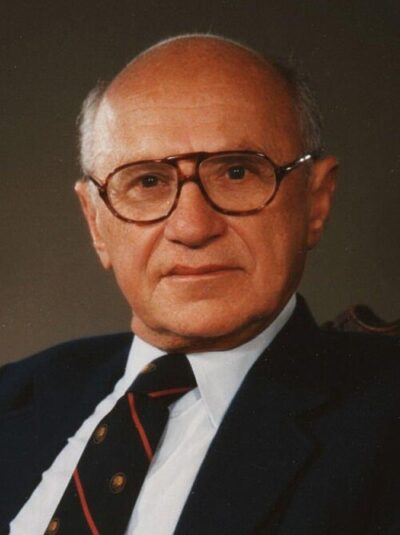
Milton Friedman
Milton Friedman was an American economist and statistician. Born July 31, 1912, in Brooklyn. Died November 16, 2006, in San Francisco. Educated at Rahway High School and Columbia University. Awards include Prize in Economic Sciences in Memory of Alfred Nobel, National Medal of Science and Adam Smith Award.
Facts
47 facts · 2 confirmed by two sources · 17 cited · 28 from one source
Where this comes from
Papalocal keeps its own record. It started from these sources; what each one said is kept here as it was copied, so a change on their side never changes this page by itself. Tap one to read its version.
What Wikidata says · copied November 13, 2026 · revision 2567468607
- Described as
- American economist and statistician (1912–2006)
- Other names
- Milton Galbraith Friedman
- Born
- July 31, 1912 · 11 references
- Died
- November 16, 2006 · 12 references
- Born in
- Brooklyn · 1 reference
- Died in
- San Francisco · 4 references
- Buried in
- San Francisco Bay · 1 reference
- Cause of death
- heart failure
- Citizen of
- United States · 2 references
- Occupation
- economist · 1 reference; university teacher · 1 reference; statistician · 1 reference; essayist
- Political party
- Republican Party
- Worked for
- University of Chicago
- Education
- Rahway High School (–1928); Columbia University; Rutgers University (–1932); University of Chicago (–1933); University of Cambridge
- Member of
- National Academy of Sciences; American Academy of Arts and Sciences; Accademia Nazionale dei Lincei (1978–) · 1 reference; Mont Pelerin Society; American Philosophical Society (1957–) · 1 reference; Koninklijke Vlaamse Academie van België voor Wetenschappen en Kunsten · 1 reference; Institute of Mathematical Statistics (1943–) · 1 reference; Econometric Society (1949–) · 1 reference; Philadelphia Society · 3 references
- Awards
- Prize in Economic Sciences in Memory of Alfred Nobel (1976) · 1 reference; National Medal of Science (1988); Adam Smith Award (1989); John Bates Clark Medal (1951); Presidential Medal of Freedom (1988) · 1 reference; Distinguished Fellow of the American Economic Association; Fellow of the Econometric Society (1949) · 1 reference; Fellow of the American Statistical Association; honorary doctor of Harvard University (1979) · 1 reference; Fellow of the Institute of Mathematical Statistics (1943) · 1 reference; New Jersey Hall of Fame (2019) · 1 reference
- Field
- economics; macroeconomics · 1 reference
- Spouse
- Rose Friedman (1938–2006) · 1 reference
- Children
- David D. Friedman; Jan Martel
- Religion
- Orthodox Judaism (1912–); agnostic
- Lived in
- Rahway (1912–); Brooklyn (1912)
- Wikipedias with a page
- 136
Wikidata item Q47426 (wikidata.org/wiki/Q47426), public domain (CC0). Copied November 13, 2026.
What Wikipedia says · copied November 13, 2026 · revision 1378703899
Milton Friedman ( ; July 31, 1912 – November 16, 2006) was an American economist and statistician who received the 1976 Nobel Memorial Prize in Economic Sciences for his research on consumption analysis, monetary history and theory and the complexity of stabilization policy. With George Stigler, Friedman was among the intellectual leaders of the Chicago school of economics, a neoclassical school of economic thought associated with the faculty at the University of Chicago that rejected Keynesianism in favor of monetarism before shifting their focus to new classical macroeconomics in the mid-1970s. Several students, young professors and academics who were recruited or mentored by Friedman at Chicago went on to become leading economists, including Nobel laureates Gary Becker (1992), Robert Fogel (1993), and Robert Lucas Jr. (1995).
Friedman's challenges to what he called "naive Keynesian theory" began with his interpretation of consumption, which tracks how consumers spend. He introduced the permanent income hypothesis, a theory which would later become part of mainstream economics and he was among the first to propagate the theory of consumption smoothing. During the 1960s, he became the main advocate opposing both Marxist and Keynesian government and economic policies, and described his approach (along with mainstream economics) as using "Keynesian language and apparatus" yet rejecting its initial conclusions. He theorized that there existed a natural rate of unemployment and argued that unemployment below this rate would cause inflation to accelerate. He argued that the Phillips curve was in the long run vertical at the "natural rate" and predicted what would come to be known as stagflation. Friedman promoted a macroeconomic viewpoint known as monetarism and argued that a steady, small expansion of the money supply was the preferred policy, as compared to rapid and unexpected changes. His ideas concerning monetary policy, taxation, privatization, and deregulation influenced government policies, especially during the 1980s. His monetary theory influenced the Federal Reserve's monetary policy in response to the 2008 financial crisis.
After retiring from the University of Chicago in 1977, and becoming emeritus professor in economics in 1983, Friedman served as an advisor to Republican U.S. president Ronald Reagan and Conservative British prime minister Margaret Thatcher. His political philosophy extolled the virtues of a free market economic system with minimal government intervention in social matters. In his 1962 book Capitalism and Freedom, Friedman advocated policies such as a volunteer military, freely floating exchange rates, abolition of medical licenses, a negative income tax, school vouchers, and opposition to the war on drugs and support for drug liberalization policies. His support for school choice led him to found the Friedman Foundation for Educational Choice, later renamed EdChoice.
Friedman's works cover a broad range of economic topics and public policy issues. His books and essays have had global influence, including in former communist states. A 2011 survey of economists commissioned by the EJW ranked Friedman as the second-most popular economist of the 20th century, following only John Maynard Keynes. Upon his death, The Economist described him as "the most influential economist of the second half of the 20th century ... possibly of all of it".
- Born, in its opening lines
- July 31, 1912
- Died, in its opening lines
- November 16, 2006
From the Wikipedia article “Milton Friedman” (en.wikipedia.org/wiki/Milton_Friedman), by its contributors, under CC BY-SA 4.0 (creativecommons.org/licenses/by-sa/4.0/). Copied November 13, 2026; not changed.
Confirmed Two sources agree. Cited One source, and it names where it got it. One source One source, without a reference of its own. Sources disagree The sources disagree. We show the best-supported value and keep theirs below.
