
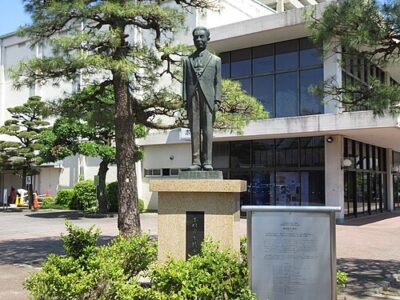
Motoo Kimura
Motoo Kimura was a Japanese scientist. Born November 13, 1924, in Okazaki. Died November 13, 1994, in Mishima. Known for neutral theory of molecular evolution. Educated at University of Wisconsin–Madison and Kyoto University. Awards include Order of Culture, International Prize for Biology and Darwin Medal.
Facts
24 facts · 2 confirmed by two sources · 10 cited · 11 from one source · 1 where the sources disagree
What’s different
- Cause of death: we show cerebral hemorrhage (Sources disagree). Wikidata also lists amyotrophic lateral sclerosis
Where this comes from
Papalocal keeps its own record. It started from these sources; what each one said is kept here as it was copied, so a change on their side never changes this page by itself. Tap one to read its version.
What Wikidata says · copied November 17, 2026 · revision 2558175943
- Described as
- Japanese scientist (1924–1994)
- Born
- November 13, 1924 · 2 references
- Died
- November 13, 1994 · 3 references
- Born in
- Okazaki · 1 reference
- Died in
- Mishima · 1 reference
- Cause of death
- cerebral hemorrhage; amyotrophic lateral sclerosis
- Citizen of
- Empire of Japan; Japan
- Occupation
- mathematician; geneticist · 1 reference
- Education
- University of Wisconsin–Madison (–1956) · 1 reference; Kyoto University
- Member of
- Royal Society of London (1993–); National Academy of Sciences (1973–) · 1 reference; Japan Academy (1982–) · 1 reference; American Academy of Arts and Sciences (1978–) · 1 reference
- Known for
- neutral theory of molecular evolution · 1 reference
- Awards
- Order of Culture (1976); International Prize for Biology (1988) · 1 reference; Darwin Medal (1992) · 1 reference; John J. Carty Award for the Advancement of Science (1987) · 1 reference; Person of Cultural Merit (1976); Asahi Prize (1986) · 1 reference; Foreign Member of the Royal Society (1993) · 1 reference
- Field
- population genetics
- Wikipedias with a page
- 26
Wikidata item Q471816 (wikidata.org/wiki/Q471816), public domain (CC0). Copied November 17, 2026.
What Wikipedia says · copied November 17, 2026 · revision 1382746188
Motoo Kimura (木村 資生, Kimura Motō) (November 13, 1924 – November 13, 1994) was a Japanese biologist best known for introducing the neutral theory of molecular evolution in 1968. He became one of the most influential theoretical population geneticists. He is remembered in genetics for his innovative use of diffusion equations to calculate the probability of fixation of beneficial, deleterious, or neutral alleles. Combining theoretical population genetics with molecular evolution data, he also developed the neutral theory of molecular evolution in which genetic drift is the main force changing allele frequencies. James Franklin Crow, himself a renowned population geneticist, considered Kimura to be one of the two greatest evolutionary geneticists, along with Gustave Malécot, after the great trio of the modern synthesis, Ronald Fisher, J. B. S. Haldane, and Sewall Wright.
- Born, in its opening lines
- November 13, 1924
- Died, in its opening lines
- November 13, 1994
From the Wikipedia article “Motoo Kimura” (en.wikipedia.org/wiki/Motoo_Kimura), by its contributors, under CC BY-SA 4.0 (creativecommons.org/licenses/by-sa/4.0/). Copied November 17, 2026; not changed.
Confirmed Two sources agree. Cited One source, and it names where it got it. One source One source, without a reference of its own. Sources disagree The sources disagree. We show the best-supported value and keep theirs below.
