
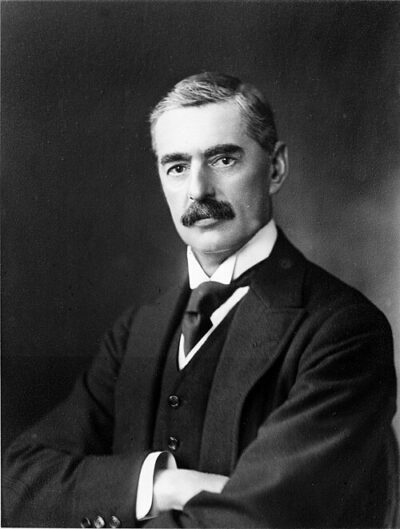
Neville Chamberlain
Neville Chamberlain was a Prime Minister of the United Kingdom from 1937 to 1940. Born March 18, 1869, in Birmingham. Died November 9, 1940, in Reading. Positions held include Lord President of the Council (1940), Chancellor of the Exchequer (2 times) (1923–1937) and Prime Minister of the United Kingdom (1937–1940). Educated at Mason Science College and University of Birmingham. Awards include honorary doctorate from the University of Strasbourg.
Facts
46 facts · 2 confirmed by two sources · 25 cited · 19 from one source
Where this comes from
Papalocal keeps its own record. It started from these sources; what each one said is kept here as it was copied, so a change on their side never changes this page by itself. Tap one to read its version.
What Wikidata says · copied November 16, 2026 · revision 2569973716
- Described as
- Prime Minister of the United Kingdom from 1937 to 1940
- Other names
- Rt. Hon. Arthur Neville Chamberlain, Arthur Neville Chamberlain
- Born
- March 18, 1869 · 16 references
- Died
- November 9, 1940 · 14 references
- Born in
- Birmingham · 3 references
- Died in
- Reading · 1 reference
- Buried in
- Westminster Abbey · 1 reference
- Cause of death
- colorectal cancer
- Name at birth
- Arthur Neville Chamberlain
- Citizen of
- United Kingdom; United Kingdom of Great Britain and Ireland
- Occupation
- politician · 1 reference; businessperson · 1 reference
- Positions held
- Lord President of the Council (1940) · 1 reference; Chancellor of the Exchequer (2 times) (1923–1937); Prime Minister of the United Kingdom (1937–1940); Leader of the Conservative Party (1937–1940); Secretary of State for Health and Social Care (2 times) (1923–1931); Lord Mayor of Birmingham (1915–1917); Member of the Privy Council of the United Kingdom; member of the 37th Parliament of the United Kingdom (1935–1940); member of the 36th Parliament of the United Kingdom (1931–1935) · 1 reference; member of the 35th Parliament of the United Kingdom (1929–1931) · 1 reference; member of the 34th Parliament of the United Kingdom (1924–1929) · 1 reference; member of the 33rd Parliament of the United Kingdom (1923–1924) · 1 reference; member of the 32nd Parliament of the United Kingdom (1922–1923) · 1 reference; member of the 31st Parliament of the United Kingdom (1918–1922) · 1 reference; Leader of the House of Commons (1937–1940) · 1 reference
- Political party
- Conservative Party
- Education
- Mason Science College · 1 reference; University of Birmingham; Rugby School · 1 reference; University of London · 1 reference
- Member of
- Royal Society of London
- Awards
- honorary doctorate from the University of Strasbourg (1939) · 2 references
- Field
- politics · 1 reference; state governance · 2 references
- Spouse
- Anne Chamberlain (1911–1940) · 2 references
- Children
- Dorothy Chamberlain · 2 references; Francis Chamberlain · 2 references
- Father
- Joseph Chamberlain · 2 references
- Mother
- Florence Kenrick · 2 references
- Siblings
- Beatrice Chamberlain · 1 reference; Hilda Chamberlain · 1 reference; Ida Chamberlain · 1 reference; Ethel Chamberlain · 1 reference
- Religion
- Unitarianism
- Military branch
- Royal Air Force · 1 reference
- Wikipedias with a page
- 120
Wikidata item Q10664 (wikidata.org/wiki/Q10664), public domain (CC0). Copied November 16, 2026.
What Wikipedia says · copied November 16, 2026 · revision 1383742521
Arthur Neville Chamberlain (; 18 March 1869 – 9 November 1940) was Prime Minister of the United Kingdom from May 1937 to May 1940 and Leader of the Conservative Party from May 1937 to October 1940. He is known for his foreign policy of appeasement, and in particular for his signing of the Munich Agreement on 30 September 1938, ceding the German-speaking Sudetenland region of Czechoslovakia to Nazi Germany led by Adolf Hitler. Following the invasion of Poland on 1 September 1939, which marked the beginning of the Second World War, Chamberlain announced the declaration of war on Germany two days later and led the United Kingdom through the first eight months of the war until his resignation as prime minister on 10 May 1940.
After working in business and local government, and after a short spell as Director of National Service in 1916 and 1917, Chamberlain followed his father Joseph Chamberlain and elder half-brother Austen Chamberlain in becoming a member of Parliament at the 1918 general election for the new Birmingham Ladywood division at the age of 49. He declined a junior ministerial position, remaining a backbencher until 1922. He was rapidly promoted in 1923 to Minister of Health and then Chancellor of the Exchequer. After a short-lived Labour-led government, he returned as Minister of Health, introducing a range of reform measures from 1924 to 1929. He was appointed Chancellor of the Exchequer in the National Government in 1931.
Chamberlain succeeded Stanley Baldwin as prime minister on 28 May 1937. His premiership was dominated by the question of policy towards an increasingly aggressive Germany, and his actions at Munich were widely popular among the British at the time. In response to Hitler's continued aggression, Chamberlain pledged the United Kingdom to defend Poland's independence if the latter were attacked, an alliance that brought his country into declaring war on Germany after it invaded Poland, which resulted in the "Phoney War", but not in any substantial assistance to Poland's fight against the aggression. The failure of Allied forces to prevent the German invasion of Norway caused the House of Commons to hold the Norway Debate in May 1940. Chamberlain's conduct of the war was heavily criticised by members of all parties and, in a vote of confidence, his government's majority was greatly reduced. Accepting that a national government supported by all the main parties was essential, Chamberlain resigned the premiership because the Labour and Liberal parties would not serve under his leadership. Although he still led the Conservative Party, he was succeeded as prime minister by his colleague Winston Churchill. Until ill health forced him to resign on 22 September 1940, Chamberlain was an important member of the war cabinet as Lord President of the Council, heading the government in Churchill's absence. His support for Churchill proved vital during the May 1940 war cabinet crisis. Chamberlain died aged 71 on 9 November of cancer, six months after leaving the premiership.
Chamberlain's reputation remains controversial among historians, the initial high regard for him being entirely eroded by books such as Guilty Men, published in July 1940, which blamed Chamberlain and his associates for the Munich accord and for allegedly failing to prepare the country for war. Most historians in the generation following Chamberlain's death held similar views, led by Churchill in The Gathering Storm. Some later historians have taken a more favourable perspective of Chamberlain and his policies, citing government papers released under the thirty-year rule and arguing that going to war with Germany in 1938 would have been disastrous as the UK was unprepared. Nonetheless, Chamberlain is still unfavourably ranked amongst British prime ministers.
- Born, in its opening lines
- March 18, 1869
- Died, in its opening lines
- November 9, 1940
From the Wikipedia article “Neville Chamberlain” (en.wikipedia.org/wiki/Neville_Chamberlain), by its contributors, under CC BY-SA 4.0 (creativecommons.org/licenses/by-sa/4.0/). Copied November 16, 2026; not changed.
Confirmed Two sources agree. Cited One source, and it names where it got it. One source One source, without a reference of its own. Sources disagree The sources disagree. We show the best-supported value and keep theirs below.
