
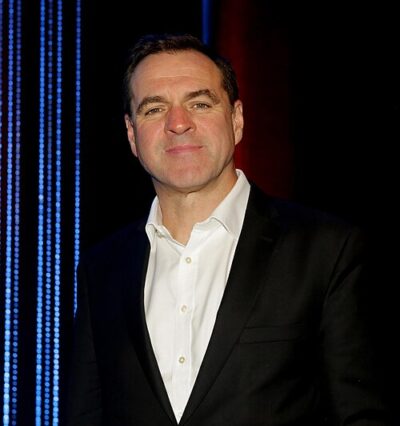
Niall Ferguson
Niall Ferguson is a British historian. Born April 18, 1964, in Glasgow. Positions held include advisory board. Educated at Magdalen College and University of Oxford. Awards include Ludwig Erhard Prize for Publications in Economics and Knight Bachelor.
Facts
31 facts · 1 confirmed by two sources · 10 cited · 20 from one source
Where this comes from
Papalocal keeps its own record. It started from these sources; what each one said is kept here as it was copied, so a change on their side never changes this page by itself. Tap one to read its version.
What Wikidata says · copied November 13, 2026 · revision 2555580109
- Described as
- British historian
- Other names
- Niall Campbell Ferguson
- Born
- April 18, 1964 · 4 references
- Born in
- Glasgow
- Citizen of
- United Kingdom; United States · 1 reference
- Occupation
- economic historian; historian · 1 reference; university teacher · 1 reference; economist · 1 reference; journalist · 1 reference
- Positions held
- advisory board
- Worked for
- Harvard University (2004–2016); New York University (2002–2004); University of Cambridge (1989–1992); University of Oxford (1992–2002); Hoover Institution (2016–2018); London School of Economics and Political Science (2010–2011) · 1 reference
- Education
- Magdalen College (–1985); University of Oxford (–1989); The Glasgow Academy
- Awards
- Ludwig Erhard Prize for Publications in Economics (2013); Knight Bachelor (2024)
- Field
- history · 1 reference; history of finance · 1 reference; educational system · 1 reference; economics · 1 reference; journalism · 1 reference
- Spouse
- Ayaan Hirsi Ali (2011–); Sue Douglas (1994–2011)
- Religion
- Christianity
- Lived in
- Washington, D.C. · 1 reference
- Website
- http://www.niallferguson.com
- Wikipedias with a page
- 45
Wikidata item Q377638 (wikidata.org/wiki/Q377638), public domain (CC0). Copied November 13, 2026.
What Wikipedia says · copied November 13, 2026 · revision 1385411817
Sir Niall Campbell Ferguson ( NEEL; born 18 April 1964) is a British and American historian who is the Milbank Family Senior Fellow at the Hoover Institution and a senior fellow at the Belfer Center for Science and International Affairs at Harvard University. Previously, he was a professor at Harvard University, the London School of Economics, New York University, a visiting professor at the New College of the Humanities, and a senior research fellow at Jesus College, Oxford. He was a visiting lecturer at the London School of Economics for the 2023/2024 academic year and at Tsinghua University in China from 2019 to 2020.
Ferguson writes and lectures on international history, economic history, financial history, and the history of the British Empire and American imperialism. He holds positive views concerning the British Empire. In 2004, he was one of Time magazine's 100 most influential people in the world. Ferguson has written and presented numerous television documentary series, including The Ascent of Money, which won an International Emmy Award for Best Documentary in 2009. In 2024, he was knighted by King Charles III for services to literature.
Ferguson has been a contributing editor for Bloomberg Television and a columnist for Newsweek. He began writing a semi-monthly column for Bloomberg Opinion in June 2020 and has also been a regular columnist at The Spectator and the Daily Mail. In 2021, he became a joint-founder of the new University of Austin. Since June 2024, he is a bi-weekly columnist at The Free Press. Ferguson has also contributed articles to many journals including Foreign Affairs and Foreign Policy. He has been described as a conservative and called himself a supporter of Ronald Reagan and Margaret Thatcher.
- Born, in its opening lines
- April 18, 1964
From the Wikipedia article “Niall Ferguson” (en.wikipedia.org/wiki/Niall_Ferguson), by its contributors, under CC BY-SA 4.0 (creativecommons.org/licenses/by-sa/4.0/). Copied November 13, 2026; not changed.
Confirmed Two sources agree. Cited One source, and it names where it got it. One source One source, without a reference of its own. Sources disagree The sources disagree. We show the best-supported value and keep theirs below.
