
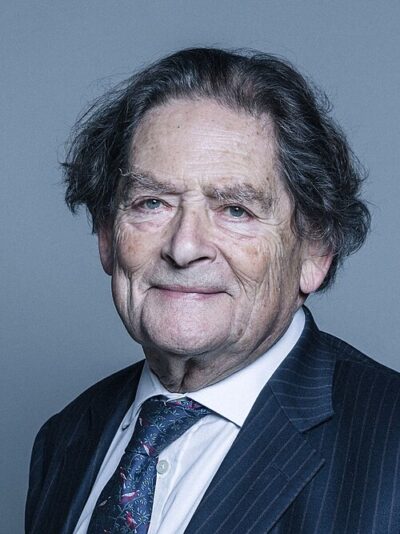
Nigel Lawson
Nigel Lawson was a British peer and politician. Born March 11, 1932, in Hampstead. Died April 3, 2023, in London. Positions held include Chancellor of the Exchequer (1983–1989), Secretary of State for Energy (1981–1983) and Financial Secretary to the Treasury (1979–1981). Educated at Christ Church and Westminster School.
Facts
34 facts · 2 confirmed by two sources · 22 cited · 10 from one source
Where this comes from
Papalocal keeps its own record. It started from these sources; what each one said is kept here as it was copied, so a change on their side never changes this page by itself. Tap one to read its version.
What Wikidata says · copied November 16, 2026 · revision 2562779838
- Described as
- British peer and politician (1932–2023)
- Other names
- Nigel Lawson, Baron Lawson of Blaby, Lord Lawson
- Born
- March 11, 1932 · 4 references
- Died
- April 3, 2023 · 2 references
- Born in
- Hampstead · 1 reference
- Died in
- London · 1 reference
- Citizen of
- United Kingdom
- Occupation
- journalist; politician · 2 references; editor
- Positions held
- Chancellor of the Exchequer (1983–1989); Secretary of State for Energy (1981–1983); Financial Secretary to the Treasury (1979–1981); member of the 50th Parliament of the United Kingdom (1987–1992) · 1 reference; member of the 49th Parliament of the United Kingdom (1983–1987) · 1 reference; member of the 48th Parliament of the United Kingdom (1979–1983) · 1 reference; member of the 47th Parliament of the United Kingdom (1974–1979) · 1 reference; member of the 46th Parliament of the United Kingdom (1974) · 1 reference; member of the House of Lords (1992–2022); Member of the Privy Council of the United Kingdom (1981–) · 1 reference
- Political party
- Conservative Party
- Education
- Christ Church · 1 reference; Westminster School · 1 reference
- Field
- politics · 1 reference; journalism · 1 reference
- Spouse
- Vanessa Salmon (1955–1980) · 2 references; Thérèse Mary Bate (1980–2012) · 1 reference
- Children
- Nigella Lawson · 1 reference; Dominic Lawson · 1 reference; Thomasina Posy Lawson · 1 reference; Horatia Holly Lawson · 1 reference; Tom Lawson · 1 reference; Emily Hero Lawson · 1 reference
- Father
- Ralph Lawson · 1 reference
- Mother
- Joan Elisabeth Davis · 1 reference
- Military branch
- Royal Navy · 1 reference
- Wikipedias with a page
- 29
Wikidata item Q335078 (wikidata.org/wiki/Q335078), public domain (CC0). Copied November 16, 2026.
What Wikipedia says · copied November 16, 2026 · revision 1385537339
Nigel Lawson, Baron Lawson of Blaby (11 March 1932 – 3 April 2023) was a British politician and journalist. A member of the Conservative Party, he served as Member of Parliament for Blaby in Leicestershire from 1974 to 1992, and served in Margaret Thatcher's Cabinet from 1981 to 1989. Prior to entering the Cabinet, he served as the Financial Secretary to the Treasury from May 1979 until his promotion to Secretary of State for Energy. He was appointed Chancellor of the Exchequer in June 1983 and served until his resignation in October 1989. In both Cabinet posts, Lawson was a key proponent of Thatcher's policies of privatisation of several key industries.
Lawson was a backbencher from 1989 until he retired in 1992 and sat in the House of Lords from 1992 until his retirement in 2022. He remained active in politics as the president of Conservatives for Britain, a campaign for Britain to leave the European Union, and was a prominent critic of the EU. He also founded and chaired a climate change denial group, the Global Warming Policy Foundation, and was an active supporter of Vote Leave.
Lawson was the father of six children, including Nigella Lawson, a food writer and celebrity cook, Dominic Lawson, a journalist, and Tom Lawson, headmaster of Eastbourne College.
- Born, in its opening lines
- March 11, 1932
- Died, in its opening lines
- April 3, 2023
From the Wikipedia article “Nigel Lawson” (en.wikipedia.org/wiki/Nigel_Lawson), by its contributors, under CC BY-SA 4.0 (creativecommons.org/licenses/by-sa/4.0/). Copied November 16, 2026; not changed.
Confirmed Two sources agree. Cited One source, and it names where it got it. One source One source, without a reference of its own. Sources disagree The sources disagree. We show the best-supported value and keep theirs below.
