
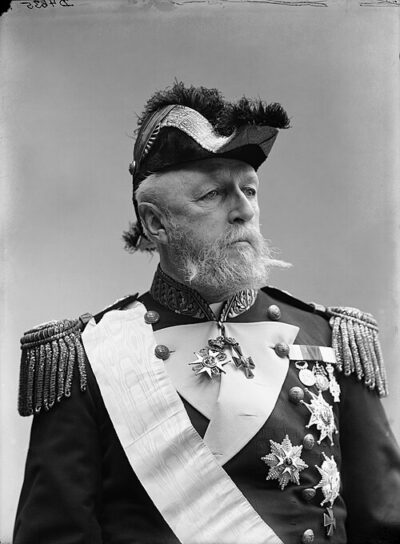
Oscar II of Sweden
Oscar II of Sweden was a King of Sweden from 1872 to 1907 and Norway from 1872 to 1905. Born January 21, 1829, in Stockholm. Died December 8, 1907, in Stockholm. Positions held include Monarch of Sweden (1872–1907) and Monarch of Norway (1872–1905). Educated at Uppsala University. Awards include Knight of the Order of the Golden Fleece, Order of St. Andrew and honorary doctor of the University of Vienna.
Facts
44 facts · 2 confirmed by two sources · 16 cited · 26 from one source
Where this comes from
Papalocal keeps its own record. It started from these sources; what each one said is kept here as it was copied, so a change on their side never changes this page by itself. Tap one to read its version.
What Wikidata says · copied November 16, 2026 · revision 2569021308
- Described as
- King of Sweden from 1872 to 1907 and Norway from 1872 to 1905 (1829–1907)
- Other names
- Oscar II, Oscar Fredrik Bernadotte
- Born
- January 21, 1829 · 9 references
- Died
- December 8, 1907 · 9 references
- Born in
- Stockholm · 2 references
- Died in
- Stockholm · 4 references
- Buried in
- Riddarholm Church · 2 references
- Citizen of
- Sweden
- Occupation
- monarch · 1 reference
- Positions held
- Monarch of Sweden (1872–1907); Monarch of Norway (1872–1905)
- Education
- Uppsala University
- Member of
- Royal Swedish Academy of Sciences; Royal Swedish Academy of Letters, History and Antiquities; Russian Academy of Sciences; Royal Prussian Academy of Sciences
- Awards
- Knight of the Order of the Golden Fleece (1872) · 1 reference; Order of St. Andrew; honorary doctor of the University of Vienna · 1 reference; Royal Order of the Seraphim · 1 reference; Order of the Norwegian Lion · 1 reference; Order of the Garter · 1 reference; Order of the Most Holy Annunciation · 1 reference; Knight of the Order of Saints Maurice and Lazarus; Royal Order of the Sword · 1 reference; Royal Order of Vasa · 1 reference; Royal Order of the Polar Star · 1 reference; Order of St. Olav · 1 reference; Order of the Golden Fleece · 1 reference; Knight Grand Cross of the Military Order of William (1849) · 1 reference; Honorary doctor of Leiden University (1897) · 1 reference
- Spouse
- Sophia of Nassau (1857–1913) · 2 references
- Children
- Gustaf V of Sweden · 1 reference; Prince Oscar Bernadotte · 1 reference; Prince Carl, Duke of Västergötland · 1 reference; Prince Eugen, Duke of Närke · 1 reference
- Father
- Oscar I of Sweden · 1 reference
- Mother
- Josephine of Leuchtenberg · 1 reference
- Siblings
- Princess Eugénie of Sweden · 1 reference; Prince Gustaf, Duke of Uppland; Prince August, Duke of Dalarna; Carl XV of Sweden · 1 reference; Hjalmar Högqvist; Max Högqvist
- Religion
- Church of Sweden
- Military rank
- admiral
- Wikipedias with a page
- 64
Wikidata item Q52924 (wikidata.org/wiki/Q52924), public domain (CC0). Copied November 16, 2026.
What Wikipedia says · copied November 16, 2026 · revision 1384398390
Oscar II (Oscar Fredrik; 21 January 1829 – 8 December 1907) was King of Sweden from 1872 until his death in 1907 and King of Norway from 1872 to 1905.
Oscar was the son of King Oscar I and Queen Josephine. He inherited the Swedish and Norwegian thrones when his brother died in 1872. Oscar II ruled during a time when both countries were undergoing a period of industrialization and rapid technological progress. His reign also saw the gradual decline of the Union of Sweden and Norway, which culminated in its dissolution in 1905. In 1905, the throne of Norway was transferred to his grandnephew Prince Carl of Denmark under the regnal name Haakon VII. When Oscar died in 1907, he was succeeded in Sweden by his eldest son, Gustaf V.
- Born, in its opening lines
- January 21, 1829
- Died, in its opening lines
- December 8, 1907
From the Wikipedia article “Oscar II” (en.wikipedia.org/wiki/Oscar_II), by its contributors, under CC BY-SA 4.0 (creativecommons.org/licenses/by-sa/4.0/). Copied November 16, 2026; not changed.
Confirmed Two sources agree. Cited One source, and it names where it got it. One source One source, without a reference of its own. Sources disagree The sources disagree. We show the best-supported value and keep theirs below.
