
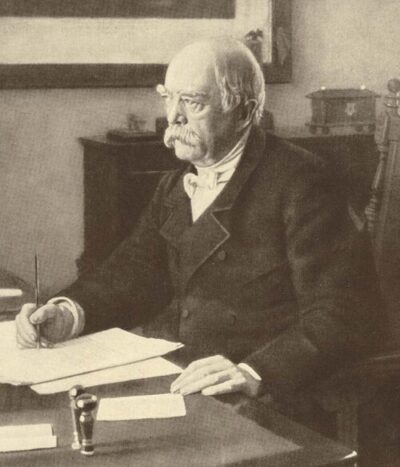
Otto von Bismarck
Otto von Bismarck was a German statesman and Chancellor. Born April 1, 1815, in Schönhausen (Elbe). Died July 30, 1898, in Friedrichsruh. Positions held include auscultator (1835–1836), Referendar (1836–1838) and Dijkgraaf (1846–). Known for Gedanken und Erinnerungen. Educated at Plamannsche Erziehungsanstalt and Evangelisches Gymnasium zum Grauen Kloster. Awards include Lifesaving Medal, Order of the Crown and Order of the Black Eagle.
Facts
72 facts · 2 confirmed by two sources · 50 cited · 20 from one source
Where this comes from
Papalocal keeps its own record. It started from these sources; what each one said is kept here as it was copied, so a change on their side never changes this page by itself. Tap one to read its version.
What Wikidata says · copied November 16, 2026 · revision 2568731453
- Described as
- German statesman and Chancellor (1815-1898)
- Other names
- Otto Eduard Leopold, Prince of Bismarck, Duke of Lauenburg, Eduard Leopold, Prince von Bismarck-Schönhausen, Prince Bismarck, Iron Chancellor, Otto Eduard Leopold von Bismarck-Schönhausen, Otto Bismark, Otto Eduard Leopol'd fon Bismark-Shengauzen, Otto von Bismarck-Schönhausen, von Bismarck, Otto Eduard Leopold von Bismarck-Schönhausen Fürst von Bismarck, Bismarck, Otto Eduard Leopold
- Born
- April 1, 1815 · 12 references
- Died
- July 30, 1898 · 12 references
- Born in
- Schönhausen (Elbe) · 3 references
- Died in
- Friedrichsruh · 3 references
- Buried in
- Bismarck Mausoleum · 1 reference
- Cause of death
- respiratory arrest · 1 reference
- Name at birth
- Otto Eduard Leopold von Bismarck · 1 reference
- Citizen of
- Kingdom of Prussia · 1 reference; German Reich · 1 reference
- Occupation
- politician · 2 references; diplomat · 1 reference; jurist · 1 reference; military officer; writer · 1 reference; volunteer serving one year (1838–1839) · 1 reference; lord of the manor · 1 reference; chancellor · 1 reference
- Positions held
- auscultator (1835–1836) · 1 reference; Referendar (1836–1838) · 1 reference; Dijkgraaf (1846–) · 1 reference; member of parliament (1847–) · 1 reference; member of the Prussian Second Chamber (1849–) · 1 reference; Legationsrat (1851–) · 1 reference; ambassador to the German Confederation (1851–) · 1 reference; envoy extraordinary and minister plenipotentiary (1859–1862) · 1 reference; Minister President of Prussia (1862–1890) · 1 reference; foreign minister (1862–) · 1 reference; member of the Prussian House of Lords; Bundeskanzler (Norddeutscher Bund) (1867–1871) · 1 reference; member of the Reichstag of the German Empire; Imperial chancellor (1871–1890) · 1 reference; commerce minister (1880–1890) · 1 reference
- Political party
- independent politician · 1 reference
- Worked for
- Mitte Local Court (1835–1836) · 1 reference
- Education
- Plamannsche Erziehungsanstalt (1821–1827) · 1 reference; Evangelisches Gymnasium zum Grauen Kloster (1827–) · 1 reference; Friedrich-Wilhelms-Gymnasium (–1832) · 1 reference; University of Göttingen (1832–1833) · 2 references; Frederick William University Berlin (1834–1835) · 1 reference; Königliche Staats- und landwirtschaftliche Akademie Eldena (1838–1839) · 2 references
- Member of
- Corps Hannovera Göttingen · 2 references; Academy of Science for Public Utility; Union-Klub; Parliament of the Erfurt Union (1850) · 1 reference
- Known for
- Gedanken und Erinnerungen · 1 reference
- Awards
- Lifesaving Medal · 1 reference; Order of the Crown; Order of the Black Eagle (1864) · 1 reference; Supreme Order of Christ; Pour le Mérite for Sciences and Arts order; Knight of the Order of the Golden Fleece; Order of St. Andrew; Order of Saint Alexander Nevsky; Order of Ludwig I · 1 reference; Royal Order of the Seraphim · 1 reference; Order of the Most Holy Annunciation · 1 reference; honorary citizen of Bonn · 1 reference; Order of Wilhelm I (1896) · 1 reference; Grand Cross of the Order of the Immaculate Conception of Vila Viçosa; Order of Saint Stanislaus, 1st class
- Spouse
- Johanna von Puttkamer (1847–) · 2 references
- Children
- Marie von Bismarck · 3 references; Wilhelm von Bismarck · 5 references; Herbert von Bismarck · 4 references
- Father
- Ferdinand von Bismarck · 3 references
- Mother
- Wilhelmine Luise Mencken · 3 references
- Siblings
- Malwine von Bismarck; Bernhard von Bismarck · 2 references
- Religion
- Lutheranism
- Military rank
- Generaloberst (1890–) · 1 reference; Generalfeldmarschall (1890–) · 1 reference; lieutenant (1841–) · 1 reference
- Wikipedias with a page
- 220
Wikidata item Q8442 (wikidata.org/wiki/Q8442), public domain (CC0). Copied November 16, 2026.
What Wikipedia says · copied November 16, 2026 · revision 1385002760
Otto Eduard Leopold, Prince of Bismarck, Count of Bismarck-Schönhausen, Duke of Lauenburg (1 April 1815 – 30 July 1898), was a German statesman and diplomat who oversaw the unification of Germany and served as its first chancellor from 1871 to 1890. Bismarck's Realpolitik and firm governance earned him the nickname Iron Chancellor (Eiserner Kanzler).
From Junker landowner origins, Bismarck rose rapidly in Prussian politics under King Wilhelm I of Prussia. He served as the Prussian ambassador to Russia and France and in both houses of the Prussian parliament. From 1862 to 1890, he held office as the minister president and foreign minister of Prussia. Under Bismarck's leadership, Prussia provoked three short, decisive wars against Denmark, Austria, and France. After Austria's defeat in 1866, he replaced the German Confederation with the North German Confederation, which aligned the smaller North German states with Prussia while excluding Austria. In 1870, Bismarck secured France's defeat with support from the independent South German states before overseeing the creation of a unified German Empire under Prussian rule. Following Germany's unification, he was given the aristocratic title Prince of Bismarck (Fürst von Bismarck). From 1871 onwards, his balance-of-power approach to diplomacy helped maintain Germany's position in a peaceful Europe. While averse to maritime colonialism, Bismarck acquiesced to elite and popular opinion by acquiring German colonies.
As part of his domestic political maneuvering, Bismarck created the first welfare state, with the goal of undermining his socialist opponents. In the 1870s, he allied himself with the low-tariff, anti-Catholic Liberals and fought the Catholic Church, in what was called the Kulturkampf (lit. 'culture struggle'). This was unsuccessful, with the Catholics responding by forming the powerful German Centre Party and using universal male suffrage to gain a bloc of seats. Bismarck responded by ending the Kulturkampf, breaking with the Liberals and forming a political alliance with the Centre Party to fight the Socialists. Under his direction, the Imperial Reichstag was sidelined and did not control government policy. A staunch monarchist, Bismarck ruled autocratically through a strong bureaucracy with power concentrated in the hands of the Junker elite. After being dismissed from office by Wilhelm II, he retired to write his memoirs.
Bismarck is most famous for his role in German unification. During the German Imperial period, he became a hero to German nationalists, who built monuments honouring him. Historians have praised him as a brilliant statesman who established Germany as a great power and maintained peace in Europe for nearly two decades. However, his authoritarian rule, opposition to liberal democracy and repressive domestic policies have also drawn criticism.
- Born, in its opening lines
- April 1, 1815
- Died, in its opening lines
- July 30, 1898
From the Wikipedia article “Otto von Bismarck” (en.wikipedia.org/wiki/Otto_von_Bismarck), by its contributors, under CC BY-SA 4.0 (creativecommons.org/licenses/by-sa/4.0/). Copied November 16, 2026; not changed.
Confirmed Two sources agree. Cited One source, and it names where it got it. One source One source, without a reference of its own. Sources disagree The sources disagree. We show the best-supported value and keep theirs below.
