
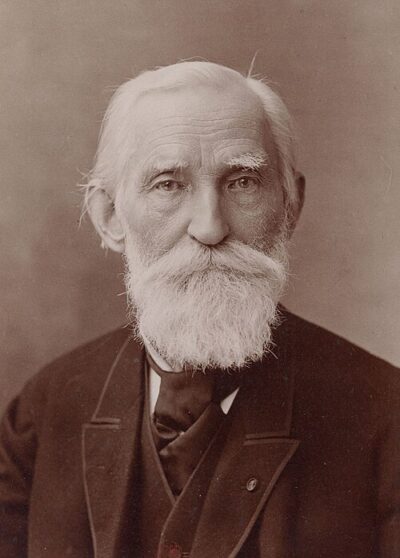
Pafnuty Chebyshev
Pafnuty Chebyshev was a Russian mathematician. Born May 4, 1821, in Akatovo. Died November 26, 1894, in Saint Petersburg. Known for prime number theorem, law of large numbers and Chebyshev linkage. Educated at Faculty of Physics and Mathematics of Moscow Imperial University and Saint Petersburg State University. Awards include Order of Saint Anna, 1st class, Order of Saint Stanislaus, 1st class and Order of St. Vladimir, 2nd class.
Facts
50 facts · 0 confirmed by two sources · 14 cited · 34 from one source · 2 where the sources disagree
What’s different
- Born: we show May 4, 1821 (Sources disagree). Wikipedia says May 16, 1821
- Died: we show November 26, 1894 (Sources disagree). Wikipedia says December 8, 1894
Where this comes from
Papalocal keeps its own record. It started from these sources; what each one said is kept here as it was copied, so a change on their side never changes this page by itself. Tap one to read its version.
What Wikidata says · copied November 16, 2026 · revision 2559067720
- Described as
- Russian mathematician (1821–1894)
- Other names
- Pafnuty Lvovich Chebyshev
- Born
- May 4, 1821 · 2 references
- Died
- November 26, 1894 · 3 references
- Born in
- Akatovo · 2 references
- Died in
- Saint Petersburg · 3 references
- Buried in
- Transfiguration church, Spas-Prognanye · 2 references
- Name at birth
- Пафну́тий Льво́вич Чебышёв · 1 reference
- Citizen of
- Russian Empire
- Occupation
- mathematician · 2 references; statistician; university teacher · 1 reference
- Worked for
- Imperial St. Petersburg University (1850–1882) · 1 reference
- Education
- Faculty of Physics and Mathematics of Moscow Imperial University (1837–1841) · 1 reference; Saint Petersburg State University (1847–1849) · 2 references
- Member of
- Royal Society of London (1877–) · 2 references; Russian Academy of Sciences (1853–) · 1 reference; French Academy of Sciences; Royal Swedish Academy of Sciences (1893–) · 1 reference; Royal Prussian Academy of Sciences (1871–) · 1 reference; Academy of Sciences of the Institute of Bologna (1873–) · 1 reference; Saint Petersburg Mathematical Society (1893–); Accademia Nazionale dei Lincei (1883–) · 1 reference
- Known for
- prime number theorem; law of large numbers; Chebyshev linkage; Chebyshev's inequality; Chebyshev's sum inequality; Chebyshev function; Chebyshev node; Chebyshev Integral; Chebyshev polynomial; Chebyshev distance
- Awards
- Order of Saint Anna, 1st class; Order of Saint Stanislaus, 1st class; Order of St. Vladimir, 2nd class; Order of Saint Alexander Nevsky; Demidov Prize (1849); Order of St. Vladimir, 3rd class · 1 reference; Foreign Member of the Royal Society (1877) · 1 reference; Knight of the Order of St. Alexander Nevsky · 1 reference; Order of St. Vladimir · 1 reference; Order of Saint Stanislaus · 1 reference; Knight of the Legion of Honour · 1 reference; Order of Saint Anna, 2nd class · 1 reference
- Field
- probability theory; number theory; applied mathematics; applied mechanics; mathematical analysis; mechanics
- Siblings
- Vladimir Chebyshev
- Wikipedias with a page
- 50
Wikidata item Q206012 (wikidata.org/wiki/Q206012), public domain (CC0). Copied November 16, 2026.
What Wikipedia says · copied November 16, 2026 · revision 1382751524
Pafnuty Lvovich Chebyshev (Russian: Пафну́тий Льво́вич Чебышёв, IPA: [pɐfˈnutʲɪj ˈlʲvovʲɪtɕ tɕɪbɨˈʂof]) (16 May [O.S. 4 May] 1821 – 8 December [O.S. 26 November] 1894) was a Russian mathematician and considered to be the founding father of Russian mathematics.
Chebyshev is known for his fundamental contributions to the fields of probability, statistics, mechanics, and number theory. A number of important mathematical concepts are named after him, including the Chebyshev inequality (which can be used to prove the weak law of large numbers), the Bertrand–Chebyshev theorem, Chebyshev polynomials, Chebyshev linkage, and Chebyshev bias.
- Born, in its opening lines
- May 16, 1821
- Died, in its opening lines
- December 8, 1894
From the Wikipedia article “Pafnuty Chebyshev” (en.wikipedia.org/wiki/Pafnuty_Chebyshev), by its contributors, under CC BY-SA 4.0 (creativecommons.org/licenses/by-sa/4.0/). Copied November 16, 2026; not changed.
Confirmed Two sources agree. Cited One source, and it names where it got it. One source One source, without a reference of its own. Sources disagree The sources disagree. We show the best-supported value and keep theirs below.
