
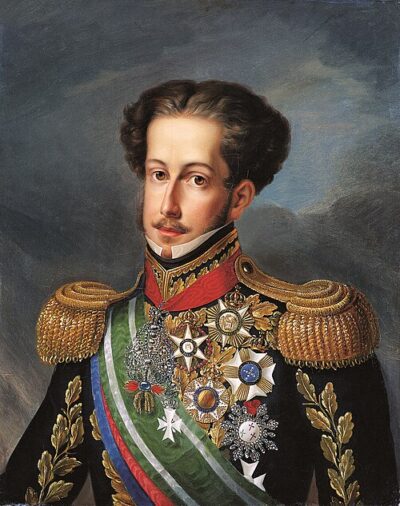
Pedro I of Brazil
Pedro I of Brazil was an Emperor of Brazil from 1822 to 1831 and King of Portugal in 1826. Born October 12, 1798, in Queluz. Died September 24, 1834, in Queluz. Positions held include Monarch of Portugal (1826), Grand Master of the Order of the Tower and Sword and Grand Master of the Order of the Immaculate Conception of Vila Viçosa. Known for Hymn of the Charter. Awards include Knight of the Order of the Holy Spirit, Knight of the Order of Saint Michael and Knight of the Order of the Golden Fleece.
Facts
61 facts · 2 confirmed by two sources · 4 cited · 53 from one source · 2 where the sources disagree
What’s different
- Born in: we show Queluz (Sources disagree). Wikidata also lists Palace of Queluz
- Died in: we show Queluz (Sources disagree). Wikidata also lists Palace of Queluz
Where this comes from
Papalocal keeps its own record. It started from these sources; what each one said is kept here as it was copied, so a change on their side never changes this page by itself. Tap one to read its version.
What Wikidata says · copied November 16, 2026 · revision 2568844168
- Described as
- Emperor of Brazil from 1822 to 1831 and King of Portugal in 1826 (1798-1834)
- Other names
- Peter I of Brazil, Pedro IV, Pedro IV of Portugal, Pedro IV of Portugal and I of Brazil, Peter IV of Portugal, Pedro I
- Born
- October 12, 1798 · 6 references
- Died
- September 24, 1834 · 6 references
- Born in
- Palace of Queluz; Queluz · 2 references
- Died in
- Palace of Queluz; Queluz · 2 references
- Buried in
- Monument to the Independence of Brazil
- Cause of death
- tuberculosis
- Name at birth
- Pedro de Alcântara Francisco António João Carlos Xavier de Paula Miguel Rafael Joaquim José Gonzaga Pascoal Cipriano Serafim
- Citizen of
- Kingdom of Portugal; Empire of Brazil
- Occupation
- politician; composer · 1 reference; poet; monarch
- Positions held
- Monarch of Portugal (1826); Grand Master of the Order of the Tower and Sword; Grand Master of the Order of the Immaculate Conception of Vila Viçosa; Emperor of Brazil (1822–1831)
- Member of
- Academia Brasileira de Música · 1 reference
- Known for
- Hymn of the Charter
- Awards
- Knight of the Order of the Holy Spirit; Knight of the Order of Saint Michael; Knight of the Order of the Golden Fleece; Grand Cross of the Order of Isabella the Catholic; Order of St. Andrew; Imperial Order of the Rose; Grand Cross of the Order of the Tower and Sword; Knight Grand Cross in the Order of the Netherlands Lion; Grand Cross of the Order of Charles III · 1 reference; Order of Saint Hubert; Order of Saint Michael; Knight Grand Cross of the Order of Saint Stephen of Hungary; Order of Saint Louis; Order of Saint Michael · 1 reference; Order of Pedro I · 1 reference
- Field
- music · 1 reference; composer · 1 reference
- Spouse
- Maria Leopoldina of Austria (1817–1826) · 1 reference; Amélie of Leuchtenberg (1829–1834) · 1 reference
- Children
- Maria II of Portugal; Infante Miguel of Portugal; Prince João Carlos, Prince of Beira; Princess Januária, Countess of Aquila; Princess Paula of Brazil; Princess Francisca of Brazil; Pedro II of Brazil; Princess Maria Amélia of Brazil; Isabel Maria de Alcântara, Duchess of Goiás · 1 reference; Rodrigo Delfim Pereira; Maria Isabel de Alcântara Brasileira; Pedro de Alcántara Brasileiro
- Father
- John VI of Portugal
- Mother
- Carlota Joaquina of Spain
- Siblings
- Infanta Ana de Jesus Maria, Marchioness of Loulé; Miguel I of Portugal; Infanta Maria Francisca of Portugal; Infante Francisco António, Prince of Beira; Maria da Assunção of Portugal; Queen Maria Isabel of Spain; Isabel Maria of Portugal; Maria Teresa de Bragança
- Religion
- Catholic Church
- Wikipedias with a page
- 83
Wikidata item Q939 (wikidata.org/wiki/Q939), public domain (CC0). Copied November 16, 2026.
What Wikipedia says · copied November 16, 2026 · revision 1384519699
Dom Pedro I (12 October 1798 – 24 September 1834), known in Brazil and in Portugal as "the Liberator" (Portuguese: o Libertador) or "the Soldier King" (o Rei Soldado) in Portugal, was the founder and first ruler of the Empire of Brazil from 1822 to 1831 (under the name of Pedro I) and King of Portugal in 1826 (under the name of Pedro IV).
Born in Lisbon, Pedro was the fourth child of King Dom John VI of Portugal and Queen Carlota Joaquina, and thus a member of the House of Braganza. When the country was invaded by French troops in 1807, he and his family fled to Portugal's largest and wealthiest colony, Brazil. The outbreak of the Liberal Revolution of 1820 in Lisbon compelled Pedro I's father to return to Portugal in April 1821, leaving him to rule Brazil as regent. He had to deal with challenges from revolutionaries and insubordination by Portuguese troops, all of which he subdued. The Portuguese government's threat to revoke the political autonomy that Brazil had enjoyed since 1808 was met with widespread discontent in Brazil. Pedro I chose the Brazilian side and declared Brazil's independence from Portugal on 7 September 1822. On 12 October, he was acclaimed Emperor and by March 1824 had defeated all armies loyal to Portugal. A few months later, Pedro I crushed the short-lived Confederation of the Equator, a failed secession attempt by provincial rebels in Brazil's northeast.
A secessionist rebellion in the southern province of Cisplatina in early 1825, and the subsequent attempt by the United Provinces of the Río de la Plata to annex it, led the Empire into the Cisplatine War. In March 1826, Pedro I briefly became king of Portugal before abdicating in favor of his eldest daughter, Dona Maria II. The situation worsened in 1828 when the war in the south resulted in Brazil's loss of Cisplatina. During the same year in Lisbon, Maria II's throne was usurped by Prince Dom Miguel, Pedro I's younger brother. The Emperor's concurrent and scandalous sexual affair with Domitila de Castro tarnished his reputation. Other difficulties arose in the Brazilian parliament, where a struggle over whether the government would be chosen by the monarch or by the legislature dominated political debates from 1826 to 1831. Unable to deal with problems in both Brazil and Portugal simultaneously, on 7 April 1831 Pedro I abdicated in favor of his son Dom Pedro II, and sailed for Europe.
Pedro I invaded Portugal at the head of an army in July 1832. Faced at first with what seemed a national civil war, he soon became involved in a wider conflict that enveloped the Iberian Peninsula in a struggle between proponents of liberalism and those seeking a return to absolutism. Pedro I died of tuberculosis in September 1834, just a few months after he and the liberals had emerged victorious. He was hailed by both contemporaries and posterity as a key figure who helped spread the liberal ideals that allowed Brazil and Portugal to move from absolutist regimes to representative forms of government.
- Born, in its opening lines
- October 12, 1798
- Died, in its opening lines
- September 24, 1834
From the Wikipedia article “Pedro I of Brazil” (en.wikipedia.org/wiki/Pedro_I_of_Brazil), by its contributors, under CC BY-SA 4.0 (creativecommons.org/licenses/by-sa/4.0/). Copied November 16, 2026; not changed.
Confirmed Two sources agree. Cited One source, and it names where it got it. One source One source, without a reference of its own. Sources disagree The sources disagree. We show the best-supported value and keep theirs below.
