
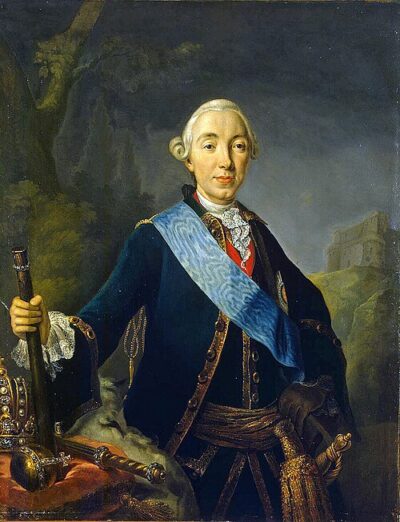
Peter III of Russia
Peter III of Russia was The seventh Emperor of Russia, 1762 (lived 1728-1762). Born February 10, 1728, in Kiel. Died July 6, 1762, in Ropsha Palace. Positions held include Emperor of all the Russias (1761–1762) and Head of the House of Romanov. Awards include Pour le Mérite, Order of the Black Eagle and Order of the White Eagle.
Facts
25 facts · 0 confirmed by two sources · 1 cited · 21 from one source · 3 where the sources disagree
What’s different
- Born: we show February 10, 1728 (Sources disagree). Wikipedia says February 21, 1728
- Died: we show July 6, 1762 (Sources disagree). Wikipedia says July 17, 1762
- Buried in: we show Annunciation Church of the Alexander Nevsky Lavra (1796) (Sources disagree). Wikidata also lists Peter and Paul Cathedral and Alexander Nevsky Lavra
Where this comes from
Papalocal keeps its own record. It started from these sources; what each one said is kept here as it was copied, so a change on their side never changes this page by itself. Tap one to read its version.
What Wikidata says · copied November 16, 2026 · revision 2569995478
- Described as
- The seventh Emperor of Russia, 1762 (lived 1728-1762)
- Other names
- Charles Peter Ulrich of Holstein-Gottorp, Karl Peter Ulrich
- Born
- February 10, 1728 · 3 references
- Died
- July 6, 1762 · 1 reference
- Born in
- Kiel · 5 references
- Died in
- Ropsha Palace · 1 reference
- Buried in
- Peter and Paul Cathedral; Alexander Nevsky Lavra; Annunciation Church of the Alexander Nevsky Lavra (1796) · 1 reference
- Name at birth
- Karl Peter Ulrich von Schleswig-Golstein-Gottorf
- Citizen of
- Russian Empire
- Occupation
- monarch
- Positions held
- Emperor of all the Russias (1761–1762); Head of the House of Romanov
- Awards
- Pour le Mérite; Order of the Black Eagle; Order of the White Eagle; Order of Saint Alexander Nevsky; Order of St. Andrew; Order of Saint Anna · 1 reference
- Spouse
- Catherine II of Russia (1745–) · 1 reference
- Children
- Paul I of Russia; Anna Petrovna
- Father
- Charles Frederick, Duke of Schleswig-Holstein-Gottorp
- Mother
- Anna Petrovna of Russia
- Religion
- Eastern Orthodoxy; Lutheranism · 1 reference
- Lived in
- Kiel; Saint Petersburg
- Wikipedias with a page
- 85
Wikidata item Q151789 (wikidata.org/wiki/Q151789), public domain (CC0). Copied November 16, 2026.
What Wikipedia says · copied November 16, 2026 · revision 1384377036
Peter III Fyodorovich (Russian: Пётр III Фёдорович, romanized: Pyotr III Fyodorovich, born Charles Peter Ulrich of Schleswig-Holstein-Gottorp; 21 February 1728 – 17 July 1762) was Emperor of Russia from 5 January 1762 until 9 July of the same year, when his wife, Catherine II, overthrew him in a palace coup d'état. He implemented many notable reforms during his reign, though he is criticised for undoing Russian gains in the Seven Years' War by forming an alliance with Prussia.
Peter was the son of Duke Charles Frederick of Holstein-Gottorp, and Grand Duchess Anna Petrovna of Russia, who died of puerperal fever after childbirth. After succeeding to the throne of Holstein-Gottorp following his father’s death, Peter was made heir presumptive to both the Russian and Swedish thrones in 1742. Due to his conversion to Russian Orthodoxy, he was disqualified from becoming King of Sweden.
Peter married his paternal second cousin, Princess Sophie of Anhalt-Zerbst, who took the Orthodox name of Catherine Alexeievna, in 1745. They had one child who survived to adulthood, Paul Petrovich. Peter succeeded his maternal aunt as Emperor of Russia in 1762. After a 186-day reign, Peter III was overthrown by his wife, and soon died under unclear circumstances. The official cause proposed by Catherine's new government was that he died due to hemorrhoids. This explanation was met with skepticism, both in Russia and abroad, with notable critics such as Voltaire and d'Alembert expressing doubt about the plausibility of death from such a condition.
After Peter III's death, many impostors thrived, pretending to be him, the most famous of whom were Yemelyan Pugachev and the "Montenegerin Tsar Peter III" (Stephan the Little).
- Born, in its opening lines
- February 21, 1728
- Died, in its opening lines
- July 17, 1762
From the Wikipedia article “Peter III of Russia” (en.wikipedia.org/wiki/Peter_III_of_Russia), by its contributors, under CC BY-SA 4.0 (creativecommons.org/licenses/by-sa/4.0/). Copied November 16, 2026; not changed.
Confirmed Two sources agree. Cited One source, and it names where it got it. One source One source, without a reference of its own. Sources disagree The sources disagree. We show the best-supported value and keep theirs below.
