
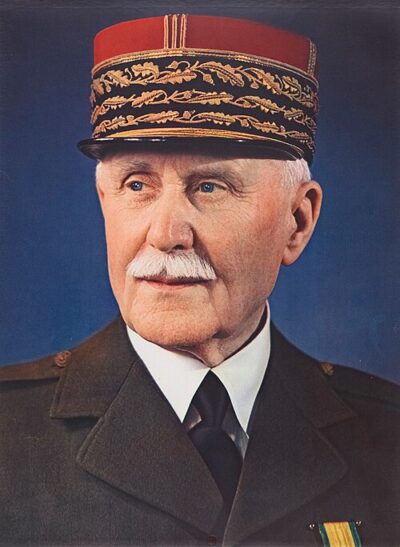
Philippe Pétain
Philippe Pétain was a French military and political leader. Born April 24, 1856, in Cauchy-à-la-Tour. Died July 23, 1951, in Port-Joinville. Positions held include Minister of State (1935), Deputy Prime Minister of France (1940) and President of the Council (1940–1942). Educated at École Spéciale Militaire de Saint-Cyr. Awards include Order of the White Eagle (Second Polish Republic), Médaille militaire and Croix de guerre 1914–1918.
Facts
52 facts · 2 confirmed by two sources · 14 cited · 36 from one source
Where this comes from
Papalocal keeps its own record. It started from these sources; what each one said is kept here as it was copied, so a change on their side never changes this page by itself. Tap one to read its version.
What Wikidata says · copied November 16, 2026 · revision 2568845338
- Described as
- French military and political leader (1856–1951)
- Other names
- Henri Philippe Benoni Omer Joseph Pétain, Marshal Pétain, Philippe Petain, Henri Philippe Benoni Omer Joseph Petain, Marshal Petain
- Born
- April 24, 1856 · 11 references
- Died
- July 23, 1951 · 11 references
- Born in
- Cauchy-à-la-Tour · 1 reference
- Died in
- Port-Joinville · 1 reference
- Buried in
- tomb of Philippe Pétain
- Name at birth
- Henri Philippe Bénoni Omer Joseph Pétain
- Citizen of
- France · 1 reference
- Occupation
- politician · 3 references; diplomat; military officer · 1 reference; military personnel · 1 reference; marshal · 1 reference
- Positions held
- Minister of State (1935); Deputy Prime Minister of France (1940); President of the Council (1940–1942); Head of State of Vichy France (1940–1944); ambassador of France to Spain (1939–1940); Minister of War (1934); vice president (1920–1931); Member of the Académie française (1929–1945) · 1 reference; French co-prince of Andorra (1940–1944); commanding officer (1917–1919); Prime Minister of France (1940–1942); Chief of Staff of the French Army (1917)
- Political party
- independent politician
- Education
- École Spéciale Militaire de Saint-Cyr
- Member of
- Académie des Sciences Morales et Politiques (1919–); Académie Française (1929–1945) · 1 reference
- Awards
- Order of the White Eagle (Second Polish Republic); Médaille militaire (1918–1945) · 1 reference; Croix de guerre 1914–1918; Inter-Allied Victory medal (Belgium); Médaille commémorative de la guerre 1914–1918; Colonial Medal; Distinguished Service Medal; Marshal of France (1918) · 1 reference; Godfather promotion of Special Military School of Saint-Cyr; Order of St. George, 4th class; Grand Master of the Legion of Honour; Order of the Star of Karađorđe; Cross of Valour; Cross of Liberty; Royal Order of Cambodia
- Field
- politician · 1 reference
- Spouse
- Annie Pétain
- Father
- Omer-Venant Pétain
- Mother
- Clotilde Legrand
- Religion
- Catholic Church
- Military branch
- French Armed Forces · 1 reference
- Military rank
- divisional general (1914) · 1 reference; brigadier general (1914) · 1 reference; colonel (1910) · 1 reference
- Wikipedias with a page
- 97
Wikidata item Q5721 (wikidata.org/wiki/Q5721), public domain (CC0). Copied November 16, 2026.
What Wikipedia says · copied November 16, 2026 · revision 1384481545
Henri Philippe Benoni Omar Joseph Pétain (French: [filip petɛ̃]; 24 April 1856 – 23 July 1951), also known as Marshal Pétain (French: maréchal Pétain, [maʁeʃal petɛ̃]), was a French military officer, dictator, and politician who commanded the French Army in World War I and later became the head of the Axis-collaborationist regime of Vichy France, from 1940 to 1944, during World War II.
Pétain was admitted to the Saint-Cyr Military Academy in 1876 and pursued a career in the military, achieving the rank of colonel by the outbreak of World War I. He led the French Army to victory at the nine-month-long Battle of Verdun, for which he was called "the Lion of Verdun" (le lion de Verdun). After the failed Nivelle Offensive and subsequent mutinies, he was appointed Commander-in-Chief and succeeded in restoring control. Pétain remained in command for the rest of the war and emerged as a national hero. During the interwar period, he was head of the peacetime French Army, commanded joint Franco-Spanish operations during the Rif War and served twice as a government minister. During this time he was known as le vieux Maréchal ('the Old Marshal').
On 16 June 1940, with the Fall of France imminent and the government seeking an armistice, Prime Minister Paul Reynaud resigned, recommending to President Albert Lebrun that he appoint Pétain in his place, which he did that day, while the government was at Bordeaux. The government then resolved to sign armistice agreements with Nazi Germany and Fascist Italy. The entire government subsequently moved briefly to Clermont-Ferrand, then to the town of Vichy in central France. A Congress of the French Parliament voted on 10 July to transform the French Third Republic into the French State, better known as Vichy France, a puppet regime that was allowed to govern the southeast of France in collaboration with the Axis powers, and Pétain became head of state. Aged 84 at his appointments, he remains the oldest head of government and head of state of France. Pétain's regime was characterised from the outset by authoritarianism and antisemitism. After Germany and Italy occupied all of France in November 1942, Pétain's government worked closely with the German military administration.
After the war, Pétain was tried and convicted for treason on 15 August 1945. He was originally sentenced to death, but due to his age and World War I service, his sentence was commuted to life in prison in exile. He died aged 95 on Île d'Yeu, where he had served five years in prison and exile. His journey from military obscurity, to hero of France during World War I, to collaborationist ruler during World War II, led his successor Charles de Gaulle to declare that Pétain's life was "successively banal, then glorious, then deplorable, but never mediocre".
- Born, in its opening lines
- April 24, 1856
- Died, in its opening lines
- July 23, 1951
From the Wikipedia article “Philippe Pétain” (en.wikipedia.org/wiki/Philippe_Pétain), by its contributors, under CC BY-SA 4.0 (creativecommons.org/licenses/by-sa/4.0/). Copied November 16, 2026; not changed.
Confirmed Two sources agree. Cited One source, and it names where it got it. One source One source, without a reference of its own. Sources disagree The sources disagree. We show the best-supported value and keep theirs below.
