
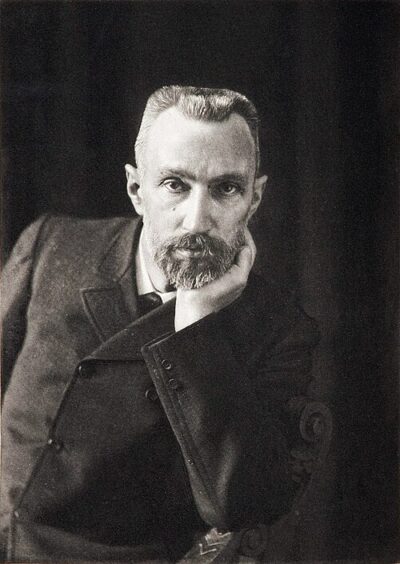
Pierre Curie
Pierre Curie was a French physicist and chemist. Born May 15, 1859, in Paris. Died April 19, 1906, in Paris. Positions held include professor. Known for radioactivity and piezoelectricity. Educated at Science Faculty of Paris and Sorbonne. Awards include Nobel Prize in Physics, Elliott Cresson Medal and Benjamin Franklin Medal.
Facts
41 facts · 2 confirmed by two sources · 16 cited · 23 from one source
Where this comes from
Papalocal keeps its own record. It started from these sources; what each one said is kept here as it was copied, so a change on their side never changes this page by itself. Tap one to read its version.
What Wikidata says · copied November 16, 2026 · revision 2565539126
- Described as
- French physicist and chemist (1859–1906)
- Born
- May 15, 1859 · 14 references
- Died
- April 19, 1906 · 14 references
- Born in
- Paris · 3 references
- Died in
- Paris · 4 references
- Buried in
- Panthéon (1995–)
- Cause of death
- struck by vehicle · 1 reference
- Citizen of
- France · 1 reference
- Occupation
- physicist · 4 references; chemist · 3 references; university teacher; nuclear physicist
- Positions held
- professor
- Worked for
- University of Paris
- Education
- Science Faculty of Paris; Sorbonne; homeschooling
- Member of
- French Academy of Sciences; Pierre and Marie Curie · 1 reference
- Known for
- radioactivity · 1 reference; piezoelectricity · 1 reference
- Awards
- Nobel Prize in Physics (1903) · 2 references; Elliott Cresson Medal (1909) · 1 reference; Benjamin Franklin Medal; Davy Medal (1903) · 1 reference; Matteucci Medal (1904); La Caze Prize of the Academy of Sciences (1901); Jean Reynaud Prize (1906)
- Field
- physics; chemistry · 1 reference; crystallography · 1 reference; magnetism · 1 reference; piezoelectricity · 1 reference; radioactivity · 1 reference
- Spouse
- Marie Curie (1895–1906) · 2 references
- Children
- Irène Joliot-Curie · 1 reference; Ève Curie · 1 reference
- Father
- Eugène Curie
- Mother
- Sophie-Claire Depouilly
- Siblings
- Jacques Curie
- Lived in
- rue de la Glacière (1898); France
- Wikipedias with a page
- 132
Wikidata item Q37463 (wikidata.org/wiki/Q37463), public domain (CC0). Copied November 16, 2026.
What Wikipedia says · copied November 16, 2026 · revision 1383023039
Pierre Curie (15 May 1859 – 19 April 1906) was a French physicist and chemist, and a pioneer in crystallography and magnetism. He shared one half of the 1903 Nobel Prize in Physics with his wife, Maria Skłodowska-Curie, for their work on radioactivity. With their win, the Curies became the first married couple to win a Nobel Prize, launching the Curie family legacy of five Nobel Prizes.
- Born, in its opening lines
- May 15, 1859
- Died, in its opening lines
- April 19, 1906
From the Wikipedia article “Pierre Curie” (en.wikipedia.org/wiki/Pierre_Curie), by its contributors, under CC BY-SA 4.0 (creativecommons.org/licenses/by-sa/4.0/). Copied November 16, 2026; not changed.
Confirmed Two sources agree. Cited One source, and it names where it got it. One source One source, without a reference of its own. Sources disagree The sources disagree. We show the best-supported value and keep theirs below.
