
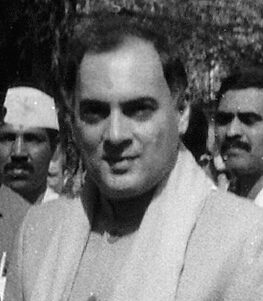
Rajiv Gandhi
Rajiv Gandhi was a Prime Minister of India. Born August 20, 1944, in Mumbai. Died May 21, 1991, in Sriperumbudur. Positions held include Minister of External Affairs (2 times) (1984–1988), Prime Minister of India (1984–1989) and Member of the Lok Sabha (1981–1991). Educated at Trinity College and Imperial College London. Awards include Order of Augusto César Sandino, Indira Gandhi Peace Prize and Bharat Ratna.
Facts
35 facts · 2 confirmed by two sources · 26 cited · 7 from one source
Where this comes from
Papalocal keeps its own record. It started from these sources; what each one said is kept here as it was copied, so a change on their side never changes this page by itself. Tap one to read its version.
What Wikidata says · copied November 16, 2026 · revision 2563961533
- Described as
- Prime Minister of India (1984-1989)
- Other names
- Rajiv Ratna Gandhi
- Born
- August 20, 1944 · 11 references
- Died
- May 21, 1991 · 10 references
- Born in
- Mumbai · 1 reference
- Died in
- Sriperumbudur · 2 references
- Buried in
- Raj Ghat and associated memorials
- Cause of death
- explosion · 1 reference
- Citizen of
- India (1950–) · 2 references; British Raj (–1947) · 1 reference; Dominion of India (1947–1950)
- Occupation
- politician · 3 references; amateur radio operator
- Positions held
- Minister of External Affairs (2 times) (1984–1988) · 1 reference; Prime Minister of India (1984–1989) · 2 references; Member of the Lok Sabha (1981–1991) · 1 reference; Leader of the Opposition in the Lok Sabha (1989–1990) · 1 reference; President of the Indian National Congress (1984–1991) · 1 reference; Member of the 9th Lok Sabha (1989–1991); Member of the 7th Lok Sabha; Member of the 8th Lok Sabha
- Political party
- Indian National Congress · 1 reference
- Education
- Trinity College · 1 reference; Imperial College London · 1 reference; The Doon School · 1 reference; University of Cambridge · 1 reference; Welham Boys' School
- Awards
- Order of Augusto César Sandino · 1 reference; Indira Gandhi Peace Prize (1991) · 1 reference; Bharat Ratna (1991) · 1 reference
- Spouse
- Sonia Gandhi (1969–1991) · 1 reference
- Children
- Rahul Gandhi · 1 reference; Priyanka Vadra · 1 reference
- Father
- Feroze Gandhi · 1 reference
- Mother
- Indira Gandhi · 1 reference
- Siblings
- Sanjay Gandhi · 1 reference
- Religion
- Hinduism · 1 reference
- Wikipedias with a page
- 108
Wikidata item Q4593 (wikidata.org/wiki/Q4593), public domain (CC0). Copied November 16, 2026.
What Wikipedia says · copied November 16, 2026 · revision 1384623849
Rajiv Ratna Gandhi (20 August 1944 – 21 May 1991) was an Indian aircraft pilot, technocrat and statesman who served as the prime minister of India from 1984 to 1989 for two terms. He took office after the assassination of his mother, then–prime minister Indira Gandhi, to become the youngest Indian prime minister at the age of 40. He served until his defeat at the 1989 election, and then became Leader of the Opposition in Lok Sabha, resigning in December 1990, six months before his own assassination.
Gandhi was not related to Mahatma Gandhi. Instead, he was from the politically powerful Nehru–Gandhi family, which had been associated with the Indian National Congress party. For much of his childhood, his maternal grandfather Jawaharlal Nehru was prime minister. Gandhi attended The Doon School, an elite boarding institution, and then the University of Cambridge in the United Kingdom. He returned to India in 1966 and became a professional pilot for the state-owned Indian Airlines. In 1968, he married Sonia Maino; the couple settled in Delhi for a domestic life with their children Rahul and Priyanka. For much of the 1960s and 1970s, his mother was prime minister and his younger brother Sanjay an MP; despite this, Gandhi remained apolitical.
After Sanjay died in a plane crash in 1980, Gandhi reluctantly entered politics at the behest of his mother. The following year he won his brother's Parliamentary seat of Amethi and became a member of the Lok Sabha, the lower house of India's Parliament. As part of his political grooming, Rajiv was made general secretary of the Congress party and given significant responsibility in organising the 1982 Asian Games.
On the morning of 31 October 1984, his mother (the then prime minister) was assassinated by her two Sikh bodyguards Satwant Singh and Beant Singh in the aftermath of Operation Blue Star, an Indian military action to remove Sikh separatist activists from the Golden Temple. Later that day, Gandhi was appointed prime minister. His leadership was tested over the next few days as organised mobs rioted against the Sikh community, resulting in anti-Sikh massacres in Delhi. That December, the Congress party won the largest Lok Sabha majority to date, 414 seats out of 541. Gandhi's period in office was mired in controversies such as Bhopal disaster, Bofors scandal and Mohd. Ahmed Khan v. Shah Bano Begum. In 1988, he reversed the coup in Maldives, antagonising militant Tamil groups such as PLOTE, intervening and then sending peacekeeping troops to Sri Lanka in 1987, leading to open conflict with the Liberation Tigers of Tamil Eelam (LTTE). His party was defeated in the 1989 election.
Gandhi remained Congress president until the elections in 1991. While campaigning for the elections, he was assassinated by a suicide bomber from the LTTE. In 1991, the Indian government posthumously awarded Gandhi the Bharat Ratna, the country's highest civilian award. At the India Leadership Conclave in 2009, the Revolutionary Leader of Modern India award was conferred posthumously on Gandhi.
- Born, in its opening lines
- August 20, 1944
- Died, in its opening lines
- May 21, 1991
From the Wikipedia article “Rajiv Gandhi” (en.wikipedia.org/wiki/Rajiv_Gandhi), by its contributors, under CC BY-SA 4.0 (creativecommons.org/licenses/by-sa/4.0/). Copied November 16, 2026; not changed.
Confirmed Two sources agree. Cited One source, and it names where it got it. One source One source, without a reference of its own. Sources disagree The sources disagree. We show the best-supported value and keep theirs below.
