
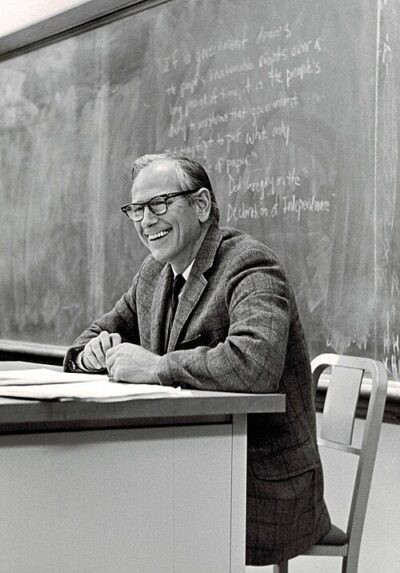
Robert A. Dahl
Robert A. Dahl was an American political scientist. Born December 17, 1915, in Inwood. Died February 5, 2014, in Hamden. Positions held include chairperson (1966–1967). Known for Who Governs?. Educated at Yale University and University of Washington. Awards include Guggenheim Fellowship, Johan Skytte Prize in Political Science and Wilbur Cross Medal.
Facts
27 facts · 2 confirmed by two sources · 12 cited · 13 from one source
Where this comes from
Papalocal keeps its own record. It started from these sources; what each one said is kept here as it was copied, so a change on their side never changes this page by itself. Tap one to read its version.
What Wikidata says · copied November 13, 2026 · revision 2558225767
- Described as
- American political scientist (1915–2014)
- Other names
- Robert Alan Dahl, Robert Dahl
- Born
- December 17, 1915 · 9 references
- Died
- February 5, 2014 · 7 references
- Born in
- Inwood · 2 references
- Died in
- Hamden · 1 reference
- Citizen of
- United States
- Occupation
- political scientist; professor; sociologist; social scientist · 1 reference; university teacher · 1 reference
- Positions held
- chairperson (1966–1967) · 2 references
- Worked for
- Yale University (1946–1986) · 2 references
- Education
- Yale University (–1940) · 1 reference; University of Washington (–1936) · 1 reference
- Member of
- National Academy of Sciences (1972–) · 1 reference; American Academy of Arts and Sciences; American Philosophical Society; British Academy
- Known for
- Who Governs?
- Awards
- Guggenheim Fellowship (1950) · 1 reference; Johan Skytte Prize in Political Science (1995) · 1 reference; Wilbur Cross Medal (1986) · 1 reference; Sterling Professor; honorary doctor of the University of Madrid Complutense (2001); Spitz Prize; Benjamin E. Lippincott Award (1989) · 1 reference
- Field
- political science
- Wikipedias with a page
- 44
Wikidata item Q83907 (wikidata.org/wiki/Q83907), public domain (CC0). Copied November 13, 2026.
What Wikipedia says · copied November 13, 2026 · revision 1379644925
Robert Alan Dahl (; December 17, 1915 – February 5, 2014) was an American political theorist and Sterling Professor of Political Science at Yale University.
He established the pluralist theory of democracy—in which political outcomes are enacted through competitive, if unequal, interest groups—and introduced "polyarchy" as a descriptor of actual democratic governance. An originator of "empirical theory" and known for advancing behavioralist characterizations of political power, Dahl's research focused on the nature of decision making in actual institutions, such as American cities. He is the most important scholar associated with the pluralist approach to describing and understanding both city and national power structures.
In addition to his work on the descriptive theory of democracy, he was long occupied with the formulation of the constituent elements of democracy considered as a theoretical but realizable ideal. He has been credited to be a major theorist of democracy, with supporters praising what they claim to be the cogency, clarity and veracity of his portrayal of some of the key characteristics of ‘realizable-ideal’ democracy, as well as his descriptive analysis of the dynamics of modern pluralist-democracy.
- Born, in its opening lines
- December 17, 1915
- Died, in its opening lines
- February 5, 2014
From the Wikipedia article “Robert Dahl” (en.wikipedia.org/wiki/Robert_Dahl), by its contributors, under CC BY-SA 4.0 (creativecommons.org/licenses/by-sa/4.0/). Copied November 13, 2026; not changed.
Confirmed Two sources agree. Cited One source, and it names where it got it. One source One source, without a reference of its own. Sources disagree The sources disagree. We show the best-supported value and keep theirs below.
