
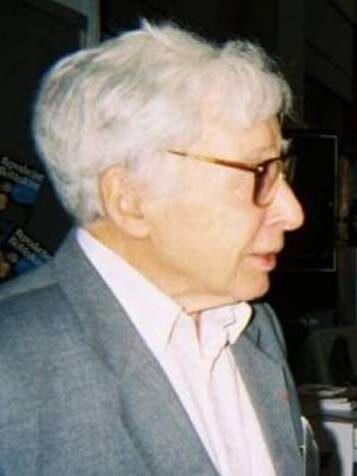
Robert Edwards
Robert Edwards was an English physiologist and pioneer in reproductive medicine and in-vitro fertilisation. Born September 27, 1925, in Batley. Died April 10, 2013, in Cambridge. Educated at Bangor University and University of Edinburgh. Awards include Knight Bachelor, Commander of the Order of the British Empire and Fellow of the Royal Society.
Facts
31 facts · 2 confirmed by two sources · 12 cited · 17 from one source
Where this comes from
Papalocal keeps its own record. It started from these sources; what each one said is kept here as it was copied, so a change on their side never changes this page by itself. Tap one to read its version.
What Wikidata says · copied November 16, 2026 · revision 2563198573
- Described as
- English physiologist and pioneer in reproductive medicine and in-vitro fertilisation
- Other names
- Robert G. Edwards, Sir Robert Geoffrey Edwards, Robert Geoffrey Edwards, Bob Edwards
- Born
- September 27, 1925 · 7 references
- Died
- April 10, 2013 · 9 references
- Born in
- Batley · 2 references
- Died in
- Cambridge · 1 reference
- Buried in
- Elmwood Cemetery · 1 reference
- Cause of death
- disease
- Name at birth
- Robert Geoffrey Edwards
- Citizen of
- United Kingdom · 2 references
- Occupation
- physician; physiologist; biologist · 3 references; researcher
- Worked for
- University of Cambridge
- Education
- Bangor University; University of Edinburgh
- Member of
- Royal Society of London; Academia Europaea (1989–) · 1 reference
- Awards
- Knight Bachelor; Commander of the Order of the British Empire; Fellow of the Royal Society; Lasker-DeBakey Clinical Medical Research Award (2001) · 1 reference; Nobel Prize in Physiology or Medicine (2010) · 2 references; King Faisal Prize in Medicine (1989); Annual Review Prize Lecture (2008) · 1 reference; Eardley Holland Gold Medal (2005) · 1 reference; honorary doctor of the University of Valencia (1994) · 1 reference; honorary doctorate of the Vrije Universiteit Brussel (1988) · 1 reference
- Field
- reproductive medicine
- Spouse
- Ruth Fowler Edwards (–2013)
- Lived in
- Manchester; Leeds
- Wikipedias with a page
- 74
Wikidata item Q104913 (wikidata.org/wiki/Q104913), public domain (CC0). Copied November 16, 2026.
What Wikipedia says · copied November 16, 2026 · revision 1371990276
Sir Robert Geoffrey Edwards (27 September 1925 – 10 April 2013) was a British physiologist and pioneer in reproductive medicine, and in-vitro fertilisation (IVF) in particular. Along with obstetrician and gynaecologist Patrick Steptoe and nurse and embryologist Jean Purdy, Edwards successfully pioneered conception through IVF, which led to the birth of Louise Brown on 25 July 1978. They founded the first IVF programme for infertile patients and trained other scientists in their techniques. Edwards was the founding editor-in-chief of Human Reproduction in 1986. In 2010, he was awarded the Nobel Prize in Physiology or Medicine "for the development of in vitro fertilization".
- Born, in its opening lines
- September 27, 1925
- Died, in its opening lines
- April 10, 2013
From the Wikipedia article “Robert Edwards (physiologist)” (en.wikipedia.org/wiki/Robert_Edwards_(physiologist)), by its contributors, under CC BY-SA 4.0 (creativecommons.org/licenses/by-sa/4.0/). Copied November 16, 2026; not changed.
Confirmed Two sources agree. Cited One source, and it names where it got it. One source One source, without a reference of its own. Sources disagree The sources disagree. We show the best-supported value and keep theirs below.
