
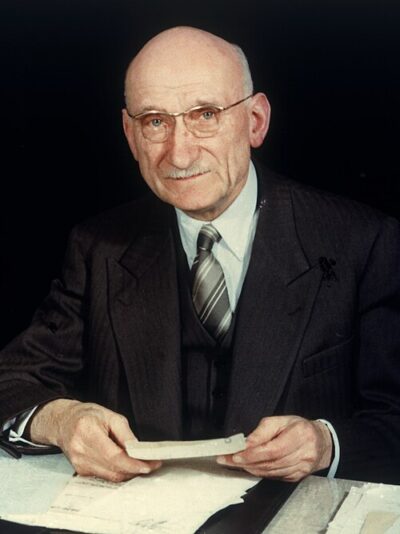
Robert Schuman
Robert Schuman was a Luxembourgish-born German-French statesman and Venerable. Born June 29, 1886, in Luxembourg. Died September 4, 1963, in Scy-Chazelles. Positions held include President of the Council (1947–1948), Member of the European Parliament (1958–1962) and President of the European Parliament (1958–1960). Educated at University of Strasbourg and University of Bonn. Awards include Knight of Pius IX, Erasmus Prize and Charlemagne Prize.
Facts
44 facts · 2 confirmed by two sources · 10 cited · 32 from one source
Where this comes from
Papalocal keeps its own record. It started from these sources; what each one said is kept here as it was copied, so a change on their side never changes this page by itself. Tap one to read its version.
What Wikidata says · copied November 16, 2026 · revision 2568983075
- Described as
- Luxembourgish-born German-French statesman and Venerable (1886-1963)
- Other names
- Jean-Baptiste Nicolas Robert Schuman, Venerable Robert Schuman
- Born
- June 29, 1886 · 14 references
- Died
- September 4, 1963 · 14 references
- Born in
- Luxembourg · 2 references
- Died in
- Scy-Chazelles · 4 references
- Buried in
- Église Saint-Quentin
- Name at birth
- Jean-Baptiste Nicolas Robert Schuman
- Citizen of
- France; Germany
- Occupation
- politician · 1 reference; diplomat; lawyer; jurist · 1 reference
- Positions held
- President of the Council (1947–1948); Member of the European Parliament (1958–1962) · 1 reference; President of the European Parliament (1958–1960); member of the general council (2 times) (1937–1949); Deputy of the French Third Republic (1919–1942); Minister of Foreign Affairs (1948–1952); Minister of Justice (1955–1956); Minister of the Economy, Finances and Industry (1946–1947)
- Political party
- Popular Republican Movement; Lorrain Republican Union; Popular Democratic Party
- Worked for
- University of Strasbourg
- Education
- University of Strasbourg; University of Bonn; Humboldt-Universität zu Berlin; LMU Munich; Athénée de Luxembourg; Lycée Fabert
- Member of
- WKStV Unitas-Salia Bonn
- Awards
- Knight of Pius IX; Erasmus Prize (1959) · 1 reference; Charlemagne Prize (1958) · 1 reference; honorary doctorate at the Laval University (1952) · 1 reference; honorary doctor of the Katholieke Universiteit Leuven; honorary citizen of Luxembourg (1949) · 1 reference; Grand Cross 1st class of the Order of Merit of the Federal Republic of Germany; Honorary doctor of the University of Ottawa; honorary citizen of Bonn; Grand Cross of the Order of Saint-Charles (1951) · 1 reference
- Religion
- Catholic Church
- Lived in
- Robert Schuman's House (1926–1963)
- Website
- http://www.robert-schuman.com
- Wikipedias with a page
- 75
Wikidata item Q15981 (wikidata.org/wiki/Q15981), public domain (CC0). Copied November 16, 2026.
What Wikipedia says · copied November 16, 2026 · revision 1381773484
Jean-Baptiste Nicolas Robert Schuman (French: [ʁɔbɛʁ ʃuman]; 29 June 1886 – 4 September 1963) was a Luxembourg-born French statesman. Schuman was a Christian democratic (Popular Republican Movement) political thinker and activist. Twice Prime Minister of France, a reformist Minister of Finance and a Foreign Minister, he was instrumental in building postwar European and trans-Atlantic institutions and was one of the founders of the European Communities, the Council of Europe and NATO. He was the one who proposed the Schuman Declaration, which established the European Coal and Steel Community, ultimately a predecessor of the European Union. The 1964–1965 academic year at the College of Europe was named in his honour. In 2021, Schuman was declared venerable by Pope Francis in recognition of his acting on Christian principles.
- Born, in its opening lines
- June 29, 1886
- Died, in its opening lines
- September 4, 1963
From the Wikipedia article “Robert Schuman” (en.wikipedia.org/wiki/Robert_Schuman), by its contributors, under CC BY-SA 4.0 (creativecommons.org/licenses/by-sa/4.0/). Copied November 16, 2026; not changed.
Confirmed Two sources agree. Cited One source, and it names where it got it. One source One source, without a reference of its own. Sources disagree The sources disagree. We show the best-supported value and keep theirs below.
