
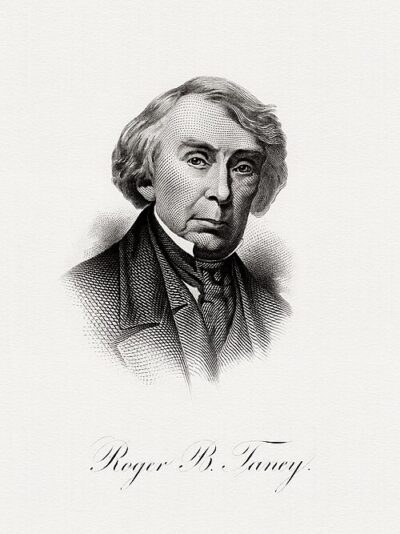
Roger B. Taney
Roger B. Taney was a chief justice of the United States from 1836 to 1864. Born March 17, 1777, in Calvert County. Died October 12, 1864, in Washington, D.C.. Positions held include United States Secretary of the Treasury (1833–1834), United States Attorney General (1831–1833) and Chief Justice of the United States (1836–1864). Educated at Dickinson College.
Facts
26 facts · 2 confirmed by two sources · 5 cited · 19 from one source
Where this comes from
Papalocal keeps its own record. It started from these sources; what each one said is kept here as it was copied, so a change on their side never changes this page by itself. Tap one to read its version.
What Wikidata says · copied November 15, 2026 · revision 2562714064
- Described as
- chief justice of the United States from 1836 to 1864 (1777–1864)
- Other names
- Roger Taney, Roger Brooke Taney
- Born
- March 17, 1777 · 6 references
- Died
- October 12, 1864 · 6 references
- Born in
- Calvert County
- Died in
- Washington, D.C.
- Buried in
- St. John's Cemetery · 1 reference
- Citizen of
- United States
- Occupation
- judge; lawyer; politician · 1 reference; jurist · 1 reference
- Positions held
- United States Secretary of the Treasury (1833–1834); United States Attorney General (1831–1833); Chief Justice of the United States (1836–1864); member of the Maryland House of Delegates; member of the State Senate of Maryland; board member (1846–1864)
- Political party
- Democratic Party; Federalist Party
- Worked for
- United States Department of the Treasury
- Education
- Dickinson College
- Member of
- American Philosophical Society (1844–)
- Spouse
- Anne Arnold Phebe Charlton Key Taney
- Children
- Anne Arnold Taney Campbell
- Father
- Michael Taney V · 1 reference
- Mother
- Monica Brooke · 1 reference
- Religion
- Catholic Church
- Wikipedias with a page
- 31
Wikidata item Q359470 (wikidata.org/wiki/Q359470), public domain (CC0). Copied November 15, 2026.
What Wikipedia says · copied November 15, 2026 · revision 1385218486
Roger Brooke Taney ( TAW-nee; March 17, 1777 – October 12, 1864) was an American lawyer and politician who served as the fifth chief justice of the United States from 1836 until his death in 1864. Prior to joining the U.S. Supreme Court, Taney served as the U.S. attorney general and U.S. secretary of the treasury under President Andrew Jackson. Taney's legacy is chiefly defined by the majority opinion he wrote in Dred Scott v. Sandford (1857), which ruled that African Americans could not be considered U.S. citizens and that Congress could not prohibit slavery in the U.S. territories.
Taney was born into a wealthy, slave-owning family in Calvert County, Maryland. He won election to the Maryland House of Delegates as a member of the Federalist Party but later broke with the party over the War of 1812. After switching to the Democratic-Republican Party, Taney was elected to the Maryland Senate in 1816. He emerged as one of the most prominent attorneys in the state and was appointed as the Attorney General of Maryland in 1827. Taney supported Andrew Jackson's presidential campaigns in 1824 and 1828, and he became a member of Jackson's Democratic Party. After a cabinet shake-up in 1831, President Jackson appointed Taney as his attorney general. Taney became one of the most important members of Jackson's cabinet and played a major role in the Bank War. Beginning in 1833, Taney served as secretary of the treasury under a recess appointment, but his nomination to that position was rejected by the United States Senate.
In 1835, after Democrats took control of the Senate, Jackson appointed Taney to succeed the late John Marshall on the Supreme Court as Chief Justice, becoming the first Catholic to serve on the Supreme Court. Taney presided over a jurisprudential shift toward states' rights, but the Taney Court did not reject federal authority to the degree that many of Taney's critics had feared. By the early 1850s, he was widely respected, and some elected officials looked to the Supreme Court to settle the national debate over slavery. Despite emancipating his own slaves and giving pensions to those who were too old to work, Taney was outraged by Northern attacks on the institution, and sought to use his Dred Scott decision to permanently end the slavery debate. His broad ruling deeply angered many Northerners and strengthened the anti-slavery Republican Party; its nominee Abraham Lincoln won the 1860 presidential election.
After Lincoln's election, Taney sympathized with the seceding Southern states and blamed Lincoln for the war, but he did not resign from the Supreme Court. He strongly disagreed with President Lincoln's broader interpretation of executive power in the American Civil War. In Ex parte Merryman, Taney held that the president could not suspend the writ of habeas corpus. Lincoln retaliated to the ruling by invoking nonacquiescence. Taney later tried to hold George Cadwalader, one of Lincoln's generals, in contempt of court for ignoring Taney's writ of habeas corpus, and the Lincoln administration again invoked nonacquiescence in response. Taney finally relented, saying, "I have exercised all the power which the Constitution and laws confer on me, but that power has been resisted by a force too strong for me to overcome."
Taney died in 1864, and Lincoln appointed Salmon P. Chase as his successor. At the time of Taney's death in 1864, he was widely reviled in the North, and Lincoln declined to make a public statement in response to his death. Taney continues to have a controversial historical reputation, and his Dred Scott ruling is widely considered to be the worst Supreme Court decision ever made.
- Born, in its opening lines
- March 17, 1777
- Died, in its opening lines
- October 12, 1864
From the Wikipedia article “Roger B. Taney” (en.wikipedia.org/wiki/Roger_B._Taney), by its contributors, under CC BY-SA 4.0 (creativecommons.org/licenses/by-sa/4.0/). Copied November 15, 2026; not changed.
Confirmed Two sources agree. Cited One source, and it names where it got it. One source One source, without a reference of its own. Sources disagree The sources disagree. We show the best-supported value and keep theirs below.
