
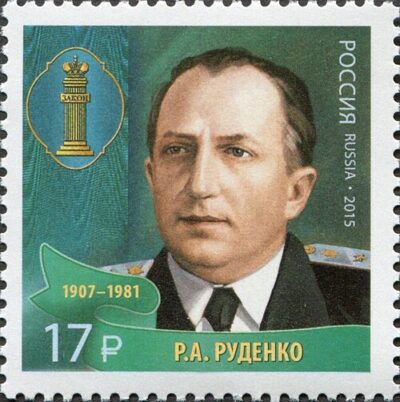
Roman Rudenko
Roman Rudenko was a Soviet lawyer. Born July 25, 1907, in Nosivka. Died January 23, 1981, in Moscow. Positions held include Procurator General of the Soviet Union (1953–1981) and deputy of the Supreme Soviet of the Soviet Union. Awards include Order of the October Revolution, Order of the Red Banner of Labour and Medal "For the Victory over Germany in the Great Patriotic War 1941–1945".
Facts
32 facts · 1 confirmed by two sources · 4 cited · 26 from one source · 1 where the sources disagree
What’s different
- Born: we show July 25, 1907 (Sources disagree). Wikipedia says August 7, 1907
Where this comes from
Papalocal keeps its own record. It started from these sources; what each one said is kept here as it was copied, so a change on their side never changes this page by itself. Tap one to read its version.
What Wikidata says · copied November 18, 2026 · revision 2535813078
- Described as
- Soviet lawyer (1907-1981)
- Other names
- Roman Andreyevich Rudenko, Roman Andrejovych Rudenko
- Born
- July 25, 1907 · 1 reference
- Died
- January 23, 1981 · 5 references
- Born in
- Nosivka
- Died in
- Moscow · 1 reference
- Buried in
- Novodevichy Cemetery
- Citizen of
- Russian Empire; Soviet Union
- Occupation
- jurist · 2 references; politician; military personnel · 1 reference; public prosecutor general · 1 reference
- Positions held
- Procurator General of the Soviet Union (1953–1981); deputy of the Supreme Soviet of the Soviet Union
- Political party
- Communist Party of the Soviet Union (1926–1981)
- Member of
- Central Committee of the Communist Party of the Soviet Union
- Awards
- Order of the October Revolution (1971); Order of the Red Banner of Labour (1948); Medal "For the Victory over Germany in the Great Patriotic War 1941–1945"; Medal "For the Defence of Moscow"; Medal "For Valiant Labour in the Great Patriotic War 1941–1945"; Jubilee Medal "In Commemoration of the 100th Anniversary of the Birth of Vladimir Ilyich Lenin" · 1 reference; Jubilee Medal "Twenty Years of Victory in the Great Patriotic War 1941–1945" · 1 reference; Jubilee Medal "Thirty Years of Victory in the Great Patriotic War 1941–1945" · 1 reference; Medal "Veteran of Labour" · 1 reference; Jubilee Medal "50 Years of the Armed Forces of the USSR" · 1 reference; Jubilee Medal "60 Years of the Armed Forces of the USSR" · 1 reference; Medal "In Commemoration of the 800th Anniversary of Moscow" · 1 reference; Order of Lenin (5 times) (1945, 1957, 1967, 1972, 1977); Hero of Socialist Labour (1972); "Hammer and Sickle" gold medal (1972)
- Military rank
- Lieutenant general of justice; general · 1 reference
- Wikipedias with a page
- 20
Wikidata item Q706118 (wikidata.org/wiki/Q706118), public domain (CC0). Copied November 18, 2026.
What Wikipedia says · copied November 18, 2026 · revision 1375165732
Roman Andreyevich Rudenko (Russian: Роман Андреевич Руденко, Ukrainian: Роман Андрійович Руденко, romanized: Roman Andriyovych Rudenko; 7 August [O.S. 25 July] 1907 – 23 January 1981) was a Soviet lawyer and statesman.
Procurator-General of the Ukrainian Soviet Socialist Republic from 1944 to 1953, Rudenko became Procurator-General of the entire Soviet Union after 1953. He is well known internationally for acting as chief prosecutor for the USSR at the 1946 trial of the major Nazi war criminals in Nuremberg. He was also chief prosecutor at the "Trial of the Sixteen" (Polish Underground leaders) held in Moscow the year before. At the time he served at Nuremberg, Rudenko held the rank of Lieutenant-General within the USSR Procuracy.
In 1961, Rudenko was elected to the CPSU Central Committee. In 1972, he was awarded the Soviet honorary title of Hero of Socialist Labour.
- Born, in its opening lines
- August 7, 1907
- Died, in its opening lines
- January 23, 1981
From the Wikipedia article “Roman Rudenko” (en.wikipedia.org/wiki/Roman_Rudenko), by its contributors, under CC BY-SA 4.0 (creativecommons.org/licenses/by-sa/4.0/). Copied November 18, 2026; not changed.
Confirmed Two sources agree. Cited One source, and it names where it got it. One source One source, without a reference of its own. Sources disagree The sources disagree. We show the best-supported value and keep theirs below.
