
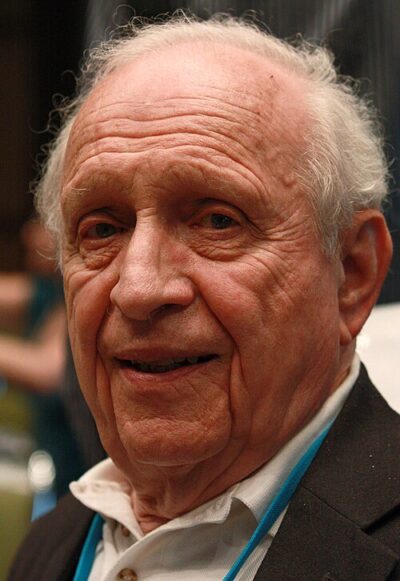
Roy J. Glauber
Roy J. Glauber was an American theoretical physicist. Born September 1, 1925, in New York City. Died December 26, 2018, in Newton. Educated at Harvard University and Bronx High School of Science. Awards include Guggenheim Fellowship, Nobel Prize in Physics and Albert A. Michelson Medal.
Facts
30 facts · 2 confirmed by two sources · 12 cited · 16 from one source
Where this comes from
Papalocal keeps its own record. It started from these sources; what each one said is kept here as it was copied, so a change on their side never changes this page by itself. Tap one to read its version.
What Wikidata says · copied November 13, 2026 · revision 2567151400
- Described as
- American theoretical physicist (1925–2018)
- Other names
- Roy Jay Glauber, R.J. Glauber
- Born
- September 1, 1925 · 9 references
- Died
- December 26, 2018 · 4 references
- Born in
- New York City · 3 references
- Died in
- Newton
- Citizen of
- United States
- Occupation
- physicist · 1 reference; university teacher · 1 reference
- Worked for
- Harvard University; University of Arizona; Leiden University (1974) · 1 reference
- Education
- Harvard University; Bronx High School of Science
- Member of
- Royal Society of London (1997); National Academy of Sciences; American Academy of Arts and Sciences; Academia Europaea (2012–) · 1 reference
- Awards
- Guggenheim Fellowship · 1 reference; Nobel Prize in Physics (2005) · 2 references; Albert A. Michelson Medal (1985); Max Born Award (1985) · 1 reference; Humboldt Research Fellowship; Fellow of the American Physical Society; Dannie Heineman Prize for Mathematical Physics (1996) · 1 reference; Humboldt Prize; honorary doctor of the University of Valencia (2008) · 1 reference; Foreign Member of the Royal Society (1997) · 1 reference; Gold medal of the Spanish National Research Council (2008); Honorary Fellow of the Royal Society Te Apārangi (1997–) · 1 reference
- Field
- physics; theoretical physics · 1 reference
- Wikipedias with a page
- 73
Wikidata item Q64188 (wikidata.org/wiki/Q64188), public domain (CC0). Copied November 13, 2026.
What Wikipedia says · copied November 13, 2026 · revision 1371992776
Roy Jay Glauber (September 1, 1925 – December 26, 2018) was an American theoretical physicist. He was the Mallinckrodt Professor of Physics at Harvard University and Adjunct Professor of Optical Sciences at the University of Arizona. Born in New York City, he was awarded one half of the 2005 Nobel Prize in Physics "for his contribution to the quantum theory of optical coherence", with the other half shared by John L. Hall and Theodor W. Hänsch. In this work, published in 1963, he created a model for photodetection and explained the fundamental characteristics of different types of light, such as laser light (see coherent state) and light from light bulbs (see blackbody). His theories are widely used in the field of quantum optics. In statistical physics he pioneered the study of the dynamics of first-order phase transitions, since he first defined and investigated the stochastic dynamics of an Ising model in a paper published in 1963.
He served on the National Advisory Board of the Center for Arms Control and Non-Proliferation, the research arm of Council for a Livable World.
- Born, in its opening lines
- September 1, 1925
- Died, in its opening lines
- December 26, 2018
From the Wikipedia article “Roy J. Glauber” (en.wikipedia.org/wiki/Roy_J._Glauber), by its contributors, under CC BY-SA 4.0 (creativecommons.org/licenses/by-sa/4.0/). Copied November 13, 2026; not changed.
Confirmed Two sources agree. Cited One source, and it names where it got it. One source One source, without a reference of its own. Sources disagree The sources disagree. We show the best-supported value and keep theirs below.
