
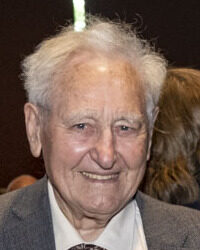
Roy Kerr
Roy Kerr is a New Zealand mathematician and bridge player. Born May 16, 1934, in Kurow. Positions held include full professor (1971–1992) and professor emeritus (1992–). Known for rotating black hole, Kerr–Newman black hole and Kerr–Newman metric. Educated at University of Canterbury and Trinity College. Awards include Hughes Medal, Hector Medal and Rutherford Medal.
Facts
41 facts · 1 confirmed by two sources · 22 cited · 18 from one source
Where this comes from
Papalocal keeps its own record. It started from these sources; what each one said is kept here as it was copied, so a change on their side never changes this page by itself. Tap one to read its version.
What Wikidata says · copied November 18, 2026 · revision 2517240059
- Described as
- New Zealand mathematician and bridge player
- Other names
- Roy Patrick Kerr, Roy P. Kerr, R. P. Kerr, R. Kerr
- Born
- May 16, 1934 · 1 reference
- Born in
- Kurow
- Name at birth
- Roy Patrick Kerr · 1 reference
- Citizen of
- New Zealand
- Occupation
- mathematician · 1 reference; physicist; bridge player; university teacher
- Positions held
- full professor (1971–1992) · 1 reference; professor emeritus (1992–) · 1 reference
- Worked for
- University of Canterbury (1971–1993) · 2 references; Syracuse University (1960–1962) · 1 reference; University of Texas at Austin (1962–1971) · 1 reference
- Education
- University of Canterbury (1951–1954) · 1 reference; Trinity College (1955–1958) · 1 reference; University of Cambridge (–1958) · 2 references; St Andrew's College (–1950) · 1 reference
- Member of
- Royal Society of London (2019) · 1 reference
- Sport
- contract bridge
- Known for
- rotating black hole; Kerr–Newman black hole; Kerr–Newman metric; Kerr metric; Kerr-Schild metric; Kerr-Schild perturbations
- Awards
- Hughes Medal (1984) · 1 reference; Hector Medal (1982) · 1 reference; Rutherford Medal (1993) · 1 reference; Marcel Grossmann Award (2006) · 1 reference; Albert Einstein Medal (2013) · 1 reference; Fellow of the Royal Society Te Apārangi (1975) · 1 reference; Crafoord Prize in Astronomy (2016) · 1 reference; Fellow of the Royal Society (2019) · 2 references; Companion of the New Zealand Order of Merit (2011) · 1 reference; Crafoord Prize (2016) · 1 reference; Oskar Klein Medal (2020) · 1 reference; honorary doctor of the University of Canterbury (2015) · 1 reference
- Field
- mathematics · 1 reference; physics · 1 reference; theory of relativity · 1 reference; contract bridge · 1 reference
- Wikipedias with a page
- 22
Wikidata item Q959840 (wikidata.org/wiki/Q959840), public domain (CC0). Copied November 18, 2026.
What Wikipedia says · copied November 18, 2026 · revision 1372174090
Roy Patrick Kerr (; born 16 May 1934) is a New Zealand mathematician who discovered the Kerr geometry, an exact solution to the Einstein field equation of general relativity. His solution models the gravitational field outside an uncharged rotating massive object, including a rotating black hole. His solution to Einstein's equations predicted spinning black holes before they were discovered.
- Born, in its opening lines
- May 16, 1934
From the Wikipedia article “Roy Kerr” (en.wikipedia.org/wiki/Roy_Kerr), by its contributors, under CC BY-SA 4.0 (creativecommons.org/licenses/by-sa/4.0/). Copied November 18, 2026; not changed.
Confirmed Two sources agree. Cited One source, and it names where it got it. One source One source, without a reference of its own. Sources disagree The sources disagree. We show the best-supported value and keep theirs below.
