
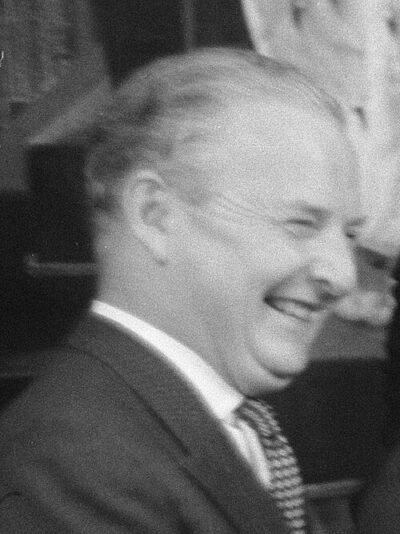
Selwyn Lloyd
Selwyn Lloyd was a politician. Born July 28, 1904, in Liverpool. Died May 17, 1978, in Oxfordshire. Positions held include Speaker of the House of Commons (1971–1976), Shadow Leader of the House of Commons (1964–1965) and Lord Privy Seal (1963–1964). Educated at Fettes College and Magdalene College. Awards include Commander of the Order of the British Empire, Legionnaire of Legion of Merit and Order of the Companions of Honour.
Facts
36 facts · 2 confirmed by two sources · 14 cited · 20 from one source
Where this comes from
Papalocal keeps its own record. It started from these sources; what each one said is kept here as it was copied, so a change on their side never changes this page by itself. Tap one to read its version.
What Wikidata says · copied November 18, 2026 · revision 2562958132
- Described as
- politician (1904-1978)
- Other names
- John Selwyn Brooke Lloyd, Baron Selwyn-Lloyd, John Selwyn Brooke Lloyd
- Born
- July 28, 1904 · 5 references
- Died
- May 17, 1978 · 2 references
- Born in
- Liverpool
- Died in
- Oxfordshire
- Citizen of
- United Kingdom
- Occupation
- politician · 1 reference
- Positions held
- Speaker of the House of Commons (1971–1976); Shadow Leader of the House of Commons (1964–1965); Lord Privy Seal (1963–1964); Chancellor of the Exchequer (1960–1962); Secretary of State for Foreign and Commonwealth Affairs (1955–1960); Secretary of State for Defence (1955); Minister of Supply (1954–1955); member of the 47th Parliament of the United Kingdom (1974–1976); member of the 46th Parliament of the United Kingdom (1974) · 1 reference; member of the 45th Parliament of the United Kingdom (1970–1974) · 1 reference; member of the 44th Parliament of the United Kingdom (1966–1970) · 1 reference; member of the 43rd Parliament of the United Kingdom (1964–1966) · 1 reference; member of the 42nd Parliament of the United Kingdom (1959–1964) · 1 reference; member of the 41st Parliament of the United Kingdom (1955–1959) · 1 reference; member of the 40th Parliament of the United Kingdom (1951–1955) · 1 reference
- Political party
- Conservative Party (1945–1971)
- Education
- Fettes College; Magdalene College
- Awards
- Commander of the Order of the British Empire; Legionnaire of Legion of Merit; Order of the Companions of Honour
- Field
- politics · 1 reference; foreign policy · 1 reference; parliament · 1 reference; lower house · 1 reference
- Spouse
- Elizabeth Marshall · 2 references
- Children
- Anna Lloyd · 1 reference
- Religion
- Methodism
- Military branch
- British Army
- Military rank
- colonel · 1 reference
- Wikipedias with a page
- 20
Wikidata item Q333080 (wikidata.org/wiki/Q333080), public domain (CC0). Copied November 18, 2026.
What Wikipedia says · copied November 18, 2026 · revision 1384722635
John Selwyn Brooke Selwyn-Lloyd, Baron Selwyn-Lloyd (28 July 1904 – 17 May 1978) was a British politician who served as Speaker of the House of Commons from 1971 to 1976, having previously held various ministerial positions under Prime Ministers Winston Churchill, Anthony Eden, Harold Macmillan and Alec Douglas-Home between 1954 and 1964. A member of the Conservative Party, Lloyd served as Foreign Secretary from 1955 to 1960 and as Chancellor of the Exchequer from 1960 to 1962. He was the Member of Parliament (MP) for Wirral from 1945 to 1976.
Born and raised in Cheshire, Lloyd was an active Liberal as a young man in the 1920s. In the following decade, he practised as a barrister and served on Hoylake Urban District Council, by which time he had become a Conservative Party sympathiser. During the Second World War he rose to be deputy chief of staff of Second Army, playing an important role in planning sea transport to the Normandy beachhead and reaching the acting rank of brigadier.
Elected to Parliament in 1945 as a Conservative, he held ministerial office from 1951, eventually rising to be Foreign Secretary under Prime Minister Anthony Eden from April 1955. His tenure coincided with the Suez Crisis, for which he at first attempted to negotiate a peaceful settlement, before reluctantly assisting with Eden's wish to negotiate collusion with France and Israel as a prelude to military action. He continued as foreign secretary under the premiership of Harold Macmillan until July 1960, when he was moved to the job of Chancellor of the Exchequer. In this job he set up the NEDC, but became an increasingly unpopular figure because of the contractionary measures which he felt compelled to take, including the "Pay Pause" of July 1961, culminating in the sensational Liberal victory at the Orpington by-election in March 1962. In July 1962 Macmillan dismissed him from the Cabinet, making him the highest-profile casualty in the reshuffle known as the "Night of the Long Knives".
He returned to office under Prime Minister Alec Douglas-Home as Leader of the House of Commons (1963–64), and was elected Speaker of the House of Commons from 1971 until his retirement in 1976.
- Born, in its opening lines
- July 28, 1904
- Died, in its opening lines
- May 17, 1978
From the Wikipedia article “Selwyn Lloyd” (en.wikipedia.org/wiki/Selwyn_Lloyd), by its contributors, under CC BY-SA 4.0 (creativecommons.org/licenses/by-sa/4.0/). Copied November 18, 2026; not changed.
Confirmed Two sources agree. Cited One source, and it names where it got it. One source One source, without a reference of its own. Sources disagree The sources disagree. We show the best-supported value and keep theirs below.
