
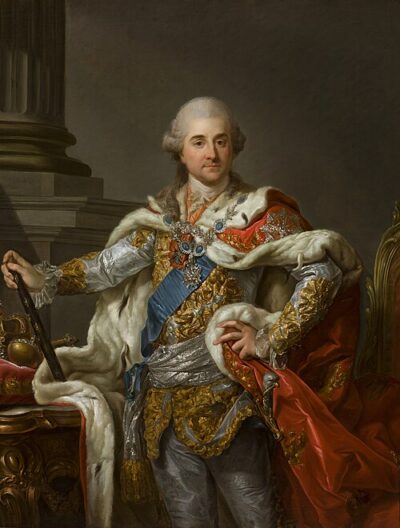
Stanisław August Poniatowski
Stanisław August Poniatowski was a King of Poland and Grand Duke of Lithuania. Born January 17, 1732, in Vowchyn. Died February 12, 1798, in Saint Petersburg. Positions held include King of Poland (1764–1795), Deputy to the Sejm of the Polish–Lithuanian Commonwealth and starosta of Przemyśl. Awards include Knight of the Order of St. Alexander Nevsky, Order of the White Eagle (Polish–Lithuanian Commonwealth) and Order of the Black Eagle.
Facts
48 facts · 2 confirmed by two sources · 6 cited · 40 from one source
Where this comes from
Papalocal keeps its own record. It started from these sources; what each one said is kept here as it was copied, so a change on their side never changes this page by itself. Tap one to read its version.
What Wikidata says · copied November 16, 2026 · revision 2569154399
- Described as
- King of Poland and Grand Duke of Lithuania (1764-1795)
- Other names
- Stanisław II August Poniatowski, Stanislaus Augustus of Poland, Stanislovas Augustas Poniatovskis
- Born
- January 17, 1732 · 9 references
- Died
- February 12, 1798 · 8 references
- Born in
- Vowchyn · 1 reference
- Died in
- Saint Petersburg · 1 reference
- Buried in
- Catholic Church of St. Catherine (1798–1938); Church of the Holy Trinity in Voŭčyn (1938–1988); St. John's Archcathedral (1995–)
- Cause of death
- stroke
- Name at birth
- Stanisław Antoni Poniatowski
- Citizen of
- Polish–Lithuanian Commonwealth; Russian Empire
- Occupation
- diplomat; military personnel · 1 reference
- Positions held
- King of Poland (1764–1795); Deputy to the Sejm of the Polish–Lithuanian Commonwealth; starosta of Przemyśl
- Member of
- Royal Prussian Academy of Sciences; Saint Petersburg Academy of Sciences; Russian Academy of Sciences; Targowica Confederation; Royal Society of London (1766–) · 1 reference; Freemasonry
- Awards
- Knight of the Order of St. Alexander Nevsky (1797); Order of the White Eagle (Polish–Lithuanian Commonwealth) (1756); Order of the Black Eagle (1764); Order of St. Andrew (1764); Order of Saint Stanislaus; Grand Cross of the Order of Military Virtue; Royal Fellow of the Royal Society (1766) · 1 reference
- Children
- Michal Grabowski · 1 reference; Izabela Grabowska · 1 reference; Stanisław Grabowski · 2 references; Anna Petrovna; Michał Cichocki; Kazimierz Grabowski; Konstancja Żwanowa; Princess Maria Czartoryska · 1 reference
- Father
- Stanisław Poniatowski
- Mother
- Konstancja Czartoryska
- Siblings
- Kazimierz Poniatowski; Franciszek Poniatowski · 1 reference; Andrzej Poniatowski · 1 reference; Michał Jerzy Poniatowski · 1 reference; Izabella Poniatowska · 1 reference; Ludwika Maria Poniatowska · 1 reference; Aleksander Poniatowski · 1 reference
- Religion
- Catholicism
- Lived in
- Saint Petersburg · 1 reference
- Wikipedias with a page
- 63
Wikidata item Q54019 (wikidata.org/wiki/Q54019), public domain (CC0). Copied November 16, 2026.
What Wikipedia says · copied November 16, 2026 · revision 1379316674
Stanisław II August (born Stanisław Antoni Poniatowski; 17 January 1732 – 12 February 1798), known also by his regnal Latin name Stanislaus II Augustus, and as Stanisław August Poniatowski (Lithuanian: Stanislovas Augustas Poniatovskis), was King of Poland and Grand Duke of Lithuania from 1764 to 1795, and the last monarch of the Polish–Lithuanian Commonwealth.
Born into wealthy Polish aristocracy, Poniatowski arrived as a diplomat at the Russian imperial court in Saint Petersburg in 1755 at the age of 22 and became intimately involved with the future empress Catherine the Great. With her aid, he was elected King of Poland and Grand Duke of Lithuania by the Sejm in September 1764 following the death of Augustus III. Contrary to expectations, Poniatowski attempted to reform and strengthen the large but ailing Commonwealth. His efforts were met with external opposition from neighbouring Prussia, Russia and Austria, all committed to keeping the Commonwealth weak. From within, he was opposed by conservative interests, which saw the reforms as a threat to their traditional liberties and privileges granted centuries earlier.
The defining crisis of his early reign was the War of the Bar Confederation (1768–1772) that led to the First Partition of Poland (1772). The latter part of his reign saw reforms wrought by the Diet (1788–1792) and the Constitution of 3 May 1791. These reforms were overthrown by the 1792 Targowica Confederation and by the Polish–Russian War of 1792, leading directly to the Second Partition of Poland (1793), the Kościuszko Uprising (1794) and the final and Third Partition of Poland (1795), marking the end of the Commonwealth. Stripped of all meaningful power, Poniatowski abdicated in November 1795 and spent the last years of his life as a captive in Saint Petersburg's Marble Palace.
A controversial figure in Poland's history, he is viewed with ambivalence as a brave and skillful statesman by some and as an overly hesitant coward by others, and even as a traitor. He is criticized primarily for his failure to resolutely stand against opposing forces and prevent the partitions, which led to the destruction of the Polish state. On the other hand, he is remembered as a great patron of arts and sciences who laid the foundation for the Commission of National Education, the first institution of its kind in the world, the Great Sejm of 1788–1792, which led to the Constitution of 3 May 1791 and as a sponsor of many architectural landmarks. Historians tend to agree that, taking the circumstances into account, he was a skillful statesman, pointing out that passing the Constitution was a sign of bravery, although his unwillingness to organize a proper nationwide uprising afterward is seen as cowardice and the key reason for the Second Partition and the subsequent downfall of Poland.
- Born, in its opening lines
- January 17, 1732
- Died, in its opening lines
- February 12, 1798
From the Wikipedia article “Stanisław August Poniatowski” (en.wikipedia.org/wiki/Stanisław_August_Poniatowski), by its contributors, under CC BY-SA 4.0 (creativecommons.org/licenses/by-sa/4.0/). Copied November 16, 2026; not changed.
Confirmed Two sources agree. Cited One source, and it names where it got it. One source One source, without a reference of its own. Sources disagree The sources disagree. We show the best-supported value and keep theirs below.
