
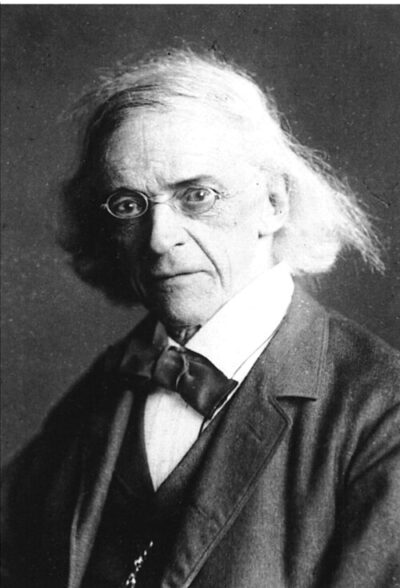
Theodor Mommsen
Theodor Mommsen was a German classical scholar and historian. Born November 30, 1817, in Garding. Died November 1, 1903, in Charlottenburg. Positions held include member of the Reichstag of the German Empire (1881–1884), Member of the Prussian House of Representatives (1863–1879) and professor (1847–1885). Known for The History of Rome and Corpus Inscriptionum Latinarum. Educated at Kiel University and Christianeum. Awards include Nobel Prize in Literature, Pour le Mérite for Sciences and Arts order and Bavarian Maximilian Order for Science and Art.
Facts
64 facts · 2 confirmed by two sources · 22 cited · 40 from one source
Where this comes from
Papalocal keeps its own record. It started from these sources; what each one said is kept here as it was copied, so a change on their side never changes this page by itself. Tap one to read its version.
What Wikidata says · copied November 16, 2026 · revision 2570081384
- Described as
- German classical scholar and historian (1817–1903)
- Other names
- Christian Mommsen, Theodore Mommsen, T. Mommsen, Christian Matthias Theodor Mommsen, Mommsen
- Born
- November 30, 1817 · 12 references
- Died
- November 1, 1903 · 10 references
- Born in
- Garding · 4 references
- Died in
- Charlottenburg · 4 references
- Buried in
- Dreifaltigkeitskirchhof II
- Name at birth
- Christian Matthias Theodor Mommsen · 1 reference
- Citizen of
- Duchy of Schleswig (–1866); Kingdom of Prussia (1866–); German Reich; German Empire · 1 reference
- Occupation
- historian of classical antiquity · 1 reference; numismatist; jurist · 2 references; journalist; legal historian; writer · 1 reference; university teacher; politician · 1 reference
- Positions held
- member of the Reichstag of the German Empire (1881–1884) · 1 reference; Member of the Prussian House of Representatives (1863–1879) · 1 reference; professor (1847–1885)
- Political party
- National Liberal Party · 1 reference; Liberal Union · 1 reference; German Progress Party (1861–) · 1 reference
- Worked for
- Leipzig University (1847–1851) · 1 reference; Royal Prussian Academy of Sciences (1858–) · 1 reference; Frederick William University Berlin (1861–1885) · 1 reference; University of Wrocław (1854–1858) · 1 reference; University of Zurich (1852–1854) · 1 reference
- Education
- Kiel University (1838–1843) · 1 reference; Christianeum (1835–)
- Member of
- Royal Prussian Academy of Sciences (1858–) · 1 reference; Saxon Academy of Sciences and Humanities (1849–); Serbian Academy of Sciences and Arts; Serbian Learned Society; German Archaeological Institute; Bavarian Academy of Sciences and Humanities; Göttingen Academy of Sciences and Humanities in Lower Saxony; Saint Petersburg Academy of Sciences; Hungarian Academy of Sciences; Austrian Archaeological Institute (1898–)
- Known for
- The History of Rome (1854–); Corpus Inscriptionum Latinarum (1853–)
- Awards
- Nobel Prize in Literature (1902) · 2 references; Pour le Mérite for Sciences and Arts order (1868) · 1 reference; Bavarian Maximilian Order for Science and Art (1871) · 1 reference; honorary citizen of Rome · 1 reference
- Field
- study of history; history · 1 reference; jurisprudence · 1 reference; classical philology · 1 reference; classical antiquity · 1 reference
- Spouse
- Maria Auguste Mommsen (1854–) · 1 reference
- Children
- Marie Mommsen · 1 reference; Wolfgang Mommsen · 1 reference; Karl Mommsen · 1 reference; Ernst Mommsen · 1 reference; Konrad Mommsen · 1 reference; Hans Georg Mommsen · 1 reference; Lisbet Mommsen · 1 reference; Adelheid Mommsen · 2 references
- Father
- Jens Mommsen · 1 reference
- Siblings
- Tycho Mommsen · 1 reference; August Mommsen · 1 reference
- Wikipedias with a page
- 126
Wikidata item Q25351 (wikidata.org/wiki/Q25351), public domain (CC0). Copied November 16, 2026.
What Wikipedia says · copied November 16, 2026 · revision 1384241114
Christian Matthias Theodor Mommsen (; German: [ˈteːodoːɐ̯ ˈmɔmzn̩] ; 30 November 1817 – 1 November 1903) was a German classical scholar, historian, jurist, journalist, politician and archaeologist. He is widely regarded as one of the greatest classicists of the 19th century. He received the 1902 Nobel Prize in Literature for his historical writings, including The History of Rome, after having been nominated by 18 members of the Prussian Academy of Sciences. He was also a prominent German politician, as a member of the Prussian and German parliaments. His works on Roman law and on the law of obligations had a significant impact on the German civil code.
- Born, in its opening lines
- November 30, 1817
- Died, in its opening lines
- November 1, 1903
From the Wikipedia article “Theodor Mommsen” (en.wikipedia.org/wiki/Theodor_Mommsen), by its contributors, under CC BY-SA 4.0 (creativecommons.org/licenses/by-sa/4.0/). Copied November 16, 2026; not changed.
Confirmed Two sources agree. Cited One source, and it names where it got it. One source One source, without a reference of its own. Sources disagree The sources disagree. We show the best-supported value and keep theirs below.
