
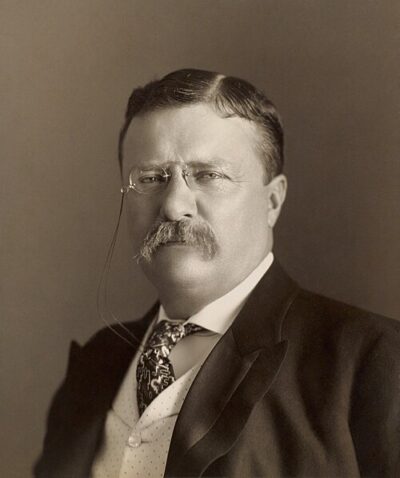
Theodore Roosevelt
Theodore Roosevelt was the 26th President of the United States from 1901 to 1909. Born October 27, 1858, in Manhattan. Died January 6, 1919, in Sagamore Hill. Positions held include President of the United States (1901–1909), Vice President of the United States (1901) and Governor of New York (1899–1900). Known for African game trails : an account of the African wanderings of an American hunter-naturalist, Hunting trips of a ranchman, sketches of sport on the northern cattle plains; and The wilderness hunter; an account of the big game of the United States and its chase with horse, hound, and rifle;. Educated at Harvard College and Columbia University. Awards include Nobel Peace Prize, Medal of Honor and David Livingstone Centenary Medal.

Facts
68 facts · 2 confirmed by two sources · 35 cited · 30 from one source · 1 where the sources disagree
What’s different
- Height: we show 1.78 m (5 ft 10 in) (Sources disagree). Wikidata also lists 1.79 m (5 ft 10 in)
Where this comes from
Papalocal keeps its own record. It started from these sources; what each one said is kept here as it was copied, so a change on their side never changes this page by itself. Tap one to read its version.
What Wikidata says · copied November 13, 2026 · revision 2568178386
- Described as
- 26th President of the United States from 1901 to 1909 (1858–1919)
- Other names
- Theodore Roosevelt, Jr., T. Roosevelt, Jr., T. Roosevelt, Teddy Roosevelt, Theodore Roosevelt Jr.
- Born
- October 27, 1858 · 16 references
- Died
- January 6, 1919 · 15 references
- Born in
- Manhattan · 1 reference
- Died in
- Sagamore Hill · 1 reference
- Buried in
- Youngs Memorial Cemetery · 2 references
- Cause of death
- pulmonary embolism
- Name at birth
- Theodore Roosevelt Jr.
- Citizen of
- United States
- Occupation
- explorer; historian; essayist; writer · 1 reference; politician · 2 references; autobiographer; rancher · 1 reference; naturalist · 2 references
- Positions held
- President of the United States (1901–1909) · 2 references; Vice President of the United States (1901) · 1 reference; Governor of New York (1899–1900) · 1 reference; Assistant Secretary of the Navy (1897–1898) · 1 reference; Governor-General of the Philippines; member of the New York State Assembly (1883–1884) · 1 reference; president · 1 reference
- Political party
- Republican Party (2 times) (1880–1919); Progressive Party (1912–1916) · 1 reference
- Education
- Harvard College · 1 reference; Columbia University; Columbia Law School; Friends Seminary · 1 reference
- Member of
- American Academy of Arts and Letters (1898–) · 1 reference; American Historical Association (1912–) · 1 reference; American Philosophical Society (1906–) · 1 reference; Phi Beta Kappa Society (1880–) · 1 reference; Veterans of Foreign Wars · 1 reference; Camp Fire Club · 1 reference
- Known for
- African game trails : an account of the African wanderings of an American hunter-naturalist; Hunting trips of a ranchman, sketches of sport on the northern cattle plains;; The wilderness hunter; an account of the big game of the United States and its chase with horse, hound, and rifle;
- Awards
- Nobel Peace Prize (1906) · 2 references; Medal of Honor (2001) · 1 reference; David Livingstone Centenary Medal (1917); Honorary Doctorate from the National Autonomous University of Mexico (1910); Honorary doctor of the Humboldt University of Berlin; Honorary doctorate from the University of Cairo
- Field
- politics of the United States
- Spouse
- Alice Hathaway Lee Roosevelt (1880–1884) · 4 references; Edith Roosevelt (1886–1919) · 3 references
- Children
- Alice Lee Roosevelt · 2 references; Theodore Roosevelt Jr. · 2 references; Kermit Roosevelt · 2 references; Ethel Roosevelt Derby · 2 references; Archibald Roosevelt · 2 references; Quentin Roosevelt · 2 references
- Father
- Theodore Roosevelt Sr. · 2 references
- Mother
- Martha Bulloch Roosevelt · 2 references
- Siblings
- Elliott Bulloch Roosevelt · 2 references; Bamie Roosevelt · 2 references; Corinne Roosevelt Robinson · 2 references
- Religion
- Continental Reformed Protestantism; Anglicanism
- Military branch
- United States Army (1882–1886)
- Military rank
- colonel
- Lived in
- New York City; Oyster Bay · 1 reference; Washington, D.C.; Sagamore Hill · 1 reference
- Nickname
- Teddy
- Height
- 1.79 m (5 ft 10 in); 1.78 m (5 ft 10 in) · 1 reference
- Wikipedias with a page
- 196
Wikidata item Q33866 (wikidata.org/wiki/Q33866), public domain (CC0). Copied November 13, 2026.
What Wikipedia says · copied November 13, 2026 · revision 1385444969
Theodore Roosevelt Jr. (October 27, 1858 – January 6, 1919) was the 26th president of the United States, serving from 1901 to 1909. A member of the Republican Party and the 25th vice president, he assumed the presidency after President William McKinley was assassinated. Roosevelt was the youngest person to be president, at 42 years old.
A sickly child with debilitating asthma, Roosevelt overcame health problems through a regime of vigorous exercise, which he called "the strenuous life". He was homeschooled and began a lifelong naturalist avocation before attending Harvard University. His book The Naval War of 1812 established his reputation as a historian and popular writer. Roosevelt became leader of the reform faction of Republicans in the New York State Legislature. After the simultaneous deaths of his first wife Alice Hathaway Lee Roosevelt and mother Martha Bulloch Roosevelt, he recuperated by buying and operating a cattle ranch in the Dakotas. Roosevelt served as the assistant secretary of the Navy under McKinley, and in 1898 helped plan the successful naval war against Spain. He resigned to help form and lead the Rough Riders, a unit that fought the Spanish Army in Cuba to great publicity. Returning a war hero, Roosevelt was elected New York's governor in 1898. Because the New York state party leadership disliked his ambitious state agenda, they convinced McKinley to choose him as his running mate in the 1900 presidential election. The McKinley–Roosevelt ticket won a landslide victory.
As a leader of the progressive movement, Roosevelt championed his "Square Deal" domestic policies after taking over as president, which called for fairness for all citizens, breaking corporate trusts, regulating railroads, and pure food and drugs. His pursuit of antitrust litigation in particular earned him the nickname "the Trust Buster". Roosevelt prioritized conservation and established national parks, forests, and monuments to preserve U.S. natural resources. In foreign policy, he focused on Central America, beginning construction of the Panama Canal. Roosevelt expanded the U.S. Navy and sent the Great White Fleet on a world tour to project naval power. His successful efforts to end the Russo-Japanese War won him the 1906 Nobel Peace Prize, the first non-European to win a Nobel Prize. He was elected to a full term in 1904 and convinced William Howard Taft, his Secretary of War, to succeed him in 1908.
Roosevelt grew frustrated with Taft's brand of conservatism yet failed to win the 1912 Republican presidential nomination. He founded the Bull Moose Party and ran in 1912; the split allowed the Democrat Woodrow Wilson to win. Roosevelt led a four-month expedition to the Amazon basin, where he nearly died of tropical disease. During World War I, he criticized Wilson for keeping the U.S. out; his offer to lead volunteers to France was rejected. Roosevelt's health deteriorated and he died in 1919. Polls of historians and political scientists rank him as one of the greatest presidents in American history.
- Born, in its opening lines
- October 27, 1858
- Died, in its opening lines
- January 6, 1919
From the Wikipedia article “Theodore Roosevelt” (en.wikipedia.org/wiki/Theodore_Roosevelt), by its contributors, under CC BY-SA 4.0 (creativecommons.org/licenses/by-sa/4.0/). Copied November 13, 2026; not changed.
Confirmed Two sources agree. Cited One source, and it names where it got it. One source One source, without a reference of its own. Sources disagree The sources disagree. We show the best-supported value and keep theirs below.
