
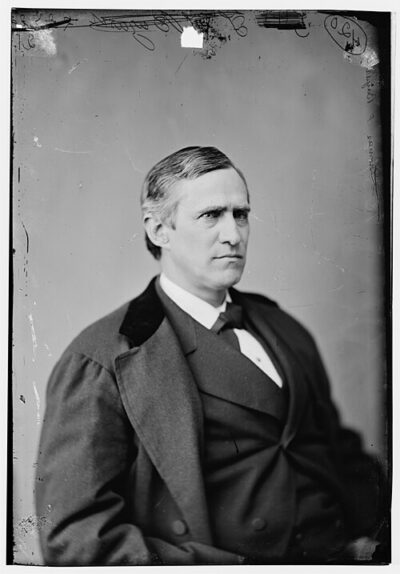
Thomas F. Bayard
Thomas F. Bayard was an American lawyer, politician and diplomat. Born October 29, 1828, in Wilmington. Died September 28, 1898, in Dedham. Positions held include United States Secretary of State (1885–1889), President pro tempore of the United States Senate (1881) and United States Ambassador to the United Kingdom (1893–1897).
Facts
27 facts · 2 confirmed by two sources · 13 cited · 12 from one source
What’s different
- Died: we show September 28, 1898 (Confirmed). Wikidata also lists September 29, 1898
Where this comes from
Papalocal keeps its own record. It started from these sources; what each one said is kept here as it was copied, so a change on their side never changes this page by itself. Tap one to read its version.
What Wikidata says · copied November 15, 2026 · revision 2568448195
- Described as
- American lawyer, politician and diplomat (1828–1898)
- Other names
- Thomas Francis Bayard
- Born
- October 29, 1828 · 4 references
- Died
- September 28, 1898 · 5 references; September 29, 1898 · 2 references
- Born in
- Wilmington · 1 reference
- Died in
- Dedham · 1 reference
- Buried in
- Old Swedes Churchyard · 1 reference
- Citizen of
- United States
- Occupation
- politician · 2 references; lawyer; diplomat · 1 reference; ambassador · 1 reference; jurist · 1 reference; prosecutor · 1 reference; foreign minister · 1 reference
- Positions held
- United States Secretary of State (1885–1889); President pro tempore of the United States Senate (1881); United States Ambassador to the United Kingdom (1893–1897); United States senator (1869–1885) · 1 reference; senator · 1 reference
- Political party
- Democratic Party
- Member of
- American Philosophical Society (1897–)
- Children
- Thomas F. Bayard Jr. · 1 reference; Florence Bayard Hilles; Mabel Bayard Warren · 1 reference
- Father
- James A. Bayard Jr. · 1 reference
- Mother
- Anne Francis
- Religion
- Episcopal Church
- Lived in
- Wilmington
- Wikipedias with a page
- 27
Wikidata item Q708034 (wikidata.org/wiki/Q708034), public domain (CC0). Copied November 15, 2026.
What Wikipedia says · copied November 15, 2026 · revision 1382863781
Thomas Francis Bayard Sr. (October 29, 1828 – September 28, 1898) was an American lawyer, politician and diplomat from Wilmington, Delaware. A Democrat, he served three terms as the United States senator from Delaware and made three unsuccessful bids for the Democratic nomination for President of the United States. In 1885, President Grover Cleveland appointed him Secretary of State. After four years in private life, he returned to the diplomatic arena as Ambassador to Great Britain.
Born in Delaware to a prominent family, Bayard learned politics from his father James A. Bayard Jr., who also served in the Senate. In 1869, the Delaware legislature elected Bayard to the Senate upon his father's retirement. A Peace Democrat during the Civil War, Bayard spent his early years in the Senate in opposition to Republican policies, especially the Reconstruction of the defeated Confederate states. His conservatism extended to financial matters as he became known as a staunch supporter of the gold standard and an opponent of greenbacks and silver coinage which he believed would cause inflation. Bayard's conservative politics made him popular in the Southern United States and with financial interests in the Eastern United States, but never popular enough to obtain the Democratic nomination for president which he attempted to win in 1876, 1880 and 1884.
In 1885, President Cleveland appointed Bayard Secretary of State. Bayard worked with Cleveland to promote American trade in the Pacific while avoiding the acquisition of colonies at a time when many Americans clamored for them. He sought increased cooperation with the United Kingdom of Great Britain and Ireland, working to resolve disputes over fishing and seal-hunting rights in the waters around the Canada–United States border. As ambassador, Bayard continued to strive for Anglo-American friendship. This brought him into conflict with his successor at the State Department Richard Olney, when Olney and Cleveland demanded more aggressive diplomatic overtures than Bayard wished in the Venezuelan crisis of 1895. His term at the American embassy ended in 1897 and he died the following year.
- Born, in its opening lines
- October 29, 1828
- Died, in its opening lines
- September 28, 1898
From the Wikipedia article “Thomas F. Bayard” (en.wikipedia.org/wiki/Thomas_F._Bayard), by its contributors, under CC BY-SA 4.0 (creativecommons.org/licenses/by-sa/4.0/). Copied November 15, 2026; not changed.
Confirmed Two sources agree. Cited One source, and it names where it got it. One source One source, without a reference of its own. Sources disagree The sources disagree. We show the best-supported value and keep theirs below.
