
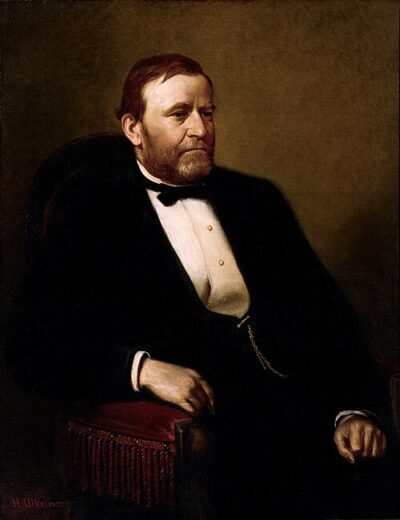
Ulysses S. Grant
Ulysses S. Grant was a president of the United States from 1869 to 1877. Born April 27, 1822, in Point Pleasant. Died July 23, 1885, in Wilton. Positions held include President of the United States (1869–1877), Commanding General of the United States Army (1864–1869) and President-elect of the United States (1868–1869). Educated at United States Military Academy. Awards include Congressional Gold Medal.
Facts
36 facts · 2 confirmed by two sources · 10 cited · 23 from one source · 1 where the sources disagree
What’s different
- Height: we show 1.73 m (5 ft 8 in) (Sources disagree). Wikidata also lists 1.75 m (5 ft 9 in)
Where this comes from
Papalocal keeps its own record. It started from these sources; what each one said is kept here as it was copied, so a change on their side never changes this page by itself. Tap one to read its version.
What Wikidata says · copied November 13, 2026 · revision 2567581347
- Described as
- president of the United States from 1869 to 1877
- Other names
- President Grant, U.S. Grant, General Grant, U. S. Grant, Ulysses Grant, Ulysses Hiram Grant, Hiram Ulysses Grant, Ulysses Simpson Grant, Ulysses S Grant
- Born
- April 27, 1822 · 11 references
- Died
- July 23, 1885 · 10 references
- Born in
- Point Pleasant · 1 reference
- Died in
- Wilton
- Buried in
- Grant's Tomb
- Cause of death
- laryngeal cancer · 1 reference
- Name at birth
- Hiram Ulysses Grant
- Citizen of
- United States
- Occupation
- explorer; writer · 1 reference; statesperson; army officer; politician · 1 reference; military personnel · 1 reference
- Positions held
- President of the United States (1869–1877); Commanding General of the United States Army (1864–1869); President-elect of the United States (1868–1869); United States Secretary of War (1867–1868) · 1 reference
- Political party
- Republican Party
- Education
- United States Military Academy
- Member of
- American Philosophical Society (1868–)
- Awards
- Congressional Gold Medal
- Spouse
- Julia Grant (1848–1885) · 2 references
- Children
- Frederick Dent Grant; Ulysses S. Grant, Jr.; Nellie Grant · 2 references; Jesse Root Grant · 1 reference
- Father
- Jesse Root Grant · 1 reference
- Mother
- Hannah Simpson Grant · 1 reference
- Religion
- Presbyterianism; Methodism
- Military branch
- Union Army
- Military rank
- General of the Army
- Lived in
- New York City
- Nickname
- “Unconditional Surrender” Grant
- Height
- 1.75 m (5 ft 9 in); 1.73 m (5 ft 8 in) · 1 reference
- Wikipedias with a page
- 161
Wikidata item Q34836 (wikidata.org/wiki/Q34836), public domain (CC0). Copied November 13, 2026.
What Wikipedia says · copied November 13, 2026 · revision 1385420936
Ulysses S. Grant (born Hiram Ulysses Grant; April 27, 1822 – July 23, 1885) was the 18th president of the United States, serving from 1869 to 1877, and was the Commanding General of the Union Army. He led the army to victory in the American Civil War in 1865.
Grant was born in Ohio and graduated from the United States Military Academy in 1843. He served with distinction in the Mexican–American War, but returned to civilian life impoverished in 1854. In 1861, shortly after the Civil War began, Grant joined the Union Army. He rose to prominence after securing victories in the western theater in 1862. In 1863, he led the Vicksburg campaign that gave Union forces control of the Mississippi River and dealt a major strategic blow to the Confederacy. President Abraham Lincoln promoted Grant to lieutenant general and command of all Union armies after his victory at Chattanooga. Grant fought Robert E. Lee through the Overland Campaign, which ended when Lee surrendered to Grant at Appomattox. In 1866, President Andrew Johnson promoted Grant to General of the Army. Grant broke with Johnson over Reconstruction policies. A war hero, drawn in by his sense of duty, Grant was unanimously nominated by the Republican Party and elected president in 1868.
As president, Grant stabilized the post-war economy, supported Reconstruction and the Fifteenth Amendment, and prosecuted the Ku Klux Klan. An effective civil rights executive, Grant signed a bill to create the United States Department of Justice and worked with Radical Republicans to protect African Americans. In 1871, he created the first Civil Service Commission. Grant was re-elected in the 1872 presidential election, but was inundated by executive scandals during his second term. His response to the Panic of 1873 was ineffective in halting the Long Depression, which contributed to the Democrats winning the House majority in 1874. Grant's Native American policy was to assimilate Indians into Anglo-American culture. In his foreign policy, the Alabama Claims against Britain were peacefully resolved, but the Senate rejected his proposal to annex Santo Domingo. During the disputed 1876 presidential election, he facilitated the approval by Congress of a compromise.
Leaving office in 1877, Grant undertook a world tour, becoming the first president to circumnavigate the world. In 1880, he was unsuccessful in obtaining the Republican nomination for a third term. In 1885, dying of throat cancer, Grant wrote his memoirs, which were posthumously published and became a major critical and financial success. At his death, he was the most popular American and was memorialized as a symbol of national unity. Due to the pseudohistorical and negationist mythology of the Lost Cause of the Confederacy spread by Confederate sympathizers around the turn of the 20th century, historical assessments and rankings of Grant's presidency suffered considerably before they began recovering in the 21st century.
- Born, in its opening lines
- April 27, 1822
- Died, in its opening lines
- July 23, 1885
From the Wikipedia article “Ulysses S. Grant” (en.wikipedia.org/wiki/Ulysses_S._Grant), by its contributors, under CC BY-SA 4.0 (creativecommons.org/licenses/by-sa/4.0/). Copied November 13, 2026; not changed.
Confirmed Two sources agree. Cited One source, and it names where it got it. One source One source, without a reference of its own. Sources disagree The sources disagree. We show the best-supported value and keep theirs below.
