
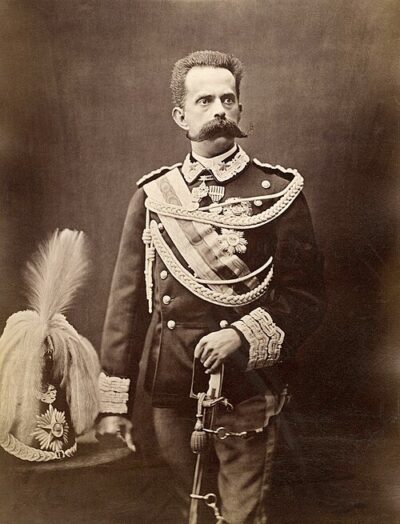
Umberto I of Italy
Umberto I of Italy was a king of Italy. Born March 14, 1844, in Turin. Died July 29, 1900, in Monza. Positions held include Monarch of Italy (1878–1900) and Head of the House of Savoy. Awards include Knight of the Order of the Golden Fleece, Order of the Black Eagle and Order of St. Andrew.
Facts
36 facts · 2 confirmed by two sources · 3 cited · 30 from one source · 1 where the sources disagree
What’s different
- Buried in: we show Pantheon (Sources disagree). Wikidata also lists Tomb of King Umberto I and Queen Margherita of Italy
Where this comes from
Papalocal keeps its own record. It started from these sources; what each one said is kept here as it was copied, so a change on their side never changes this page by itself. Tap one to read its version.
What Wikidata says · copied November 16, 2026 · revision 2559699321
- Described as
- king of Italy (1844-1900)
- Other names
- Umberto I, Umberto Ranieri Carlo Emanuele Giovanni Maria Ferdinando Eugenio di Savoia, Humbert I
- Born
- March 14, 1844 · 8 references
- Died
- July 29, 1900 · 8 references
- Born in
- Turin · 2 references
- Died in
- Monza · 2 references
- Buried in
- Pantheon · 1 reference; Tomb of King Umberto I and Queen Margherita of Italy · 1 reference
- Cause of death
- gunshot wound
- Citizen of
- Kingdom of Italy (1861–)
- Occupation
- monarch; sovereign · 1 reference
- Positions held
- Monarch of Italy (1878–1900); Head of the House of Savoy
- Member of
- Umberto I of Italy and Queen Margherita · 1 reference
- Awards
- Knight of the Order of the Golden Fleece; Order of the Black Eagle; Order of St. Andrew; Order of the Elephant (1863); Grand Master of the Order of the Most Holy Annunciation · 1 reference; Civil Order of Savoy · 1 reference; Order of the Garter · 1 reference; Pour le Mérite · 1 reference; Order of the Golden Fleece · 1 reference; Royal Order of the Seraphim · 1 reference; Knight of the Order of St. Alexander Nevsky · 1 reference; Order of the Most Holy Annunciation · 1 reference; Commemorative Medal of the Unity of Italy · 1 reference; Order of the Royal House of Chakri · 1 reference
- Spouse
- Margherita of Savoy (1868–) · 1 reference
- Children
- Victor Emmanuel III of Italy
- Father
- Victor Emmanuel II of Italy
- Mother
- Archduchess Adelaide of Austria
- Siblings
- Maria Pia of Savoy; Princess Maria Clotilde of Savoy; Amadeo I of Spain; Prince Oddone, Duke of Montferrat
- Religion
- Catholicism
- Military rank
- general
- Wikipedias with a page
- 76
Wikidata item Q153688 (wikidata.org/wiki/Q153688), public domain (CC0). Copied November 16, 2026.
What Wikipedia says · copied November 16, 2026 · revision 1385897609
Umberto I or Humbert I (Italian: Umberto Ranieri Carlo Emanuele Giovanni Maria Ferdinando Eugenio di Savoia; 14 March 1844 – 29 July 1900) was King of Italy from 9 January 1878 until his assassination in 1900. His reign saw the creation of the Italian colonial empire and the formation of the Triple Alliance among Italy, Germany, and Austria-Hungary.
The son of Victor Emmanuel II and Adelaide of Austria, Umberto took part in the Italian Wars of Independence as a commander of the Royal Sardinian Army. He assumed the Italian throne in 1878 on the death of his father. A strong militarist, Umberto approved the alliance with Germany and Austria-Hungary, which was formalised in 1882. He also encouraged Italy's colonial efforts and oversaw the incorporation of Eritrea and Somalia into the emerging Italian Empire, while the First Italo-Ethiopian War resulted in defeat at the Battle of Adwa.
In the last years of his reign, Umberto faced increasing social unrest and serious economic difficulties. Tensions mounted as a result of growing opposition to new colonial campaigns, the spread of socialism, and crackdowns on civil liberties. Umberto was contested by left-wing circles for his conservatism and particularly for the decorations he gave in 1898 to Bava Beccaris, a general who bloodily suppressed demonstrations over rising food prices in Milan. He was deeply hated by Italian anarchists, who had already attempted to assassinate him during the first year of his reign.
In 1900, two years after the Bava Beccaris massacre, Umberto was killed in Monza by anarchist Gaetano Bresci. He was succeeded by his son, Victor Emmanuel III. Before his killing, he was also one of the recipients of one of Friedrich Nietzsche's Wahnbriefe notes. The Umbertino architecture style was named after him.
- Born, in its opening lines
- March 14, 1844
- Died, in its opening lines
- July 29, 1900
From the Wikipedia article “Umberto I of Italy” (en.wikipedia.org/wiki/Umberto_I_of_Italy), by its contributors, under CC BY-SA 4.0 (creativecommons.org/licenses/by-sa/4.0/). Copied November 16, 2026; not changed.
Confirmed Two sources agree. Cited One source, and it names where it got it. One source One source, without a reference of its own. Sources disagree The sources disagree. We show the best-supported value and keep theirs below.
