
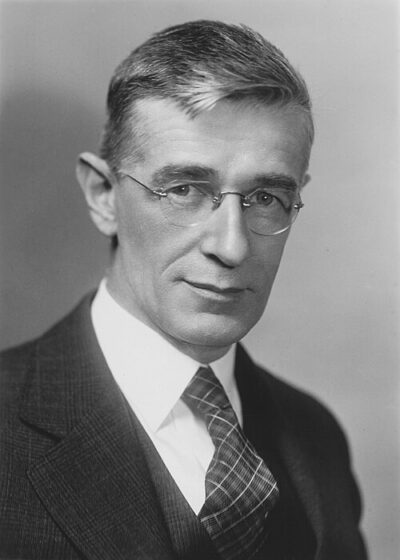
Vannevar Bush
Vannevar Bush was an American electrical engineer and science administrator. Born March 11, 1890, in Everett. Died June 28, 1974, in Belmont. Positions held include chairperson (1957–1959) and board member (1940–1956). Known for Memex. Educated at Massachusetts Institute of Technology and Tufts University. Awards include National Medal of Science, Knight Commander of the Order of the British Empire and Edison Medal.
Facts
48 facts · 2 confirmed by two sources · 18 cited · 28 from one source
Where this comes from
Papalocal keeps its own record. It started from these sources; what each one said is kept here as it was copied, so a change on their side never changes this page by itself. Tap one to read its version.
What Wikidata says · copied November 13, 2026 · revision 2532929129
- Described as
- American electrical engineer and science administrator (1890–1974)
- Other names
- V. Bush, Vanevar Bush
- Born
- March 11, 1890 · 8 references
- Died
- June 28, 1974 · 7 references
- Born in
- Everett · 1 reference
- Died in
- Belmont · 1 reference
- Buried in
- Massachusetts
- Cause of death
- pneumonia
- Citizen of
- United States
- Occupation
- computer scientist; inventor; politician; university teacher; engineer; science administrator; electrical engineer · 1 reference
- Positions held
- chairperson (1957–1959) · 2 references; board member (1940–1956)
- Worked for
- Massachusetts Institute of Technology
- Education
- Massachusetts Institute of Technology; Tufts University; Harvard University · 1 reference; Chelsea High School; Tufts University School of Engineering
- Member of
- MIT Corporation (1932–1974) · 1 reference; American Academy of Arts and Sciences; American Philosophical Society (1937–) · 1 reference; American Association for the Advancement of Science · 1 reference; American Physical Society · 1 reference; National Academy of Sciences (1934–) · 1 reference; Literary Society of Washington
- Known for
- Memex · 1 reference
- Awards
- National Medal of Science (1963) · 1 reference; Knight Commander of the Order of the British Empire; Edison Medal (1943) · 1 reference; Legion of Honour; John Fritz Medal (1951) · 1 reference; William Procter Prize for Scientific Achievement (1954) · 1 reference; Josiah Willard Gibbs Lectureship (1935); National Inventors Hall of Fame (2004) · 1 reference; John J. Carty Award for the Advancement of Science (1953); Hoover Medal (1946); Holley Medal (1943) · 1 reference; Louis E. Levy Medal of the Franklin Institute (1928); John Scott Award (1943) · 1 reference; Washington Award (1946); National Academy of Engineering Founders Award (1966)
- Field
- futures studies
- Father
- Reverend Richard Perry Bush · 1 reference
- Mother
- Emma Linnwood Bush · 1 reference
- Wikipedias with a page
- 52
Wikidata item Q299595 (wikidata.org/wiki/Q299595), public domain (CC0). Copied November 13, 2026.
What Wikipedia says · copied November 13, 2026 · revision 1385350931
Vannevar Bush ( van-NEE-var; March 11, 1890 – June 28, 1974) was an American engineer, inventor and science administrator, who during World War II headed the U.S. Office of Scientific Research and Development (OSRD), through which almost all wartime military R&D was carried out, including important developments in radar and the initiation and early administration of the Manhattan Project. He emphasized the importance of scientific research to national security and economic well-being, and was chiefly responsible for the movement that led to the creation of the National Science Foundation.
Bush joined the Department of Electrical Engineering at the Massachusetts Institute of Technology (MIT) in 1919, and founded the company that became Raytheon in 1922. Bush became vice president of MIT and dean of the MIT School of Engineering in 1932, and president of the Carnegie Institution of Washington in 1938.
During his career, Bush patented a string of his own inventions. He is known particularly for his engineering work on analog computers, and for the memex. Starting in 1927, Bush constructed a differential analyzer, a mechanical analog computer with some digital components that could solve differential equations with as many as 18 independent variables. An offshoot of the work at MIT by Bush and others was the beginning of digital circuit design theory. The memex, which he began developing in the 1930s (heavily influenced by Emanuel Goldberg's "Statistical Machine" from 1928) was a hypothetical adjustable microfilm viewer with a structure analogous to that of hypertext. The memex and Bush's 1945 essay "As We May Think" influenced generations of computer scientists, who drew inspiration from his vision of the future.
Bush was appointed to the National Advisory Committee for Aeronautics (NACA) in 1938, and soon became its chairman. As chairman of the National Defense Research Committee (NDRC), and later director of OSRD, Bush coordinated the activities of some six thousand leading American scientists in the application of science to warfare. Bush was a well-known policymaker and public intellectual during World War II, when he was in effect the first presidential science advisor. As head of NDRC and OSRD, he initiated the Manhattan Project, and ensured that it received top priority from the highest levels of government. In Science, The Endless Frontier, his 1945 report to the president of the United States, Bush called for an expansion of government support for science, and he pressed for the creation of the National Science Foundation.
- Born, in its opening lines
- March 11, 1890
- Died, in its opening lines
- June 28, 1974
From the Wikipedia article “Vannevar Bush” (en.wikipedia.org/wiki/Vannevar_Bush), by its contributors, under CC BY-SA 4.0 (creativecommons.org/licenses/by-sa/4.0/). Copied November 13, 2026; not changed.
Confirmed Two sources agree. Cited One source, and it names where it got it. One source One source, without a reference of its own. Sources disagree The sources disagree. We show the best-supported value and keep theirs below.
