
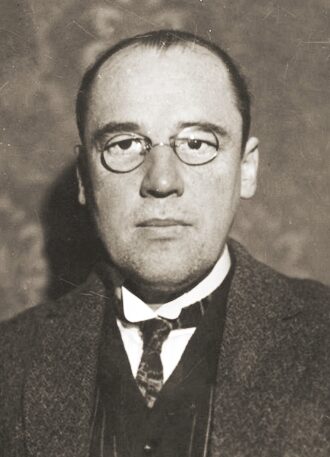
Wacław Sierpiński
Wacław Sierpiński was a Polish mathematician. Born March 14, 1882, in Warsaw. Died October 21, 1969, in Warsaw. Known for Sierpiński triangle, Sierpinski carpet and Sierpiński space. Educated at University of Warsaw and Jagiellonian University. Awards include Commander with Star of the Order of Polonia Restituta, Stefan Banach Prize and honorary doctor of the University of Wrocław.
Facts
48 facts · 2 confirmed by two sources · 19 cited · 27 from one source
Where this comes from
Papalocal keeps its own record. It started from these sources; what each one said is kept here as it was copied, so a change on their side never changes this page by itself. Tap one to read its version.
What Wikidata says · copied November 16, 2026 · revision 2562461718
- Described as
- Polish mathematician
- Other names
- Wacław Franciszek Sierpiński
- Born
- March 14, 1882 · 1 reference
- Died
- October 21, 1969 · 8 references
- Born in
- Warsaw · 2 references
- Died in
- Warsaw · 1 reference
- Buried in
- Powązki Cemetery · 1 reference
- Name at birth
- Wacław Franciszek Sierpiński
- Citizen of
- Poland
- Occupation
- mathematician · 3 references; topologist; university teacher · 1 reference; teacher · 1 reference
- Worked for
- University of Warsaw (1919–1960) · 1 reference; Lviv University (1908–1914) · 1 reference
- Education
- University of Warsaw (1899–1904) · 1 reference; Jagiellonian University (1906–1908) · 2 references
- Member of
- German Academy of Sciences at Berlin (1950–) · 1 reference; French Academy of Sciences (1960–) · 2 references; Poznań Society of Friends of Learning; Academy of Learning; Lwów Scientific Society; Polish Academy of Learning; Polish Academy of Sciences (1952–) · 2 references; Warsaw Scientific Society; Pontifical Academy of Sciences (1968–) · 2 references; Bulgarian Academy of Sciences (1936–) · 1 reference
- Known for
- Sierpiński triangle; Sierpinski carpet; Sierpiński space; Sierpiński curve; Sierpinski number; Sierpiński's constant; Sierpiński arrowhead curve; Hexaflake; Sierpiński set; Menger sponge
- Awards
- Commander with Star of the Order of Polonia Restituta; Stefan Banach Prize (1946) · 1 reference; honorary doctor of the University of Wrocław; honorary doctor of the Lviv University; Work Flag Order, 1st class · 1 reference; Grand Cross of the Order of Polonia Restituta · 1 reference; honorary doctor of the University of Bordeaux (1947) · 1 reference; doctor honoris causa from the University of Paris (1939) · 4 references
- Field
- number theory; topology; mathematics; set theory · 1 reference; function theory · 1 reference
- Wikipedias with a page
- 39
Wikidata item Q297206 (wikidata.org/wiki/Q297206), public domain (CC0). Copied November 16, 2026.
What Wikipedia says · copied November 16, 2026 · revision 1383047249
Wacław Franciszek Sierpiński (Polish: [ˈvat͡swaf fraɲˈt͡ɕiʂɛk ɕɛrˈpij̃skʲi] ; 14 March 1882 – 21 October 1969) was a Polish mathematician. He was known for contributions to set theory (research on the axiom of choice and the continuum hypothesis), number theory, theory of functions, and topology. He published over 700 papers and 50 books.
Three well-known fractals are named after him (the Sierpiński triangle, the Sierpiński carpet, and the Sierpiński curve), as are Sierpiński numbers and the associated Sierpiński problem.
- Born, in its opening lines
- March 14, 1882
- Died, in its opening lines
- October 21, 1969
From the Wikipedia article “Wacław Sierpiński” (en.wikipedia.org/wiki/Wacław_Sierpiński), by its contributors, under CC BY-SA 4.0 (creativecommons.org/licenses/by-sa/4.0/). Copied November 16, 2026; not changed.
Confirmed Two sources agree. Cited One source, and it names where it got it. One source One source, without a reference of its own. Sources disagree The sources disagree. We show the best-supported value and keep theirs below.
