
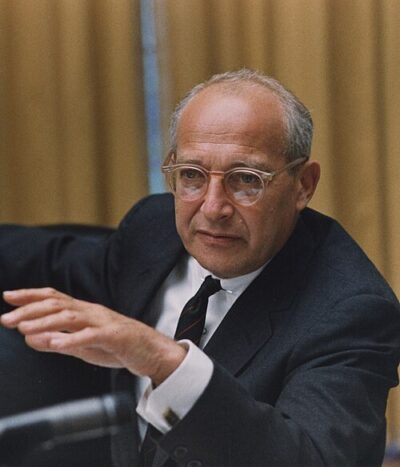
Walt Whitman Rostow
Walt Whitman Rostow was an American economist, political theorist and government official. Born October 7, 1916, in New York City. Died February 13, 2003, in Austin. Positions held include United States National Security Advisor (1966–1969), Counselor of the United States Department of State (1961–1966) and Director of Policy Planning (1961–1966). Educated at Yale University and Balliol College. Awards include Officer of the Order of the British Empire, Legionnaire of Legion of Merit and Presidential Medal of Freedom.
Facts
32 facts · 2 confirmed by two sources · 11 cited · 19 from one source
Where this comes from
Papalocal keeps its own record. It started from these sources; what each one said is kept here as it was copied, so a change on their side never changes this page by itself. Tap one to read its version.
What Wikidata says · copied November 15, 2026 · revision 2569715441
- Described as
- American economist, political theorist and government official (1916–2003)
- Other names
- Walt Rostow, W. W. Rostow
- Born
- October 7, 1916 · 6 references
- Died
- February 13, 2003 · 5 references
- Born in
- New York City · 1 reference
- Died in
- Austin · 1 reference
- Buried in
- Woodlawn Cemetery · 1 reference
- Citizen of
- United States
- Occupation
- economist · 1 reference; university teacher · 1 reference; politician · 1 reference; writer · 1 reference; historian · 2 references; political scientist · 1 reference
- Positions held
- United States National Security Advisor (1966–1969); Counselor of the United States Department of State (1961–1966); Director of Policy Planning (1961–1966); Deputy National Security Advisor (1961)
- Political party
- Democratic Party
- Worked for
- Massachusetts Institute of Technology; Columbia University; Office of Strategic Services; University of Cambridge; University of Texas at Austin · 1 reference
- Education
- Yale University (–1940); Balliol College (1940–)
- Member of
- American Academy of Arts and Sciences; American Philosophical Society (1983–) · 1 reference
- Awards
- Officer of the Order of the British Empire; Legionnaire of Legion of Merit; Presidential Medal of Freedom (1969) · 1 reference; Rhodes Scholarship (1936) · 1 reference; honorary doctor of the University of Miami (1965) · 1 reference
- Spouse
- Elspeth Rostow
- Wikipedias with a page
- 36
Wikidata item Q359560 (wikidata.org/wiki/Q359560), public domain (CC0). Copied November 15, 2026.
What Wikipedia says · copied November 15, 2026 · revision 1385602232
Walt Whitman Rostow (rahs-TOU; October 7, 1916 – February 13, 2003) was an American economist, professor and political theorist who served as national security advisor to president of the United States Lyndon B. Johnson from 1966 to 1969.
Rostow worked in the Office of Strategic Services during World War II and later was a foreign policy adviser and speechwriter for presidential candidate and then President John F. Kennedy; he is often credited with writing Kennedy's famous "New Frontier" speech. Prominent for his role in shaping US foreign policy in Southeast Asia during the 1960s, he was a staunch anti-communist, noted for a belief in the efficacy of capitalism and free enterprise, and strongly supported US involvement in the Vietnam War.
Rostow is known for his book The Stages of Economic Growth: A Non-Communist Manifesto (1960), which was used in several fields of social science. Rostow's theories were embraced by many officials in both the Kennedy and Johnson administrations as a possible counter to the increasing popularity of communism in Asia, Africa and Latin America.
- Born, in its opening lines
- October 7, 1916
- Died, in its opening lines
- February 13, 2003
From the Wikipedia article “Walt Rostow” (en.wikipedia.org/wiki/Walt_Rostow), by its contributors, under CC BY-SA 4.0 (creativecommons.org/licenses/by-sa/4.0/). Copied November 15, 2026; not changed.
Confirmed Two sources agree. Cited One source, and it names where it got it. One source One source, without a reference of its own. Sources disagree The sources disagree. We show the best-supported value and keep theirs below.
