
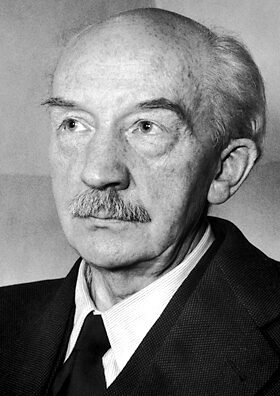
Walther Bothe
Walther Bothe was a German physicist, mathematician and chemist. Born January 8, 1891, in Oranienburg. Died February 8, 1957, in Heidelberg. Educated at Humboldt-Universität zu Berlin and University of Giessen. Awards include Pour le Mérite for Sciences and Arts order, Commander's Cross of the Order of Merit of the Federal Republic of Germany and Nobel Prize in Physics.
Facts
32 facts · 2 confirmed by two sources · 6 cited · 24 from one source
Where this comes from
Papalocal keeps its own record. It started from these sources; what each one said is kept here as it was copied, so a change on their side never changes this page by itself. Tap one to read its version.
What Wikidata says · copied November 16, 2026 · revision 2567933954
- Described as
- German physicist, mathematician and chemist (1891–1957)
- Other names
- Walter Bothe, Walther Wilhelm Georg Bothe, Bothe
- Born
- January 8, 1891 · 8 references
- Died
- February 8, 1957 · 8 references
- Born in
- Oranienburg · 3 references
- Died in
- Heidelberg · 3 references
- Buried in
- Handschuhsheim Cemetery · 1 reference
- Name at birth
- Walther Wilhelm Georg Bothe
- Citizen of
- Germany
- Occupation
- physicist · 2 references; inventor; university teacher; chemist; mathematician; nuclear physicist
- Worked for
- University of Giessen; Heidelberg University; Humboldt-Universität zu Berlin · 1 reference; Physikalisch-Technische Bundesanstalt
- Education
- Humboldt-Universität zu Berlin (1908–1913); University of Giessen · 1 reference
- Member of
- Royal Prussian Academy of Sciences; German Academy of Sciences at Berlin; Saxon Academy of Sciences and Humanities (1932–); Bavarian Academy of Sciences and Humanities; Heidelberg Academy of Sciences and Humanities (1933–) · 1 reference; Göttingen Academy of Sciences and Humanities in Lower Saxony
- Awards
- Pour le Mérite for Sciences and Arts order (1952); Commander's Cross of the Order of Merit of the Federal Republic of Germany; Nobel Prize in Physics (1954) · 2 references; Max Planck Medal (1953)
- Field
- physics
- Spouse
- Barbara Below
- Religion
- Lutheranism
- Wikipedias with a page
- 80
Wikidata item Q76474 (wikidata.org/wiki/Q76474), public domain (CC0). Copied November 16, 2026.
What Wikipedia says · copied November 16, 2026 · revision 1380614232
Walther Wilhelm Georg Bothe (German: [ˈvaltɐ ˈboːtə] ; 8 January 1891 – 8 February 1957) was a German experimental physicist who shared the 1954 Nobel Prize in Physics with Max Born "for the coincidence method and his discoveries made therewith".
Bothe served in the military during World War I from 1914 and was a prisoner of war of the Russians, returning to Germany in 1920. Upon his return to the laboratory, he developed and applied coincidence circuits to the study of nuclear reactions, such as the Compton effect, cosmic rays, and the wave–particle duality of radiation.
In 1930, Bothe became full professor and director of the Physics Department at the University of Giessen. In 1932, he became director of the Physical and Radiological Institute at Heidelberg University; he was driven out of this position by elements of the Deutsche Physik movement. To preclude his emigration from Germany, he was appointed director of the Physics Institute of the Kaiser Wilhelm Institute for Medical Research at Heidelberg University. There, he built the first operational cyclotron in Germany. Furthermore, he became a principal in the German nuclear energy project, also known as Uranverein, which was started in 1939 under the supervision of the Army Ordnance Office.
In 1946, in addition to his directorship of the Physics Institute at the KWImf, Bothe was reinstated as a professor at Heidelberg University. From 1956 to 1957, he was a member of the Nuclear Physics Working Group in Germany.
In the year after Bothe's death, his Physics Institute at the KWImF was elevated to the status of a new institute under the Max Planck Society and then became the Max Planck Institute for Nuclear Physics. Its main building was later named Bothe laboratory.
- Born, in its opening lines
- January 8, 1891
- Died, in its opening lines
- February 8, 1957
From the Wikipedia article “Walther Bothe” (en.wikipedia.org/wiki/Walther_Bothe), by its contributors, under CC BY-SA 4.0 (creativecommons.org/licenses/by-sa/4.0/). Copied November 16, 2026; not changed.
Confirmed Two sources agree. Cited One source, and it names where it got it. One source One source, without a reference of its own. Sources disagree The sources disagree. We show the best-supported value and keep theirs below.
