
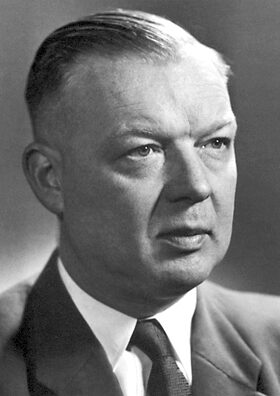
Werner Forssmann
Werner Forssmann was a German physician, Nobel prize winner. Born August 29, 1904, in Berlin. Died June 1, 1979, in Schopfheim. Positions held include professor. Educated at Humboldt-Universität zu Berlin. Awards include Nobel Prize in Physiology or Medicine and Great Cross with Star and Sash of the Order of Merit of the Federal Republic of Germany.
Facts
25 facts · 2 confirmed by two sources · 9 cited · 14 from one source
Where this comes from
Papalocal keeps its own record. It started from these sources; what each one said is kept here as it was copied, so a change on their side never changes this page by itself. Tap one to read its version.
What Wikidata says · copied November 16, 2026 · revision 2569191858
- Described as
- German physician, Nobel prize winner (1904-1979)
- Born
- August 29, 1904 · 6 references
- Died
- June 1, 1979 · 6 references
- Born in
- Berlin · 2 references
- Died in
- Schopfheim · 1 reference
- Cause of death
- myocardial infarction
- Citizen of
- German Reich (–1871); West Germany (1949–); German Empire
- Occupation
- military physician; surgeon · 1 reference; urologist · 1 reference; cardiologist; physiologist · 1 reference; physician · 2 references; university teacher · 1 reference
- Positions held
- professor
- Political party
- Nazi Party (1932–) · 1 reference
- Worked for
- Johannes Gutenberg University Mainz
- Education
- Humboldt-Universität zu Berlin
- Member of
- North Rhine-Westphalia Academy for Sciences and Arts; Sturmabteilung
- Awards
- Nobel Prize in Physiology or Medicine (1956) · 2 references; Great Cross with Star and Sash of the Order of Merit of the Federal Republic of Germany
- Field
- cardiology · 1 reference
- Children
- Wolf-Georg Forssmann · 1 reference
- Wikipedias with a page
- 55
Wikidata item Q77152 (wikidata.org/wiki/Q77152), public domain (CC0). Copied November 16, 2026.
What Wikipedia says · copied November 16, 2026 · revision 1372007434
Werner Theodor Otto Forßmann (Forssmann in English; German pronunciation: [ˈvɛʁnɐ ˈfɔʁsˌman] ; 29 August 1904 – 1 June 1979) was a German researcher and physician from Germany who shared the 1956 Nobel Prize in Medicine (with Andre Frederic Cournand and Dickinson W. Richards) for developing a procedure that allowed cardiac catheterization. In 1929, he put himself under local anesthesia and inserted a catheter into a vein of his arm. Not knowing if the catheter might pierce a vein, he put his life at risk. Forssmann was nevertheless successful; he safely passed the catheter into his heart.
- Born, in its opening lines
- August 29, 1904
- Died, in its opening lines
- June 1, 1979
From the Wikipedia article “Werner Forssmann” (en.wikipedia.org/wiki/Werner_Forssmann), by its contributors, under CC BY-SA 4.0 (creativecommons.org/licenses/by-sa/4.0/). Copied November 16, 2026; not changed.
Confirmed Two sources agree. Cited One source, and it names where it got it. One source One source, without a reference of its own. Sources disagree The sources disagree. We show the best-supported value and keep theirs below.
