
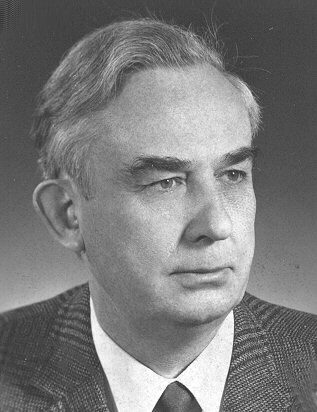
Willi Hennig
Willi Hennig was a German biologist. Born April 20, 1913, in Dürrhennersdorf. Died November 5, 1976, in Ludwigsburg. Positions held include professor. Educated at Leipzig University. Awards include Linnean Medal.
Facts
21 facts · 2 confirmed by two sources · 6 cited · 13 from one source
Where this comes from
Papalocal keeps its own record. It started from these sources; what each one said is kept here as it was copied, so a change on their side never changes this page by itself. Tap one to read its version.
What Wikidata says · copied November 16, 2026 · revision 2569163942
- Described as
- German biologist (1913–1976)
- Other names
- Emil Hans Willi Hennig, Hennig
- Born
- April 20, 1913 · 4 references
- Died
- November 5, 1976 · 4 references
- Born in
- Dürrhennersdorf · 1 reference
- Died in
- Ludwigsburg · 1 reference
- Buried in
- Tübingen
- Citizen of
- Germany
- Occupation
- biologist · 1 reference; entomologist · 1 reference; writer; zoologist; university teacher
- Positions held
- professor
- Worked for
- University of Tübingen; Leipzig University; Technische Universität Berlin
- Education
- Leipzig University
- Member of
- German Academy of Sciences Leopoldina · 1 reference; Royal Swedish Academy of Sciences
- Awards
- Linnean Medal (1974)
- Field
- dipterology
- Children
- Wolfgang Hennig · 1 reference
- Wikipedias with a page
- 31
Wikidata item Q57999 (wikidata.org/wiki/Q57999), public domain (CC0). Copied November 16, 2026.
What Wikipedia says · copied November 16, 2026 · revision 1376999680
Emil Hans Willi Hennig (20 April 1913 – 5 November 1976) was a German biologist and zoologist who is considered the founder of phylogenetic systematics, otherwise known as cladistics. In 1945 as a prisoner of war, Hennig began work on his theory of cladistics, which he published in German in 1950, with a substantially revised English translation published in 1966. With his works on evolution and systematics he revolutionised the view of the natural order of beings. As a taxonomist, he specialised in dipterans (true flies).
Hennig coined the key terms synapomorphy, symplesiomorphy, and paraphyly. He also asserted, in his "auxiliary principle", that "the presence of apomorphous (apomorphy) characters in different species 'is always reason for suspecting kinship [i.e., that species belong to a monophyletic group], and that their origin by convergence should not be presumed a priori' (Hennig, 1953). This was based on the conviction that 'phylogenetic systematics would lose all ground on which it stands' if the presence of apomorphous characters in different species were considered first of all as convergences (or parallelisms), with proof to the contrary required in each case." This has been viewed as an application of the parsimony principle to the interpretation of characters, an important component of phylogenetic inference.
He is also remembered for Hennig's progression rule in cladistics, which argues controversially that the most primitive species are found in the earliest, central part of a group's area.
- Born, in its opening lines
- April 20, 1913
- Died, in its opening lines
- November 5, 1976
From the Wikipedia article “Willi Hennig” (en.wikipedia.org/wiki/Willi_Hennig), by its contributors, under CC BY-SA 4.0 (creativecommons.org/licenses/by-sa/4.0/). Copied November 16, 2026; not changed.
Confirmed Two sources agree. Cited One source, and it names where it got it. One source One source, without a reference of its own. Sources disagree The sources disagree. We show the best-supported value and keep theirs below.
