
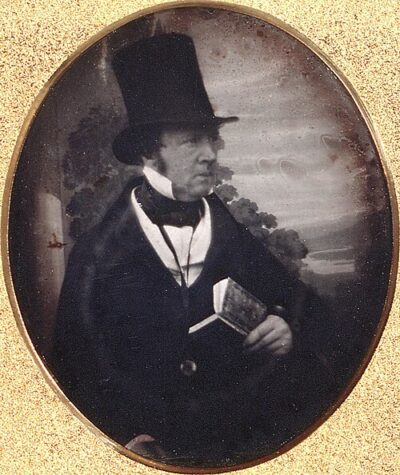
William Henry Fox Talbot
William Henry Fox Talbot was a British inventor and photographer. Born February 11, 1800, in Melbury Sampford. Died September 17, 1877, in Lacock. Positions held include member of the 11th Parliament of the United Kingdom (1832–1834) and High Sheriff of Wiltshire (1840–1841). Known for Talbot effect, The Pencil of Nature and calotype. Educated at Harrow School and Trinity College. Awards include Fellow of the Royal Society, Royal Medal and Rumford Medal.
Facts
46 facts · 2 confirmed by two sources · 30 cited · 14 from one source
Where this comes from
Papalocal keeps its own record. It started from these sources; what each one said is kept here as it was copied, so a change on their side never changes this page by itself. Tap one to read its version.
What Wikidata says · copied November 16, 2026 · revision 2558282744
- Described as
- British inventor and photographer (1800–1877)
- Other names
- H. Fox Talbot, Henri Fox Talbot, Henry Fox Talbot, Fox Talbot, Viliam Genri Foks Talbot, William Fox Talbot, William Henri Fox Talbot, Vilʹi︠a︡m Genri Foks Talbot, William Henry Talbot
- Born
- February 11, 1800 · 13 references
- Died
- September 17, 1877 · 13 references
- Born in
- Melbury Sampford · 1 reference
- Died in
- Lacock · 2 references
- Buried in
- Lacock cemetery · 1 reference
- Citizen of
- Kingdom of Great Britain; United Kingdom of Great Britain and Ireland · 2 references
- Occupation
- patent inventor; photographer · 5 references; anthropologist; politician · 1 reference; inventor · 2 references; chemist; mathematician · 1 reference; assyriologist
- Positions held
- member of the 11th Parliament of the United Kingdom (1832–1834) · 1 reference; High Sheriff of Wiltshire (1840–1841) · 2 references
- Education
- Harrow School (1810–1815) · 1 reference; Trinity College (1817–1821) · 1 reference
- Member of
- Royal Society of London (1831–); Royal Astronomical Society (1822–) · 1 reference
- Known for
- Talbot effect; The Pencil of Nature; calotype; photoglyphic engraving
- Awards
- Fellow of the Royal Society (1831) · 1 reference; Royal Medal (1838) · 1 reference; Rumford Medal (1842) · 1 reference; Royal Society Bakerian Medal (1837) · 1 reference; Porson Prize (1820) · 1 reference; honorary doctor of the University of Edinburgh (1863) · 1 reference; Fellow of the Royal Society of Edinburgh (1858) · 1 reference
- Field
- experimental physics; stereo photography · 1 reference; philosophy · 1 reference; Egyptology · 1 reference; mathematics · 1 reference; physics · 1 reference
- Spouse
- Constance Fox Talbot (1832–) · 2 references
- Children
- Charles Henry Talbot · 1 reference; Ella Talbot · 1 reference; Rosamond Constance Talbot · 1 reference; Matilda Caroline Talbot · 1 reference
- Father
- William Davenport Talbot · 2 references
- Mother
- Elizabeth Theresa Fox- Strangways · 1 reference
- Lived in
- Lacock Abbey · 1 reference
- Wikipedias with a page
- 48
Wikidata item Q299565 (wikidata.org/wiki/Q299565), public domain (CC0). Copied November 16, 2026.
What Wikipedia says · copied November 16, 2026 · revision 1385865344
William Henry Fox Talbot (; 11 February 1800 – 17 September 1877) was an English scientist, inventor, and photography pioneer who invented the salted paper and calotype processes, precursors to photographic processes of the later 19th and 20th centuries. His work in the 1840s on photomechanical reproduction led to the creation of the photoglyphic engraving process, the precursor to photogravure. He was the holder of a controversial patent that affected the early development of commercial photography in Britain. He was also a noted photographer who contributed to the development of photography as an artistic medium. He published The Pencil of Nature (1844–1846), which was illustrated with original salted paper prints from his calotype negatives and made some important early photographs of Oxford, Paris, Reading, and York.
A polymath, Talbot was elected to the Royal Society in 1831 for his work on the integral calculus, and researched in optics, chemistry, electricity and other subjects such as etymology, the decipherment of cuneiform, and ancient history.
- Born, in its opening lines
- February 11, 1800
- Died, in its opening lines
- September 17, 1877
From the Wikipedia article “Henry Fox Talbot” (en.wikipedia.org/wiki/Henry_Fox_Talbot), by its contributors, under CC BY-SA 4.0 (creativecommons.org/licenses/by-sa/4.0/). Copied November 16, 2026; not changed.
Confirmed Two sources agree. Cited One source, and it names where it got it. One source One source, without a reference of its own. Sources disagree The sources disagree. We show the best-supported value and keep theirs below.
