
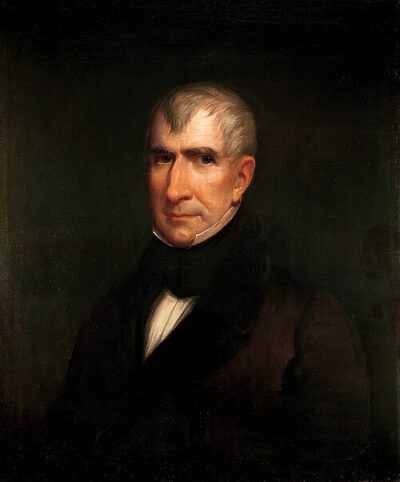
William Henry Harrison
William Henry Harrison was a president of the United States in 1841. Born February 9, 1773, in Charles City County. Died April 4, 1841, in White House. Positions held include President of the United States (1841), non-voting member of the U.S. House of Representatives (1816–1819) and United States Ambassador to Colombia (1828–1829). Educated at Hampden–Sydney College and University of Pennsylvania. Awards include Congressional Gold Medal and Hoover Medal.
Facts
45 facts · 2 confirmed by two sources · 18 cited · 25 from one source
Where this comes from
Papalocal keeps its own record. It started from these sources; what each one said is kept here as it was copied, so a change on their side never changes this page by itself. Tap one to read its version.
What Wikidata says · copied November 13, 2026 · revision 2567583040
- Described as
- president of the United States in 1841 (1773–1841)
- Other names
- Old Tippecanoe, W. H. Harrison, President Harrison, William H. Harrison
- Born
- February 9, 1773 · 12 references
- Died
- April 4, 1841 · 12 references
- Born in
- Charles City County
- Died in
- White House · 2 references
- Buried in
- William Henry Harrison Tomb State Memorial
- Citizen of
- United States
- Occupation
- politician · 1 reference; diplomat; military officer; statesperson; governor · 1 reference
- Positions held
- President of the United States (1841); non-voting member of the U.S. House of Representatives (1816–1819); United States Ambassador to Colombia (1828–1829); Governor of Indiana Territory (1801–1812) · 1 reference; United States senator (1825–1828) · 1 reference; President-elect of the United States (1840–1841); United States representative · 1 reference
- Political party
- Whig Party
- Education
- Hampden–Sydney College; University of Pennsylvania
- Awards
- Congressional Gold Medal; Hoover Medal (1945)
- Spouse
- Anna Harrison (1795–1841) · 1 reference
- Children
- John Scott Harrison; Carter Bassett Harrison · 1 reference; Elizabeth Bassett Harrison · 1 reference; John Cleves Symmes Harrison · 1 reference; Lucy Singleton Harrison · 1 reference; William Henry Harrison · 1 reference; Benjamin Harrison · 1 reference; Mary Symmes Harrison · 1 reference; Anna Tuthill Harrison · 1 reference; James Findlay Harrison · 1 reference; Marie Harrison · 1 reference
- Father
- Benjamin Harrison V
- Mother
- Elizabeth Bassett · 1 reference
- Siblings
- Carter Bassett Harrison
- Religion
- Episcopal Church
- Military branch
- United States Army
- Military rank
- general · 2 references
- Lived in
- North Bend; Grouseland
- Nickname
- walo
- Height
- 1.73 m (5 ft 8 in) · 1 reference
- Wikipedias with a page
- 140
Wikidata item Q11869 (wikidata.org/wiki/Q11869), public domain (CC0). Copied November 13, 2026.
What Wikipedia says · copied November 13, 2026 · revision 1384998541
William Henry Harrison (February 9, 1773 – April 4, 1841) was the ninth president of the United States, serving from March 1841 until his death 31 days later in April. He was the shortest serving president and the first one to die in office. His death triggered a brief constitutional crisis regarding presidential succession which ended when John Tyler, Harrison's vice president, assumed the office.
Harrison was born in Charles City County, Virginia. He was the last president to be born before the U.S. Declaration of Independence, making him a British subject. A member of the Harrison family of Virginia, he was a son of Benjamin Harrison V, a Founding Father, and the father of John Scott Harrison, the only son and father of two presidents of the United States. His grandson, Benjamin Harrison, became the 23rd president of the United States. In 1794, he participated in the Battle of Fallen Timbers, an American military victory that ended the Northwest Indian War. In 1811, he led a military force against Tecumseh's confederacy at the Battle of Tippecanoe, for which he earned the nickname "Old Tippecanoe". He was promoted to major general in the Army during the War of 1812, and led American infantry and cavalry to victory at the Battle of the Thames in Upper Canada.
Harrison's political career began in 1798, with an appointment as secretary of the Northwest Territory. In 1799, he was elected as the territory's non-voting delegate in the U.S. House of Representatives. He became governor of the newly established Indiana Territory in 1801 and, through multiple treaties with American Indian tribes, he acquired millions of acres for the nation. After the War of 1812, he moved to Ohio where, in 1816, he was elected to represent the state's 1st district in the House. In 1824, he was elected to the U.S. Senate, though his Senate term was cut short by his appointment as minister plenipotentiary to Gran Colombia in 1828.
Harrison returned to private life in Ohio until he was one of four Whig Party nominees in the 1836 U.S. presidential election, which he lost to Democrat Martin Van Buren. In the 1840 presidential election, the party nominated him again, with John Tyler as his running mate, under the campaign slogan "Tippecanoe and Tyler Too", and Harrison defeated Van Buren. Just three weeks after his inauguration, Harrison fell ill and died days later. After resolution of an ambiguity in the constitution regarding succession, Tyler became president. While he had no opportunity to make a name for his actions as a president (though his few days included actions that went against the then-common spoils system), Harrison is remembered for actions in his earlier career, including his Indian treaties, and for his inventive election campaign tactics. He is typically ranked in the bottom quartile of historical presidential rankings due to the brevity of his tenure, though for the same reason he, as well as James A. Garfield, are often omitted from them altogether.
- Born, in its opening lines
- February 9, 1773
- Died, in its opening lines
- April 4, 1841
From the Wikipedia article “William Henry Harrison” (en.wikipedia.org/wiki/William_Henry_Harrison), by its contributors, under CC BY-SA 4.0 (creativecommons.org/licenses/by-sa/4.0/). Copied November 13, 2026; not changed.
Confirmed Two sources agree. Cited One source, and it names where it got it. One source One source, without a reference of its own. Sources disagree The sources disagree. We show the best-supported value and keep theirs below.
