
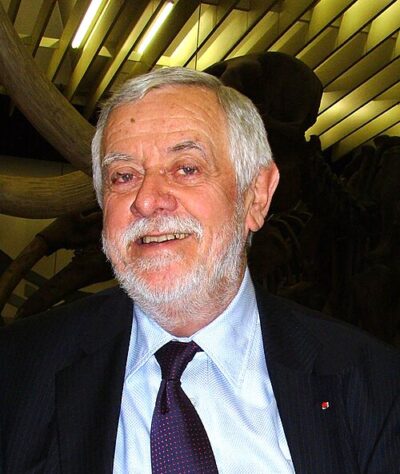
Yves Coppens
Yves Coppens was a French paleoanthropologist. Born August 9, 1934, in Vannes. Died June 22, 2022, in 11th arrondissement of Paris. Positions held include professor (1969–2005), historic preservationist (2016–) and president (2002–2005). Known for Manoir de Kerazan. Educated at University of Rennes. Awards include Grand Officer of the Legion of Honour, Commandeur des Arts et des Lettres and Commander of the French Order of Academic Palms.
Facts
51 facts · 2 confirmed by two sources · 19 cited · 30 from one source
Where this comes from
Papalocal keeps its own record. It started from these sources; what each one said is kept here as it was copied, so a change on their side never changes this page by itself. Tap one to read its version.
What Wikidata says · copied November 18, 2026 · revision 2545455009
- Described as
- French paleoanthropologist (1934–2022)
- Other names
- Y. Coppens
- Born
- August 9, 1934 · 6 references
- Died
- June 22, 2022 · 4 references
- Born in
- Vannes · 2 references
- Died in
- 11th arrondissement of Paris · 2 references
- Buried in
- Père Lachaise Cemetery · 1 reference
- Name at birth
- Yves Jean Édouard Coppens · 1 reference
- Citizen of
- France · 1 reference
- Occupation
- anthropologist · 1 reference; paleontologist · 1 reference; professor · 1 reference; paleoanthropologist · 1 reference; university teacher · 1 reference
- Positions held
- professor (1969–2005); historic preservationist (2016–); president (2002–2005); researcher (1956–1969)
- Worked for
- Collège de France (1983–2005) · 2 references; Muséum national d'histoire naturelle (1980–); École pratique des hautes études (1980–) · 1 reference; National Center for Scientific Research (1956–1969); Musée de l'Homme
- Education
- University of Rennes
- Member of
- French Academy of Sciences (1985–); Royal Academy of Science, Letters and Fine Arts of Belgium (1992–); Pontifical Academy of Sciences; Académie des sciences d'outre-mer; Académie Nationale de Médecine (1991–); Academia Europaea (1988–) · 1 reference; Accademia Nazionale delle Scienze detta dei XL; Royal Society of South Africa; Royal Anthropological Institute of Great Britain and Ireland; Académie des sciences, des arts, des cultures d'Afrique et des diasporas africaines
- Known for
- Manoir de Kerazan
- Awards
- Grand Officer of the Legion of Honour (2013) · 1 reference; Commandeur des Arts et des Lettres (2010) · 1 reference; Commander of the French Order of Academic Palms; Kalinga Prize (1984) · 1 reference; Grand Prix de l'Imaginaire for Best Young-Adult Novel (1992) · 1 reference; Honorary doctor of the University of Liège (1992); Honorary doctor of the University of Mons (1998) · 1 reference; CNRS silver medal (1982) · 1 reference; Grand Cross of the National Order of Merit (2016) · 1 reference; honorary doctor of the University of Chicago (1993) · 1 reference; Honorary doctor of the University of Bologna (1988); Associated Member of the Hassan II Academy of Sciences and Technologies (2013); Prix de Rome (2015); Officer of the Order of Agricultural Merit; Commander of the Order of Cultural Merit
- Field
- paleoanthropology · 2 references
- Spouse
- Françoise Le Guennec-Coppens
- Father
- René Coppens
- Wikipedias with a page
- 21
Wikidata item Q1382212 (wikidata.org/wiki/Q1382212), public domain (CC0). Copied November 18, 2026.
What Wikipedia says · copied November 18, 2026 · revision 1372288070
Yves Coppens (9 August 1934 – 22 June 2022) was a French anthropologist and co-discoverer of "Lucy". A graduate from the University of Rennes and the Sorbonne, he studied ancient hominids and had multiple published works on this topic, and also produced a film. In October 2014, Coppens was named an Ordinary Member of the Pontifical Academy of Sciences by Pope Francis.
- Born, in its opening lines
- August 9, 1934
- Died, in its opening lines
- June 22, 2022
From the Wikipedia article “Yves Coppens” (en.wikipedia.org/wiki/Yves_Coppens), by its contributors, under CC BY-SA 4.0 (creativecommons.org/licenses/by-sa/4.0/). Copied November 18, 2026; not changed.
Confirmed Two sources agree. Cited One source, and it names where it got it. One source One source, without a reference of its own. Sources disagree The sources disagree. We show the best-supported value and keep theirs below.
