
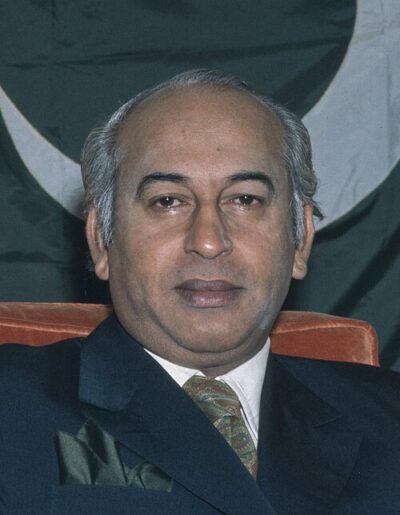
Zulfikar Ali Bhutto
Zulfikar Ali Bhutto was the 4th President and 9th Prime Minister of Pakistan. Born January 5, 1928, in Larkana. Died April 4, 1979, in Rawalpindi. Positions held include President of Pakistan (1971–1973), Prime Minister of Pakistan (1973–1977) and Speaker of the National Assembly of Pakistan (1972). Educated at University of Southern California and Christ Church.
Facts
35 facts · 2 confirmed by two sources · 4 cited · 29 from one source
Where this comes from
Papalocal keeps its own record. It started from these sources; what each one said is kept here as it was copied, so a change on their side never changes this page by itself. Tap one to read its version.
What Wikidata says · copied November 16, 2026 · revision 2568856382
- Described as
- 4th President and 9th Prime Minister of Pakistan (1928–1979)
- Other names
- Shaheed Zulfiqar Ali Bhutto, Zulfiqar Ali Bhutto
- Born
- January 5, 1928 · 5 references
- Died
- April 4, 1979 · 5 references
- Born in
- Larkana
- Died in
- Rawalpindi · 1 reference
- Buried in
- Bhutto family mausoleum
- Cause of death
- hanging to death
- Citizen of
- Pakistan; British Raj
- Occupation
- politician · 2 references; diplomat; lawyer
- Positions held
- President of Pakistan (1971–1973); Prime Minister of Pakistan (1973–1977); Speaker of the National Assembly of Pakistan (1972); Federal Minister for Foreign Affairs (2 times) (1963–1977); Member of the National Assembly of Pakistan; Federal Minister for Interior (2 times) (1971–1977) · 1 reference; Federal Minister for Defence (1971–1977) · 1 reference
- Political party
- Pakistan Peoples Party
- Education
- University of Southern California; Christ Church; University of California, Berkeley; City Law School; Cathedral and John Connon School; University of California · 1 reference
- Spouse
- Nusrat Bhutto · 1 reference; Shireen Amir
- Children
- Benazir Bhutto · 1 reference; Murtaza Bhutto · 1 reference; Sanam Bhutto.; Shahnawaz Bhutto
- Father
- Shah Nawaz Bhutto
- Mother
- Khursheed Begum
- Religion
- Islam; Shia Islam · 1 reference
- Wikipedias with a page
- 93
Wikidata item Q131355 (wikidata.org/wiki/Q131355), public domain (CC0). Copied November 16, 2026.
What Wikipedia says · copied November 16, 2026 · revision 1384966019
Zulfikar Ali Bhutto (5 January 1928 – 4 April 1979) was a Pakistani statesman who served as the fourth president of Pakistan from 1971 to 1973, and as the ninth prime minister of Pakistan from 1973 until his overthrow in 1977. He was the founder and first chairman of the Pakistan People's Party (PPP) from 1967 until his execution in 1979.
Born in Sindh and educated at the University of Southern California, University of California, Berkeley and the University of Oxford, Bhutto trained as a barrister at Lincoln's Inn before entering politics. He was a cabinet member during president Iskandar Mirza's tenure, holding various ministries during president Ayub Khan's military rule from 1958 and considered General Burki as a mentor. Bhutto became the foreign minister in 1963, advocating for Operation Gibraltar in Kashmir, leading to the 1965 war with India. Following the Tashkent Declaration, he was dismissed from the government. Bhutto established the Pakistan Peoples' Party (PPP) in 1967, focusing on a left-wing and socialist agenda, and contested the 1970 general election, arising as the largest political party in Western Pakistan with a landslide victory in Punjab and Sindh. The Awami League, victorious with a landslide in East Pakistan, and the PPP were unable to agree on power transfer, leading to civil unrest in the east — further intensified by military action under Yahya Khan's military government — followed by a civil war and a war with India, resulting in the creation of Bangladesh. After Pakistan's loss in the east, Yahya resigned amidst a military revolt against him and Bhutto assumed the presidency in December 1971, imposing emergency rule and securing a ceasefire on the western front.
Bhutto secured the release of 93,000 prisoners of war through the Delhi Agreement, a trilateral accord signed between India, Pakistan, and Bangladesh on 28 August 1973, and ratified only by India and Pakistan. He also reclaimed five thousand square miles (13,000 km2) of Indian-held territory through the Simla Agreement, signed between India and Pakistan in July 1972. He strengthened diplomatic ties with other Muslim countries, as well as China; and recognised Bangladesh in 1974 while hosting the historic Islamic Summit in Lahore — attended by leaders from 37 Muslim countries — marking the largest gathering of top Muslim leaders in modern history. After declaring a state of emergency in Balochistan in 1973, he dismissed Ataullah Mengal's government and imposed 'governor's rule', appointing Akbar Bugti as governor and ordering a military operation to suppress insurgency in the province. In collaboration with the parliamentary opposition, Bhutto's government drafted and promulgated Pakistan's current constitution in 1973, with the approval of 97 percent of the parliament — bringing an end to emergency rule and restoring parliamentary democracy across the country, with Bhutto assuming office as prime minister. He brought in Abdul Qadeer Khan, strengthened the Pakistan Atomic Energy Commission, and initiated the country's nuclear program which he regarded as a 'national priority'. Bhutto also introduced a policy of extensive nationalisation under his socialist agenda.
Despite winning the 1977 parliamentary elections, the Peoples Party faced allegations of vote rigging by the Pakistan National Alliance (PNA), the populist opposition, sparking violence across the country. Bhutto's government reached an agreement with the opposition to hold fresh elections under a neutral caretaker administration in October of the same year, but Bhutto was deposed two days later in a military coup by army chief Zia-ul-Haq on 5 July 1977. Controversially tried and executed in 1979, his trial — widely described, both in Pakistan and internationally, as a 'judicial murder' — was later declared 'unfair' by the Supreme Court of Pakistan in a mea culpa, following which he was posthumously awarded the Nishan-e-Pakistan, the country's highest civilian award, by the government of Pakistan.Bhutto's legacy remains contentious, praised for nationalist and a secular internationalist agenda, yet criticised for economic challenges, political repression and human rights abuses. He is often referred to as the Quaid-e-Awām ("the People's Leader") by his supporters. His daughter Benazir Bhutto served twice as prime minister, and his son-in-law, Asif Ali Zardari, twice as president.
- Born, in its opening lines
- January 5, 1928
- Died, in its opening lines
- April 4, 1979
From the Wikipedia article “Zulfikar Ali Bhutto” (en.wikipedia.org/wiki/Zulfikar_Ali_Bhutto), by its contributors, under CC BY-SA 4.0 (creativecommons.org/licenses/by-sa/4.0/). Copied November 16, 2026; not changed.
Confirmed Two sources agree. Cited One source, and it names where it got it. One source One source, without a reference of its own. Sources disagree The sources disagree. We show the best-supported value and keep theirs below.
