
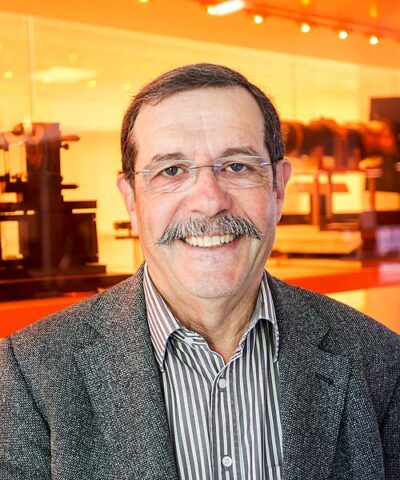
Alain Aspect
Alain Aspect is a French physicist. Born June 15, 1947, in Agen. Positions held include professor, Director of Research at CNRS and visiting professor. Educated at École normale supérieure Paris-Saclay and University of Paris-Sud. Awards include Niels Bohr International Gold Medal, UNESCO Niels Bohr Medal and CNRS Gold medal.
Facts
50 facts · 1 confirmed by two sources · 29 cited · 20 from one source
Where this comes from
Papalocal keeps its own record. It started from these sources; what each one said is kept here as it was copied, so a change on their side never changes this page by itself. Tap one to read its version.
What Wikidata says · copied November 16, 2026 · revision 2569383987
- Described as
- French physicist
- Born
- June 15, 1947 · 4 references
- Born in
- Agen · 4 references
- Name at birth
- Alain Jean Aspect
- Citizen of
- France
- Occupation
- physicist · 1 reference; university teacher · 1 reference
- Positions held
- professor · 1 reference; Director of Research at CNRS; visiting professor; Member of the Académie française (2025–)
- Worked for
- École normale supérieure Paris-Saclay (1974–1985); Collège de France (1985–1992) · 1 reference; National Center for Scientific Research (1992–2012) · 2 references; École Supérieure d'Optique, Paris-Saclay University (2012–) · 1 reference; Délégation Ile-de-France Gif-sur-Yvette (DR4) (1985–2012) · 1 reference
- Education
- École normale supérieure Paris-Saclay; University of Paris-Sud (–1983) · 1 reference
- Member of
- French Academy of Sciences (2001–) · 2 references; National Academy of Sciences (2008–); Royal Society of London (2015–) · 1 reference; French Academy of Technologies; Austrian Academy of Sciences (2009–) · 1 reference; Academia Europaea (2009–) · 1 reference; Royal Academy of Science, Letters and Fine Arts of Belgium (2015–) · 2 references; Parliamentary Office for the Evaluation of Scientific and Technological Choices; Académie Française (2025–); Accademia Nazionale dei Lincei (2018–) · 1 reference
- Awards
- Niels Bohr International Gold Medal (2013) · 1 reference; UNESCO Niels Bohr Medal (2013) · 1 reference; CNRS Gold medal (2005) · 1 reference; Frederic Ives Medal (2013) · 1 reference; Herbert Walther Prize (2012) · 1 reference; Max Born Award (1999) · 1 reference; Wolf Prize in Physics (2010) · 1 reference; Balzan Prize (2013) · 1 reference; Servant Prize (1983) · 1 reference; Holweck Prize (1991) · 1 reference; Gay-Lussac-Humboldt-Prize (1999) · 1 reference; Officer of the Legion of Honour (2014) · 1 reference; Albert Einstein Medal (2012) · 1 reference; Fellow of the American Physical Society (2005) · 1 reference; Foreign Member of the Royal Society (2015) · 1 reference
- Field
- quantum physics
- Spouse
- Annie Aspect
- Children
- Séverine Aspect; Laurent Aspect
- Father
- Jean Aspect
- Mother
- Denise Aspect
- Website
- http://www.lcf.institutoptique.fr/Alain-Aspect-homepage · 1 reference; https://www.lcf.institutoptique.fr/groupes-de-recherche/gaz-quantiques/membres/permanents/alain-aspect · 1 reference
- Wikipedias with a page
- 64
Wikidata item Q364997 (wikidata.org/wiki/Q364997), public domain (CC0). Copied November 16, 2026.
What Wikipedia says · copied November 16, 2026 · revision 1382269447
Alain Jean Aspect (French: [aspɛ] ; born 15 June 1947) is a French physicist noted for his experimental work on quantum entanglement. Aspect's experiment (1980–1982) bears his name.
Aspect was awarded the 2022 Nobel Prize in Physics, jointly with John Clauser and Anton Zeilinger, "for experiments with entangled photons, establishing the violation of Bell inequalities and pioneering quantum information science".
In 2025 he was elected to the Académie Française.
- Born, in its opening lines
- June 15, 1947
From the Wikipedia article “Alain Aspect” (en.wikipedia.org/wiki/Alain_Aspect), by its contributors, under CC BY-SA 4.0 (creativecommons.org/licenses/by-sa/4.0/). Copied November 16, 2026; not changed.
Confirmed Two sources agree. Cited One source, and it names where it got it. One source One source, without a reference of its own. Sources disagree The sources disagree. We show the best-supported value and keep theirs below.
