
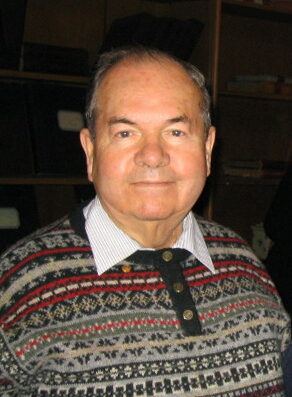
Alexei Abrikosov
Alexei Abrikosov was a Soviet, Russian and American theoretical physicist. Born June 25, 1928, in Moscow. Died March 29, 2017, in Palo Alto. Known for condensed matter physics. Educated at MSU Faculty of Physics. Awards include USSR State Prize, Nobel Prize in Physics and Fritz London Award.
Facts
41 facts · 2 confirmed by two sources · 22 cited · 17 from one source
Where this comes from
Papalocal keeps its own record. It started from these sources; what each one said is kept here as it was copied, so a change on their side never changes this page by itself. Tap one to read its version.
What Wikidata says · copied November 13, 2026 · revision 2567619609
- Described as
- Soviet, Russian and American theoretical physicist
- Other names
- Aleksey Alekseyevich Abrikosov, Aleksey A. Abrikosov, Aleksey Abrikosov, Aleksey A Abrikosov, A. A. Abrikosov, A A Abrikosov, A.A. Abrikosov, AA Abrikosov, A. Abrikosov, A Abrikosov, Abrikosov, Abrikosov A
- Born
- June 25, 1928 · 7 references
- Died
- March 29, 2017 · 5 references
- Born in
- Moscow · 2 references
- Died in
- Palo Alto · 1 reference
- Cause of death
- myocardial infarction
- Citizen of
- Russia; United States (1999–); Soviet Union
- Occupation
- physicist · 1 reference; university teacher · 1 reference
- Worked for
- Lomonosov Moscow State University (1948–1965); N. I. Lobachevsky State University of Nizhny Novgorod; Moscow Institute of Physics and Technology; National University of Science and Technology; P.L. Kapitza Institute for Physical Problems RAS (1948–1965); Landau Institute for Theoretical Physics (1965–1988); Institute for High Pressure Physics (1988–1991); University of Illinois Urbana-Champaign
- Education
- MSU Faculty of Physics (1945–1951)
- Member of
- National Academy of Sciences (2000–) · 1 reference; Academy of Sciences of the USSR (1964–) · 1 reference; American Academy of Arts and Sciences (1991–) · 1 reference; American Physical Society (1992–) · 1 reference; Royal Society of London (2001–) · 1 reference; Hungarian Academy of Sciences (2007–) · 1 reference; Russian Academy of Sciences (1987–) · 1 reference
- Known for
- condensed matter physics · 1 reference
- Awards
- USSR State Prize (1982) · 1 reference; Nobel Prize in Physics (2003) · 2 references; Fritz London Award (1972) · 1 reference; Lenin Prize (1966) · 1 reference; Landau Gold Medal (1989) · 1 reference; honorary doctorate from University of Orléans (2006) · 1 reference; Honorary doctor of the University of Lausanne (1976) · 1 reference; honorary doctorate from University of Bordeaux-I (2003) · 1 reference; John Bardeen Prize (1991) · 1 reference; Vernadsky medal (2015) · 1 reference
- Field
- theoretical physics · 1 reference; condensed matter physics
- Spouse
- Svetlana Bunkova
- Father
- Alexei Abrikosov
- Wikipedias with a page
- 83
Wikidata item Q188128 (wikidata.org/wiki/Q188128), public domain (CC0). Copied November 13, 2026.
What Wikipedia says · copied November 13, 2026 · revision 1371964862
Alexei Alexeyevich Abrikosov (Russian: Алексе́й Алексе́евич Абрико́сов; June 25, 1928 – March 29, 2017) was a Russian-American theoretical physicist whose main contributions are in the field of condensed matter physics. He was the co-recipient of the 2003 Nobel Prize in Physics, with Vitaly Ginzburg and Anthony James Leggett, for theories about how matter can behave at extremely low temperatures.
- Born, in its opening lines
- June 25, 1928
- Died, in its opening lines
- March 29, 2017
From the Wikipedia article “Alexei Abrikosov (physicist)” (en.wikipedia.org/wiki/Alexei_Abrikosov_(physicist)), by its contributors, under CC BY-SA 4.0 (creativecommons.org/licenses/by-sa/4.0/). Copied November 13, 2026; not changed.
Confirmed Two sources agree. Cited One source, and it names where it got it. One source One source, without a reference of its own. Sources disagree The sources disagree. We show the best-supported value and keep theirs below.
