
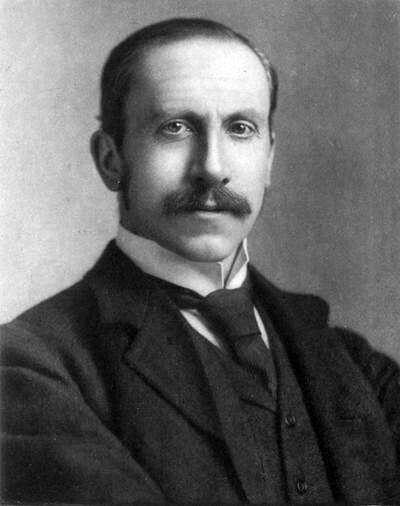
Alfred Milner, 1st Viscount Milner
Alfred Milner, 1st Viscount Milner was a British statesman and colonial administrator. Born March 23, 1854, in Giessen. Died May 13, 1925, in Canterbury. Positions held include Secretary of State for War, Secretary of State for the Colonies and Member of the Privy Council of the United Kingdom. Educated at University of Tübingen and Balliol College. Awards include Knight Grand Cross of the Order of the Bath, Knight Grand Cross of the Order of St Michael and St George and Knight of the Garter.
Facts
31 facts · 2 confirmed by two sources · 10 cited · 19 from one source
Where this comes from
Papalocal keeps its own record. It started from these sources; what each one said is kept here as it was copied, so a change on their side never changes this page by itself. Tap one to read its version.
What Wikidata says · copied November 16, 2026 · revision 2563004663
- Described as
- British statesman and colonial administrator (1854-1925)
- Other names
- Viscount Milner
- Born
- March 23, 1854 · 6 references
- Died
- May 13, 1925 · 6 references
- Born in
- Giessen · 2 references
- Died in
- Canterbury · 1 reference
- Buried in
- The Parish Church of St Mary, Salehurst · 1 reference
- Cause of death
- infectious disease
- Citizen of
- United Kingdom of Great Britain and Ireland
- Occupation
- journalist; diplomat · 1 reference; politician · 1 reference; author · 1 reference
- Positions held
- Secretary of State for War; Secretary of State for the Colonies; Member of the Privy Council of the United Kingdom; ambassador; member of the House of Lords; High Commissioner for Southern Africa (1897–1905); Governor of the Cape Colony (1897–1905); defence minister · 1 reference
- Political party
- Conservative Party
- Education
- University of Tübingen; Balliol College; King's College School; King's College London
- Awards
- Knight Grand Cross of the Order of the Bath; Knight Grand Cross of the Order of St Michael and St George; Knight of the Garter · 1 reference; Livingstone Medal
- Spouse
- Violet Milner, Viscountess Milner (1921–) · 2 references
- Father
- Charles Milner · 1 reference
- Mother
- Mary Ierne Ready · 1 reference
- Wikipedias with a page
- 30
Wikidata item Q356361 (wikidata.org/wiki/Q356361), public domain (CC0). Copied November 16, 2026.
What Wikipedia says · copied November 16, 2026 · revision 1379562951
Alfred Milner, 1st Viscount Milner, (23 March 1854 – 13 May 1925) was a British statesman and colonial administrator who played a very important role in the formulation of British foreign and domestic policy between the mid-1890s and the early 1920s. From December 1916 to November 1918, he was one of the most important members of Prime Minister David Lloyd George's War cabinet.
Milner was born in the Grand Duchy of Hesse in 1854, and was educated in Germany and England before attending Balliol College, Oxford, where he graduated with a first class in classics. Though he was called to the bar in 1881, Milner instead became a journalist before entering politics as a Liberal, before leaving the party in 1886 over his opposition to Irish Home Rule. He joined the staff of the Chancellor of the Exchequer George Goschen and was posted to Egypt as under-secretary of finance. He briefly chaired the Board of Inland Revenue until April 1897, when he was appointed Governor of the Cape Colony and High Commissioner for Southern Africa by Joseph Chamberlain following the disastrous Jameson Raid.
As Governor and High Commissioner, Milner was a leading advocate for British subjects of the Transvaal and Orange Free State, and his policy precipitated the Second Boer War. During the war, Milner received praise and criticism for his civilian administration in South Africa, including the establishment of concentration camps to intern the Boers. Following the British victory and annexation of the Boer republics, Milner was named the first British governor. Upon his return to England in 1905, he faced censure for the use of corporal punishment against Chinese labourers. He remained a firm advocate for British imperialism for the remainder of his life. Through his influence on young civil servants and imperialists, including Lionel Curtis and Leo Amery, Milner's influence on the British Empire extended through the Second World War.
During the First World War, Milner served as a key advisor and cabinet member to Prime Minister David Lloyd George. During the March 1918 collapse of the Western Front, Milner coordinated the consolidation of Allied forces under the commander of Ferdinand Foch, whom he personally selected as Supreme Allied Commander. Foch won the Battle of Amiens, repelling the German advance and turning the tide of the war. Milner was appointed Secretary of State for War for the duration of the conflict, which resulted in an Allied victory and armistice in November 1918. At the subsequent Paris Peace Conference, Milner was a leading delegate and a signatory to the Treaty of Versailles. He served as Secretary of State for the Colonies for the remainder of his public career.
- Born, in its opening lines
- March 23, 1854
- Died, in its opening lines
- May 13, 1925
From the Wikipedia article “Alfred Milner, 1st Viscount Milner” (en.wikipedia.org/wiki/Alfred_Milner,_1st_Viscount_Milner), by its contributors, under CC BY-SA 4.0 (creativecommons.org/licenses/by-sa/4.0/). Copied November 16, 2026; not changed.
Confirmed Two sources agree. Cited One source, and it names where it got it. One source One source, without a reference of its own. Sources disagree The sources disagree. We show the best-supported value and keep theirs below.
