
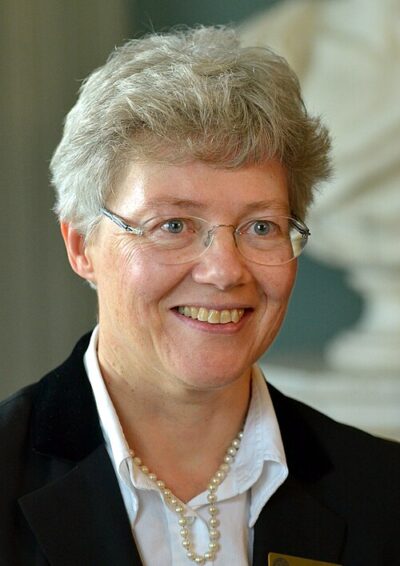
Anne L'Huillier
Anne L'Huillier is a French physicist. Born August 16, 1958, in Paris. Educated at École normale supérieure de Fontenay-aux-Roses and Pierre and Marie Curie University. Awards include Fellow of the American Physical Society, Fellow of the Optical Society and Göran Gustafsson Prize for physics.
Facts
39 facts · 1 confirmed by two sources · 24 cited · 14 from one source
Where this comes from
Papalocal keeps its own record. It started from these sources; what each one said is kept here as it was copied, so a change on their side never changes this page by itself. Tap one to read its version.
What Wikidata says · copied November 16, 2026 · revision 2567914464
- Described as
- French physicist
- Other names
- A. L'Huillier, A L'Huillier, L'Huillier, L'Huillier A, L'Huillier A., Anne L’Huillier Wahlström
- Born
- August 16, 1958 · 2 references
- Born in
- Paris · 1 reference
- Name at birth
- Anne Geneviève · 1 reference
- Citizen of
- France; Sweden
- Occupation
- physicist; university teacher · 1 reference; nuclear physicist · 1 reference
- Worked for
- Lund University (1995–) · 1 reference
- Education
- École normale supérieure de Fontenay-aux-Roses; Pierre and Marie Curie University (–1986) · 1 reference
- Member of
- Royal Swedish Academy of Sciences; Royal Swedish Academy of Engineering Sciences; National Academy of Sciences (2018–) · 1 reference; American Physical Society (1997–) · 1 reference; Austrian Academy of Sciences (2021–) · 1 reference; Accademia Nazionale dei Lincei (2021–) · 1 reference; Academia Europaea (2024–) · 1 reference; European Academy of Sciences (2014–) · 1 reference
- Awards
- Fellow of the American Physical Society (1997) · 1 reference; Fellow of the Optical Society (2016) · 1 reference; Göran Gustafsson Prize for physics (1998) · 1 reference; L'Oréal-UNESCO Award For Women in Science (2011) · 1 reference; doctor honoris causa from the Pierre and Marie Curie University (2013) · 1 reference; Zeiss Research Award (2013) · 1 reference; Emmy Noether Distinction for Women in Physics (2014) · 1 reference; honorary doctor of the University of Jena (2015); Max Born Award (2021) · 1 reference; Wolf Prize in Physics (2022) · 1 reference; BBVA Foundation Frontiers of Knowledge Award (2022) · 1 reference; Nobel Prize in Physics (2023) · 1 reference; honorary doctor of the University Paris-Saclay (2023) · 2 references; Commander of the Legion of Honour (2023) · 1 reference; Commanders Grand Cross of the Order of the Polar Star (2024) · 1 reference
- Field
- physics; attophysics; ultrafast imaging
- Spouse
- Claes-Göran Wahlström (1994–) · 1 reference
- Website
- https://portal.research.lu.se/en/persons/anne-lhuillier
- Wikipedias with a page
- 62
Wikidata item Q565544 (wikidata.org/wiki/Q565544), public domain (CC0). Copied November 16, 2026.
What Wikipedia says · copied November 16, 2026 · revision 1384340669
Anne Geneviève L'Huillier (French: [an lɥije]; born 16 August 1958) is a French physicist. She is a professor of atomic physics at Lund University in Sweden.
She leads an attosecond physics group which works through the movements of electrons in real time, which is used to understand chemical reactions on the atomic level.
Her experimental and theoretical research are credited with laying the foundation for the field of attochemistry.
In 2003 she and her group beat the world record for the shortest laser pulse, of 170 attoseconds.
L'Huillier became a member of the Royal Swedish Academy of Sciences in 2004. She has received various physics awards including the Wolf Prize in Physics in 2022 and the Nobel Prize in Physics in 2023. In 2024 she was awarded the Great Gold Medal of the Royal Swedish Academy of Engineering Sciences.
- Born, in its opening lines
- August 16, 1958
From the Wikipedia article “Anne L'Huillier” (en.wikipedia.org/wiki/Anne_L'Huillier), by its contributors, under CC BY-SA 4.0 (creativecommons.org/licenses/by-sa/4.0/). Copied November 16, 2026; not changed.
Confirmed Two sources agree. Cited One source, and it names where it got it. One source One source, without a reference of its own. Sources disagree The sources disagree. We show the best-supported value and keep theirs below.
