
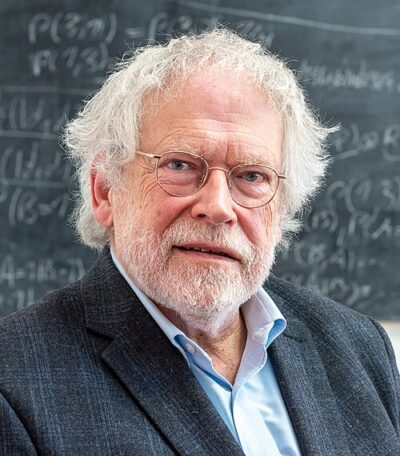
Anton Zeilinger
Anton Zeilinger is an Austrian quantum physicist. Born May 20, 1945, in Ried im Innkreis. Educated at University of Vienna. Awards include Kardinal-Innitzer-Preis, Pour le Mérite for Sciences and Arts order and Prize of the City of Vienna for Natural Sciences.
Facts
41 facts · 1 confirmed by two sources · 31 cited · 9 from one source
Where this comes from
Papalocal keeps its own record. It started from these sources; what each one said is kept here as it was copied, so a change on their side never changes this page by itself. Tap one to read its version.
What Wikidata says · copied November 16, 2026 · revision 2569768016
- Described as
- Austrian quantum physicist (born 1945)
- Other names
- A. Zeilinger, A Zeilinger, Zeilinger, Zeilinger A, Zeilinger A.
- Born
- May 20, 1945 · 3 references
- Born in
- Ried im Innkreis · 1 reference
- Citizen of
- Austria
- Occupation
- physicist · 1 reference; quantum physicist; university teacher · 1 reference; nuclear physicist · 1 reference
- Worked for
- TU Wien (1972–1990) · 1 reference; Massachusetts Institute of Technology (1977–1978) · 1 reference; Technical University of Munich (1988–1989) · 1 reference; University of Innsbruck (1990–1999) · 1 reference; University of Vienna (1999–) · 1 reference; Austrian Academy of Sciences (2013–2022) · 1 reference
- Education
- University of Vienna (–1971) · 1 reference
- Member of
- KaV Marco-Danubia Wien (1966–) · 1 reference; Berlin-Brandenburg Academy of Sciences and Humanities (2002–) · 1 reference; German Academy of Sciences Leopoldina (2005–) · 1 reference; Austrian Academy of Sciences · 1 reference; The Learned Society of Slovakia (2005–) · 1 reference; Serbian Academy of Sciences and Arts (2006–) · 1 reference; French Academy of Sciences (2010–) · 1 reference; European Academy of Sciences and Arts; Academia Europaea (2011–) · 1 reference; National Academy of Sciences (2013–) · 1 reference
- Awards
- Kardinal-Innitzer-Preis (1996) · 1 reference; Pour le Mérite for Sciences and Arts order (2000) · 1 reference; Prize of the City of Vienna for Natural Sciences (2000); Humboldt Prize (2000) · 1 reference; Austrian Decoration for Science and Art (2001) · 1 reference; Johannes Kepler Award (2002) · 1 reference; Lorenz Oken Medal (2004) · 1 reference; Klopsteg Memorial Award (2004) · 1 reference; King Faisal Prize in Science (2005) · 1 reference; Wilhelm Exner Medal (2005) · 1 reference; Honorary doctor of the Humboldt University of Berlin (2005) · 1 reference; Descartes Prize (2005) · 1 reference; Decoration of Honour in Gold for Services to the State of Vienna (2006) · 1 reference; Honorary doctor of the University of Gdańsk (2006); Wolfgang Paul Lecture (2007)
- Field
- quantum physics
- Father
- Anton Zeilinger · 1 reference
- Wikipedias with a page
- 61
Wikidata item Q78610 (wikidata.org/wiki/Q78610), public domain (CC0). Copied November 16, 2026.
What Wikipedia says · copied November 16, 2026 · revision 1383665793
Anton Zeilinger (German: [ˈanton ˈtsaɪlɪŋɐ]; born 20 May 1945) is an Austrian quantum physicist and Nobel laureate in physics of 2022. Zeilinger is professor of physics emeritus at the University of Vienna and senior scientist at the Institute for Quantum Optics and Quantum Information of the Austrian Academy of Sciences. Most of his research concerns the fundamental aspects and applications of quantum entanglement.
In 2007, Zeilinger received the first Inaugural Isaac Newton Medal of the Institute of Physics, London, for "his pioneering conceptual and experimental contributions to the foundations of quantum physics, which have become the cornerstone for the rapidly-evolving field of quantum information". In October 2022, he received the Nobel Prize in Physics, jointly with Alain Aspect and John Clauser for their work involving experiments with entangled photons, establishing the violation of Bell inequalities and pioneering quantum information science.
- Born, in its opening lines
- May 20, 1945
From the Wikipedia article “Anton Zeilinger” (en.wikipedia.org/wiki/Anton_Zeilinger), by its contributors, under CC BY-SA 4.0 (creativecommons.org/licenses/by-sa/4.0/). Copied November 16, 2026; not changed.
Confirmed Two sources agree. Cited One source, and it names where it got it. One source One source, without a reference of its own. Sources disagree The sources disagree. We show the best-supported value and keep theirs below.
