
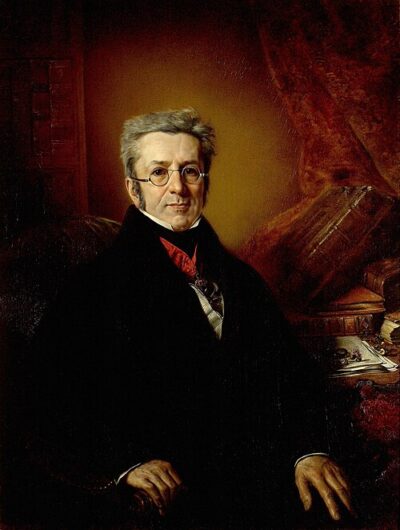
Augustin-Pyramus de Candolle
Augustin-Pyramus de Candolle was a Swiss botanist. Born February 4, 1778, in Geneva. Died September 9, 1841, in Geneva. Positions held include dean for the Academy of Montpellier (1815) and professor (1807–1816). Known for De Candolle system, Plantarum historia succulentarum and Geneva Botanic Garden. Educated at University of Paris and University of Geneva. Awards include Royal Medal and Foreign Member of the Royal Society.
Facts
44 facts · 2 confirmed by two sources · 16 cited · 26 from one source
Where this comes from
Papalocal keeps its own record. It started from these sources; what each one said is kept here as it was copied, so a change on their side never changes this page by itself. Tap one to read its version.
What Wikidata says · copied November 16, 2026 · revision 2569087330
- Described as
- Swiss botanist (1778–1841)
- Other names
- DC., Augustin de Candolle, Augustin Pyrame de Candolle, Augustin Pyramus, de Candolle, Candolle
- Born
- February 4, 1778 · 12 references
- Died
- September 9, 1841 · 12 references
- Born in
- Geneva · 5 references
- Died in
- Geneva · 5 references
- Buried in
- Cemetery of Kings · 2 references
- Citizen of
- Republic of Geneva (2 times) (1798–1815) · 1 reference; France (1798–1813); Switzerland (1815–)
- Occupation
- botanist · 2 references; professor · 1 reference; zoologist · 1 reference; naturalist · 1 reference; botanical collector · 3 references; scientific collector · 1 reference
- Positions held
- dean for the Academy of Montpellier (1815); professor (1807–1816)
- Worked for
- University of Geneva · 1 reference; University of Montpellier · 1 reference
- Education
- University of Paris · 1 reference; University of Geneva · 1 reference; Collège Calvin (1794–)
- Member of
- Royal Netherlands Academy of Arts and Sciences · 1 reference; Saint Petersburg Academy of Sciences (1835–) · 2 references; German Academy of Sciences Leopoldina (1818–) · 1 reference; Academy of Sciences of Turin (1805–) · 1 reference; Royal Society of London (1822–) · 1 reference; Académie de Stanislas (Nancy, France) · 1 reference
- Known for
- De Candolle system; Plantarum historia succulentarum; Geneva Botanic Garden; Théorie élémentaire de la botanique
- Awards
- Royal Medal · 1 reference; Foreign Member of the Royal Society (1822) · 1 reference
- Field
- taxonomy · 1 reference; natural science · 1 reference; botany; economic botany; agronomy; phytogeography
- Spouse
- Françoise Torras (1802–) · 1 reference
- Children
- Alphonse Pyramus de Candolle · 1 reference
- Father
- Augustin de Candolle · 1 reference
- Mother
- Louise Eléonore Brière · 1 reference
- Religion
- reformed · 1 reference
- Wikipedias with a page
- 53
Wikidata item Q123057 (wikidata.org/wiki/Q123057), public domain (CC0). Copied November 16, 2026.
What Wikipedia says · copied November 16, 2026 · revision 1381361934
Augustin Pyramus (or Pyrame) de Candolle (UK: , US: , French: [kɑ̃dɔl]; 4 February 1778 – 9 September 1841) was a Swiss botanist. René Louiche Desfontaines launched de Candolle's botanical career by recommending him at a herbarium. Within a couple of years de Candolle had established a new genus, and he went on to document hundreds of plant families and create a new natural plant classification system. Although de Candolle's main focus was botany, he also contributed to related fields such as phytogeography, agronomy, paleontology, medical botany, and economic botany.
De Candolle originated the idea of "Nature's war", which influenced Charles Darwin and the principle of natural selection. De Candolle recognized that multiple species may develop similar characteristics that did not appear in a common evolutionary ancestor; a phenomenon now known as convergent evolution. During his work with plants, de Candolle noticed that plant leaf movements follow a near-24-hour cycle in constant light, suggesting that an internal biological clock exists. Though many scientists doubted de Candolle's findings, experiments over a century later demonstrated that "the internal biological clock" indeed exists.
De Candolle's descendants continued his work on plant classification; son Alphonse and grandson Casimir de Candolle contributed to the Prodromus Systematis Naturalis Regni Vegetabilis, a catalog of plants begun by Augustin Pyramus de Candolle.
- Born, in its opening lines
- February 4, 1778
- Died, in its opening lines
- September 9, 1841
From the Wikipedia article “Augustin Pyramus de Candolle” (en.wikipedia.org/wiki/Augustin_Pyramus_de_Candolle), by its contributors, under CC BY-SA 4.0 (creativecommons.org/licenses/by-sa/4.0/). Copied November 16, 2026; not changed.
Confirmed Two sources agree. Cited One source, and it names where it got it. One source One source, without a reference of its own. Sources disagree The sources disagree. We show the best-supported value and keep theirs below.
