
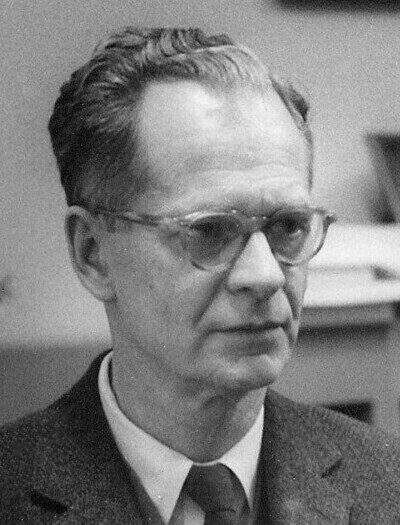
B.F. Skinner
B.F. Skinner was an American behaviorist. Born March 20, 1904, in Susquehanna Depot. Died August 18, 1990, in Cambridge. Known for The Behavior of Organisms and Beyond Freedom and Dignity. Educated at Harvard University and Hamilton College. Awards include Guggenheim Fellowship, Howard Crosby Warren Medal and Humanist of the Year.
Facts
44 facts · 2 confirmed by two sources · 20 cited · 22 from one source
Where this comes from
Papalocal keeps its own record. It started from these sources; what each one said is kept here as it was copied, so a change on their side never changes this page by itself. Tap one to read its version.
What Wikidata says · copied November 13, 2026 · revision 2561679003
- Described as
- American behaviorist (1904–1990)
- Other names
- Burrhus F. Skinner, Skinner BF, Burrhus Frederic Skinner, B. F. Skinner
- Born
- March 20, 1904 · 14 references
- Died
- August 18, 1990 · 13 references
- Born in
- Susquehanna Depot · 1 reference
- Died in
- Cambridge · 2 references
- Buried in
- Mount Auburn Cemetery · 1 reference
- Cause of death
- leukemia
- Name at birth
- Burrhus Frederic Skinner
- Citizen of
- United States · 1 reference
- Occupation
- psychologist · 2 references; philosopher; inventor; ethologist; autobiographer; university teacher · 2 references; writer
- Worked for
- Harvard University · 1 reference; University of Minnesota · 1 reference; University of Chicago · 1 reference
- Education
- Harvard University (–1931) · 1 reference; Hamilton College (–1926) · 1 reference
- Member of
- American Academy of Arts and Sciences; American Philosophical Society (1949–) · 1 reference; National Academy of Sciences
- Known for
- The Behavior of Organisms; Beyond Freedom and Dignity
- Awards
- Guggenheim Fellowship (1942) · 1 reference; Howard Crosby Warren Medal (1942) · 1 reference; Humanist of the Year (1972); APA Award for Distinguished Scientific Contributions to Psychology (1958) · 1 reference; National Medal of Science (1968); Career Achievement Award for Distinguished Psychological Contributions to Education (1966) · 1 reference; Kenneth D. Herman, Ph.D., J.D. Career Contribution Award (1972) · 1 reference; Gold Medal Award (1971); William James Fellow Award (1989) · 1 reference; APA Award for Outstanding Lifetime Contributions to Psychology (1990) · 1 reference; doctor honoris causa of Keiō University; Fellow of the Committee for Skeptical Inquiry; Honorary Fellow of the British Psychological Society (1962) · 1 reference
- Field
- psychology; behavioral analytics
- Spouse
- Yvonne Blue
- Children
- Julie Vargas; Deborah Buzan · 1 reference
- Lived in
- United States · 1 reference
- Wikipedias with a page
- 90
Wikidata item Q213195 (wikidata.org/wiki/Q213195), public domain (CC0). Copied November 13, 2026.
What Wikipedia says · copied November 13, 2026 · revision 1373395233
Burrhus Frederic Skinner (March 20, 1904 – August 18, 1990) was an American psychologist, behaviorist, inventor, and social philosopher. He was the Edgar Pierce Professor of Psychology at Harvard University from 1948 until his retirement in 1974.
Skinner developed behavior analysis, especially the philosophy of radical behaviorism, and founded the experimental analysis of behavior, a school of experimental research psychology. He also used operant conditioning to strengthen behavior, considering the rate of response to be the most effective measure of response strength. To study operant conditioning, he invented the operant conditioning chamber (aka the Skinner box), and to measure rate he invented the cumulative recorder. Using these tools, he and Charles Ferster produced Skinner's most influential experimental work, outlined in their 1957 book Schedules of Reinforcement.
Skinner was a prolific author, publishing 21 books and 180 articles. He imagined the application of his ideas to the design of a human community in his 1948 utopian novel, Walden Two, while his analysis of human behavior culminated in his 1958 work, Verbal Behavior.
Skinner, John B. Watson, and Ivan Pavlov are considered to be the pioneers of modern behaviorism. A June 2002 survey listed Skinner as the most influential psychologist of the 20th century.
- Born, in its opening lines
- March 20, 1904
- Died, in its opening lines
- August 18, 1990
From the Wikipedia article “B. F. Skinner” (en.wikipedia.org/wiki/B._F._Skinner), by its contributors, under CC BY-SA 4.0 (creativecommons.org/licenses/by-sa/4.0/). Copied November 13, 2026; not changed.
Confirmed Two sources agree. Cited One source, and it names where it got it. One source One source, without a reference of its own. Sources disagree The sources disagree. We show the best-supported value and keep theirs below.
