
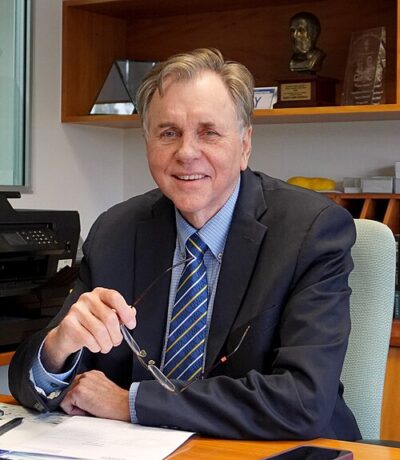
Barry Marshall
Barry Marshall is a Nobel Prize winner, and Professor of Clinical Microbiology. Born September 30, 1951, in Kalgoorlie. Educated at University of Western Australia and Newman College, Perth. Awards include Fellow of the Royal Society, Nobel Prize in Physiology or Medicine and Benjamin Franklin Medal.
Facts
35 facts · 1 confirmed by two sources · 8 cited · 26 from one source
Where this comes from
Papalocal keeps its own record. It started from these sources; what each one said is kept here as it was copied, so a change on their side never changes this page by itself. Tap one to read its version.
What Wikidata says · copied November 16, 2026 · revision 2563200346
- Described as
- Nobel Prize winner, and Professor of Clinical Microbiology
- Other names
- Barry James Marshall, Barry J. Marshall
- Born
- September 30, 1951 · 5 references
- Born in
- Kalgoorlie
- Citizen of
- Australia
- Occupation
- physician; professor; microbiologist · 1 reference; autobiographer
- Worked for
- Royal Perth Hospital (1979–); University of Virginia (1986–); Pennsylvania State University (2007–); University of Western Australia (1998–2003)
- Education
- University of Western Australia (–1974); Newman College, Perth
- Member of
- Royal Society of London (1999); National Academy of Sciences (2008–); Chinese Academy of Engineering; Australian Academy of Science
- Awards
- Fellow of the Royal Society (1999); Nobel Prize in Physiology or Medicine (2005) · 2 references; Benjamin Franklin Medal (1999); Canada Gairdner International Award (1996); Paul Ehrlich and Ludwig Darmstaedter Prize (1997); Dr A.H. Heineken Prize for Medicine (1998); Lasker-DeBakey Clinical Medical Research Award (1995) · 1 reference; Keio Medical Science Prize (2002) · 1 reference; Florey Medal (1998) · 1 reference; Buchanan Medal (1998); Centenary Medal (2001) · 1 reference; Fellow of the Australian Academy of Health and Medical Sciences; Fellow of the Australian Academy of Science (1999) · 1 reference; honorary doctor of the Chinese University of Hong Kong (2013) · 1 reference; Macfarlane Burnet Medal and Lecture (2003) · 1 reference
- Field
- microbiology
- Lived in
- Subiaco (2007) · 1 reference; Nedlands (2001) · 1 reference
- Wikipedias with a page
- 67
Wikidata item Q202136 (wikidata.org/wiki/Q202136), public domain (CC0). Copied November 16, 2026.
What Wikipedia says · copied November 16, 2026 · revision 1381483589
Barry James Marshall (born 30 September 1951) is an Australian physician, Nobel Laureate in Physiology or Medicine, Professor of Clinical Microbiology and Co-Director of the Marshall Centre at the University of Western Australia. Marshall and Robin Warren showed that the bacterium Helicobacter pylori (H. pylori) plays a major role in causing many peptic ulcers, challenging decades of medical doctrine holding that ulcers were caused primarily by stress, spicy foods, and too much acid. This discovery has allowed for a breakthrough in understanding a causative link between Helicobacter pylori infection and stomach cancer.
He is a prominent example, in the tradition of John Scott Haldane, JBS Haldane and, much later, Jonas Salk, of testing a medical hypothesis by self-administration.
- Born, in its opening lines
- September 30, 1951
From the Wikipedia article “Barry Marshall” (en.wikipedia.org/wiki/Barry_Marshall), by its contributors, under CC BY-SA 4.0 (creativecommons.org/licenses/by-sa/4.0/). Copied November 16, 2026; not changed.
Confirmed Two sources agree. Cited One source, and it names where it got it. One source One source, without a reference of its own. Sources disagree The sources disagree. We show the best-supported value and keep theirs below.
