
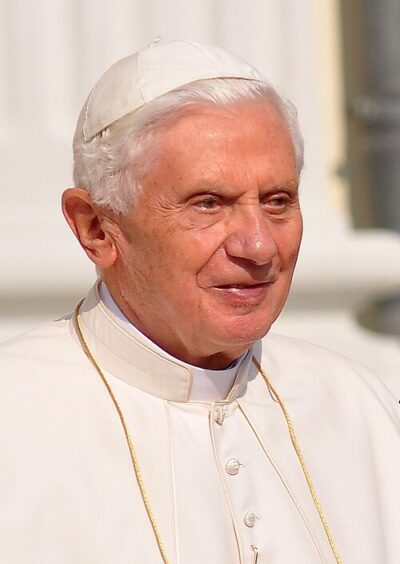
Benedict XVI
Benedict XVI was the 265 th pope of the Catholic Church. Born April 16, 1927, in Birth house of Benedict XVI. Died December 31, 2022, in Vatican City. Positions held include prefect of the Congregation for the Doctrine of the Faith (1981–2005), Pope (2005–2013) and Cardinal-Bishop of Velletri-Segni (1993–2005). Educated at LMU Munich and Ducal Georgianum. Awards include Commander of the Legion of Honour, Bavarian Order of Merit and Bayerische Verfassungsmedaille in Gold.
Facts
63 facts · 2 confirmed by two sources · 25 cited · 36 from one source
Where this comes from
Papalocal keeps its own record. It started from these sources; what each one said is kept here as it was copied, so a change on their side never changes this page by itself. Tap one to read its version.
What Wikidata says · copied November 16, 2026 · revision 2569298254
- Described as
- 265 th pope of the Catholic Church (2005–2013)
- Other names
- Pope Benedict XVI, Benedetto XVI, Pope Emeritus Benedict XVI, Pope Benedictus XVI, Joseph Aloisius Ratzinger, Joseph Ratzinger, Josef Ratzinger, Joseph Alois Ratzinger, Benedictus XVI
- Born
- April 16, 1927 · 8 references
- Died
- December 31, 2022 · 3 references
- Born in
- Birth house of Benedict XVI · 1 reference
- Died in
- Vatican City · 1 reference
- Buried in
- Vatican Grotto
- Name at birth
- Joseph Aloisius Ratzinger
- Citizen of
- Germany · 2 references; Vatican City · 1 reference; Italy · 1 reference
- Occupation
- Latin Catholic priest (1951–2023) · 1 reference; religious writer; university teacher; philosopher; transitional deacon (1950–1951) · 1 reference; Latin Catholic bishop (1977–2023); Catholic theologian · 2 references; archbishop · 2 references
- Positions held
- prefect of the Congregation for the Doctrine of the Faith (1981–2005); Pope (2005–2013) · 3 references; Cardinal-Bishop of Velletri-Segni (1993–2005) · 1 reference; cardinal-bishop of Ostia (2002–2005) · 1 reference; Dean of the College of Cardinals (2002–2005); cardinal priest (1977–1993) · 1 reference; Roman Catholic Archbishop of Munich and Freising (1977–1982) · 4 references; Pope emeritus (2013–2023) · 1 reference; cardinal (1977–) · 4 references
- Worked for
- University of Tübingen; University of Bonn; LMU Munich; University of Münster; University of Regensburg
- Education
- LMU Munich · 1 reference; Ducal Georgianum (1949–1951)
- Member of
- North Rhine-Westphalia Academy for Sciences and Arts; European Academy of Sciences and Arts; Académie des Sciences Morales et Politiques; Pontifical Academy of St. Thomas Aquinas · 1 reference; Hitler Youth · 1 reference
- Instrument
- piano
- Awards
- Commander of the Legion of Honour (1998); Bavarian Order of Merit (1977); Bayerische Verfassungsmedaille in Gold; Stephanus Award; honorary doctorate (2015) · 1 reference; Bavarian Maximilian Order for Science and Art (1995); honorary doctor of Babeș-Bolyai University (2005); honorary citizenship (7 times) (2005, 2006, 2008, 2009, 2010, 2011, 2018) · 1 reference; Grand Cross 1st class of the Order of Merit of the Federal Republic of Germany (1994); honorary doctorate from the Catholic University of Lublin (1988); Order of Karl Valentin (1989); honorary doctor of the Catholic University of Eichstätt-Ingolstadt (1987); honorary doctorate of the University of Navarre · 1 reference; honorary doctorate from the Pontifical Catholic University of Peru (1986); honorary doctor of the University of Wrocław (2000)
- Field
- Christian theology · 1 reference; Petrine ministry · 1 reference
- Father
- Joseph Ratzinger, Sr. · 1 reference
- Mother
- Maria Peintner · 2 references
- Siblings
- Georg Ratzinger · 2 references
- Religion
- Catholic Church · 1 reference; Catholicism · 1 reference
- Lived in
- Mater Ecclesiae Monastery (2013–2023)
- Website
- https://www.vatican.va/content/benedict-xvi/en.html
- Wikipedias with a page
- 200
Wikidata item Q2494 (wikidata.org/wiki/Q2494), public domain (CC0). Copied November 16, 2026.
What Wikipedia says · copied November 16, 2026 · revision 1385937698
Pope Benedict XVI (born Joseph Alois Ratzinger; 16 April 1927 – 31 December 2022) was the head of the Catholic Church and sovereign of the Vatican City from 2005 until his resignation in 2013. Following his resignation, he chose to be known as "pope emeritus", a title he held until his death on 31 December 2022. In addition to this, he was an important philosopher and theologian of the 20th and early 21st centuries.
Ordained as a priest in 1951 in Bavaria, Ratzinger embarked on an academic career and established himself as a highly regarded theologian by the late 1950s. He was appointed a full professor in 1958 when aged 31. After a long career as a professor of theology at several German universities, he was appointed Archbishop of Munich and Freising and created a cardinal by Pope Paul VI in 1977, an unusual promotion for someone who had only been ordained to the episcopate less than a month prior and not having much pastoral experience. In 1981, he was appointed Prefect of the Congregation for the Doctrine of the Faith, one of the most important dicasteries of the Roman Curia. In 2002, he also became Dean of the College of Cardinals. Before becoming pope, he had been "a major figure on the Vatican stage for a quarter of a century"; he had had an influence "second to none when it came to setting church priorities and directions" as one of John Paul II's closest confidants. Following the death of John Paul II on 2 April 2005, a conclave elected Ratzinger as his successor on 19 April; he chose Benedict XVI as his papal name in honour of Benedict XV and Benedict of Nursia.
Benedict's writings were prolific and generally defended traditional Catholic doctrine, values, and liturgy. He was originally a liberal theologian but adopted conservative views after 1968. During his papacy, Benedict advocated a return to fundamental Christian values to counter the increased secularisation of many Western countries. He viewed relativism's denial of objective truth, and the denial of moral truths in particular, as the central problem of the 21st century. Benedict also revived several traditions and permitted greater use of the Tridentine Mass. He strengthened the relationship between the Catholic Church and art, promoted the use of Latin, and reintroduced traditional papal vestments, for which reason he was called "the pope of aesthetics". He also established personal ordinariates for former Anglicans and Methodists joining the Catholic Church. Benedict's handling of sexual abuse cases within the Catholic Church and opposition to usage of condoms in areas of high HIV transmission were criticized by public health officials, anti-AIDS activists, and victims' rights organizations.
Citing health reasons due to his advanced age, Benedict resigned as pope on 28 February 2013. He became the first pope to resign from office since Gregory XII in 1415, and the first without external pressure since Celestine V in 1294. He subsequently moved into the newly renovated Mater Ecclesiae Monastery in Vatican City for his retirement. The 2013 conclave elected Francis as his successor on 13 March. In addition to his native German language, Benedict had proficiency in French, Italian, English, and Spanish. He also knew Portuguese, Latin, Biblical Hebrew, and Biblical Greek. He was a member of several social science academies, such as the French Académie des Sciences Morales et Politiques.
- Born, in its opening lines
- April 16, 1927
- Died, in its opening lines
- December 31, 2022
From the Wikipedia article “Pope Benedict XVI” (en.wikipedia.org/wiki/Pope_Benedict_XVI), by its contributors, under CC BY-SA 4.0 (creativecommons.org/licenses/by-sa/4.0/). Copied November 16, 2026; not changed.
Confirmed Two sources agree. Cited One source, and it names where it got it. One source One source, without a reference of its own. Sources disagree The sources disagree. We show the best-supported value and keep theirs below.
