
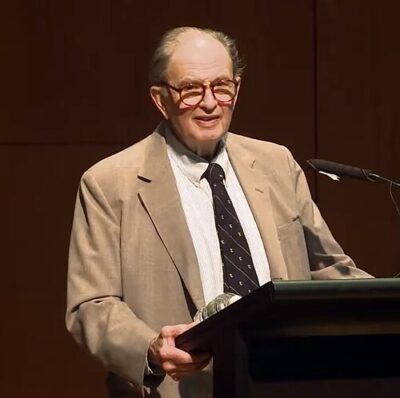
Bernard Bailyn
Bernard Bailyn was an American historian. Born September 10, 1922, in Hartford. Died August 7, 2020, in Belmont. Educated at Williams College and Harvard University. Awards include National Humanities Medal, National Book Award and Harvard Centennial Medal.
Facts
39 facts · 2 confirmed by two sources · 11 cited · 26 from one source
Where this comes from
Papalocal keeps its own record. It started from these sources; what each one said is kept here as it was copied, so a change on their side never changes this page by itself. Tap one to read its version.
What Wikidata says · copied November 18, 2026 · revision 2513961481
- Described as
- American historian (1922–2020)
- Born
- September 10, 1922 · 1 reference
- Died
- August 7, 2020 · 2 references
- Born in
- Hartford · 2 references
- Died in
- Belmont · 1 reference
- Buried in
- Mount Auburn Cemetery · 1 reference
- Cause of death
- heart failure · 1 reference
- Citizen of
- United States
- Occupation
- writer · 3 references; historian of Modern Age; historian · 3 references; university teacher
- Worked for
- Harvard University; University of Cambridge
- Education
- Williams College; Harvard University
- Member of
- Russian Academy of Sciences; Academia Europaea (1994–) · 1 reference; American Academy of Arts and Sciences (1963–) · 1 reference; American Philosophical Society (1971–); British Academy; American Historical Association; Royal Irish Academy (2011–) · 1 reference
- Awards
- National Humanities Medal (2010) · 1 reference; National Book Award (1975) · 1 reference; Harvard Centennial Medal; Bancroft Prize (1968) · 1 reference; Pulitzer Prize for History (2 times) (1968, 1987) · 1 reference; Jefferson Lecture (1998); Fellow of the American Academy of Arts and Sciences; honorary doctor of Fordham University (1976); honorary doctorate from Bard College (1968); honorary doctor of the Clark University (1975); honorary doctor of Yale University (1976); honorary doctorate of Trinity College, Dublin (1984); honorary doctor of the Dartmouth College (1991); honorary doctor of the University of Chicago (1991); honorary doctorate from Columbia University (2010)
- Field
- history of the United States · 1 reference
- Spouse
- Lotte Bailyn
- Wikipedias with a page
- 19
Wikidata item Q822286 (wikidata.org/wiki/Q822286), public domain (CC0). Copied November 18, 2026.
What Wikipedia says · copied November 18, 2026 · revision 1377863477
Bernard Bailyn (September 10, 1922 – August 7, 2020) was an American historian, author, and academic specializing in U.S. American colonial and revolutionary-era history. He was a professor at Harvard University from 1953. Bailyn won the Pulitzer Prize for History twice (in 1968 and 1987). In 1998 the National Endowment for the Humanities selected him for the Jefferson Lecture. He was a recipient of the 2010 National Humanities Medal.
Bailyn devoted much effort looking at merchants, demographic trends, Loyalists, international links across the Atlantic, and especially the political ideas that motivated the Patriots. He was best known for studies of republicanism and Atlantic history that transformed the scholarship in those fields. He was elected a Fellow of the American Academy of Arts and Sciences in 1963 and a member of the American Philosophical Society in 1971.
- Born, in its opening lines
- September 10, 1922
- Died, in its opening lines
- August 7, 2020
From the Wikipedia article “Bernard Bailyn” (en.wikipedia.org/wiki/Bernard_Bailyn), by its contributors, under CC BY-SA 4.0 (creativecommons.org/licenses/by-sa/4.0/). Copied November 18, 2026; not changed.
Confirmed Two sources agree. Cited One source, and it names where it got it. One source One source, without a reference of its own. Sources disagree The sources disagree. We show the best-supported value and keep theirs below.
