
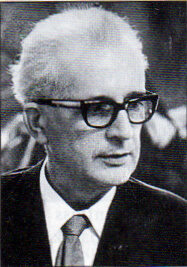
Brunó Ferenc Straub
Brunó Ferenc Straub was a Hungarian biochemist, the last Chairman of the Hungarian Presidential Council. Born January 5, 1914, in Oradea. Died February 15, 1996, in Budapest. Positions held include member of the National Assembly of Hungary (1985–1990) and President of the Presidential Council of the Hungarian People's Republic (1988–1989). Awards include Kossuth Prize (2 times), Commander with Star of the Order of Merit of Hungary and Order of Merit of the Hungarian People's Republic.
Facts
28 facts · 2 confirmed by two sources · 6 cited · 20 from one source
Where this comes from
Papalocal keeps its own record. It started from these sources; what each one said is kept here as it was copied, so a change on their side never changes this page by itself. Tap one to read its version.
What Wikidata says · copied November 17, 2026 · revision 2567666931
- Described as
- Hungarian biochemist, the last Chairman of the Hungarian Presidential Council (1914-1996)
- Other names
- Bruno Ferenc Straub, Ferenc Brunó Straub, F Bruno Straub
- Born
- January 5, 1914 · 2 references
- Died
- February 15, 1996 · 2 references
- Born in
- Oradea · 1 reference
- Died in
- Budapest · 1 reference
- Buried in
- Farkasréti Cemetery · 1 reference
- Citizen of
- Hungary
- Occupation
- politician · 1 reference; university teacher; chemist · 1 reference; biochemist · 2 references
- Positions held
- member of the National Assembly of Hungary (1985–1990); President of the Presidential Council of the Hungarian People's Republic (1988–1989)
- Political party
- Hungarian Socialist Workers' Party · 1 reference
- Worked for
- Semmelweis University
- Member of
- German Academy of Sciences Leopoldina · 1 reference; Royal Swedish Academy of Sciences; Hungarian Academy of Sciences; German Academy of Sciences at Berlin; Polish Academy of Sciences
- Awards
- Kossuth Prize (2 times) (1948, 1958); Commander with Star of the Order of Merit of Hungary (1995); Order of Merit of the Hungarian People's Republic; Order of Labour (3 times) (1954, 1960, 1970); Grand Collar of the Order of Prince Henry (1990) · 2 references; Order of the Flag of the People's Republic of Hungary · 1 reference; honorary doctor of the Maria Curie-Skłodowska University (1974)
- Spouse
- Gertrud Szabolcsi
- Children
- Éva Nyulásziné Straub
- Wikipedias with a page
- 26
Wikidata item Q527867 (wikidata.org/wiki/Q527867), public domain (CC0). Copied November 17, 2026.
What Wikipedia says · copied November 17, 2026 · revision 1347242327
Brunó Ferenc Straub (5 January 1914 in Nagyvárad, Austria-Hungary (now Oradea, Romania) – 15 February 1996) was a biochemist. As a young scholar he was a research assistant of Albert Szent-Györgyi at the University of Szeged, and subsequently worked at the Molteno Institute, Cambridge, UK. He was the first to obtain actin in a relatively pure state. He founded the Biological Research Centre in Szeged. He was the chairman of the Hungarian Presidential Council from 29 June 1988 to 23 October 1989. He proposed the theory of conformational selection in 1964, the same year the Monod–Wyman–Changeux model was proposed.
- Born, in its opening lines
- January 5, 1914
- Died, in its opening lines
- February 15, 1996
From the Wikipedia article “Brunó Ferenc Straub” (en.wikipedia.org/wiki/Brunó_Ferenc_Straub), by its contributors, under CC BY-SA 4.0 (creativecommons.org/licenses/by-sa/4.0/). Copied November 17, 2026; not changed.
Confirmed Two sources agree. Cited One source, and it names where it got it. One source One source, without a reference of its own. Sources disagree The sources disagree. We show the best-supported value and keep theirs below.
