
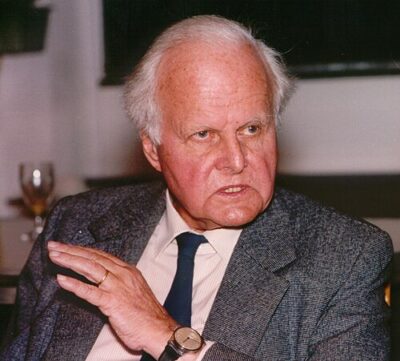
Carl Friedrich von Weizsäcker
Carl Friedrich von Weizsäcker was a German physicist. Born June 28, 1912, in Kiel. Died April 28, 2007, in Söcking. Educated at University of Göttingen and Frederick William University Berlin. Awards include Pour le Mérite for Sciences and Arts order, Great Cross with Star and Sash of the Order of Merit of the Federal Republic of Germany and Goethe Prize of the City of Frankfurt.
Facts
54 facts · 2 confirmed by two sources · 17 cited · 35 from one source
Where this comes from
Papalocal keeps its own record. It started from these sources; what each one said is kept here as it was copied, so a change on their side never changes this page by itself. Tap one to read its version.
What Wikidata says · copied November 16, 2026 · revision 2565536892
- Described as
- German physicist (1912–2007)
- Other names
- Carl Friedrich Freiherr Weizsäcker, Carl Friedrich Weizsäcker
- Born
- June 28, 1912 · 11 references
- Died
- April 28, 2007 · 10 references
- Born in
- Kiel · 2 references
- Died in
- Söcking · 1 reference
- Name at birth
- Carl Friedrich Weizsäcker
- Citizen of
- Kingdom of Württemberg; Germany
- Occupation
- physicist · 1 reference; writer; philosopher · 1 reference; university teacher; nuclear physicist; astronomer · 1 reference; peace and conflict researcher · 1 reference
- Worked for
- University of Hamburg; University of Göttingen
- Education
- University of Göttingen; Frederick William University Berlin · 1 reference; Leipzig University · 1 reference
- Member of
- Saxon Academy of Sciences and Humanities (1966–); German Academy of Sciences Leopoldina (1959–) · 1 reference; Bavarian Academy of Sciences and Humanities; Göttingen Academy of Sciences and Humanities in Lower Saxony; German Academy for Language and Literature; American Physical Society; Göttingen Eighteen; Austrian Academy of Sciences; Bavarian Academy of Fine Arts; Croatian Academy of Sciences and Arts (1992–) · 1 reference
- Awards
- Pour le Mérite for Sciences and Arts order (1961); Great Cross with Star and Sash of the Order of Merit of the Federal Republic of Germany (1973) · 1 reference; Goethe Prize of the City of Frankfurt (1958); Erasmus Prize (1969) · 1 reference; Peace Prize of the German Publishers' and Booksellers' Association (1963) · 1 reference; Max Planck Medal (1957); Templeton Prize (1989); Sigmund Freud Prize (1988) · 1 reference; Ernst Hellmut Vits Award (1980); Honorary doctor of the Technical University of Berlin; honorary doctor of the University of Aberdeen; honorary doctor of the Leipzig University; Theodor Heuss Award (1989) · 1 reference; honorary doctorate of the University of Basel; Fellow of the American Physical Society
- Field
- physics
- Spouse
- Gundalena Inez Eliza Ida Weizsäcker (1937–) · 1 reference
- Children
- Carl Christian von Weizsäcker · 1 reference; Ernst Ulrich von Weizsäcker · 1 reference; Elisabeth Raiser · 1 reference; Heinrich Weizsäcker · 1 reference
- Father
- Ernst von Weizsäcker · 1 reference
- Mother
- Marianne von Weizsäcker · 1 reference
- Siblings
- Richard von Weizsäcker · 1 reference
- Religion
- Lutheranism
- Wikipedias with a page
- 50
Wikidata item Q65350 (wikidata.org/wiki/Q65350), public domain (CC0). Copied November 16, 2026.
What Wikipedia says · copied November 16, 2026 · revision 1377290643
Carl Friedrich Freiherr von Weizsäcker (German: [kaʁl ˈfʁiːdʁɪç fɔn ˈvaɪtsɛkɐ] ; 28 June 1912 – 28 April 2007) was a German physicist and philosopher. He was the longest-living member of the team which performed nuclear research in Nazi Germany during the Second World War, under Werner Heisenberg's leadership. There is ongoing debate as to whether or not he and the other members of the team actively and willingly pursued the development of a nuclear bomb for Germany during this time.
A member of the prominent Weizsäcker family, he was son of the diplomat Ernst von Weizsäcker, elder brother of the former German President Richard von Weizsäcker, father of the physicist and environmental researcher Ernst Ulrich von Weizsäcker and father-in-law of the former General Secretary of the World Council of Churches Konrad Raiser.
Weizsäcker made important theoretical discoveries regarding energy production in stars from nuclear fusion processes. He also did influential theoretical work on planetary formation in the early Solar System.
In his late career, he focused more on philosophical, ethical and historical issues, and was awarded several international honours for his work in those areas.
- Born, in its opening lines
- June 28, 1912
- Died, in its opening lines
- April 28, 2007
From the Wikipedia article “Carl Friedrich von Weizsäcker” (en.wikipedia.org/wiki/Carl_Friedrich_von_Weizsäcker), by its contributors, under CC BY-SA 4.0 (creativecommons.org/licenses/by-sa/4.0/). Copied November 16, 2026; not changed.
Confirmed Two sources agree. Cited One source, and it names where it got it. One source One source, without a reference of its own. Sources disagree The sources disagree. We show the best-supported value and keep theirs below.
