
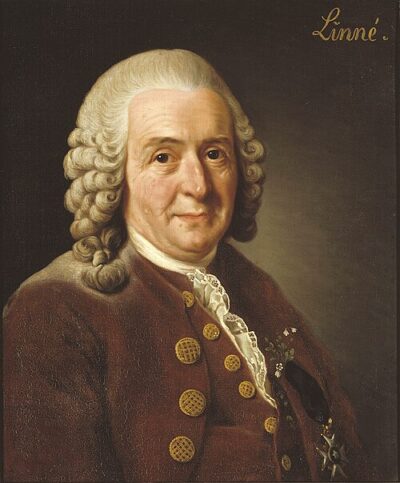
Carl Linnaeus
Carl Linnaeus was a Swedish botanist, physician, and zoologist (1707–1778); developed the foundations of modern taxonomy. Born May 23, 1707, in Råshult. Died January 10, 1778, in Linnaeus Hammarby. Known for Systema Naturae, Species Plantarum and Genera Plantarum. Educated at University of Harderwijk and Lund University. Awards include Knight of the Order of the Polar Star.
Facts
55 facts · 2 confirmed by two sources · 11 cited · 42 from one source
Where this comes from
Papalocal keeps its own record. It started from these sources; what each one said is kept here as it was copied, so a change on their side never changes this page by itself. Tap one to read its version.
What Wikidata says · copied November 16, 2026 · revision 2569135872
- Described as
- Swedish botanist, physician, and zoologist (1707–1778); developed the foundations of modern taxonomy
- Other names
- Carolo Linnaeo, Carl von Linnaeus, Carl Linnæus, Carolus a Linné, Karl von Linné, Linnæus, Carl Nilsson Linnæus, Linne, Carolus a Linne, Carolo Linnæo, Carolus Linnæus, Carl von Linne
- Born
- May 23, 1707 · 11 references
- Died
- January 10, 1778 · 11 references
- Born in
- Råshult · 2 references
- Died in
- Linnaeus Hammarby · 2 references
- Buried in
- Uppsala Cathedral · 2 references
- Name at birth
- Carl Nilsson Linnaeus
- Citizen of
- Sweden · 2 references
- Occupation
- botanist · 4 references; physician · 3 references; autobiographer; biologist · 2 references; mycologist; pteridologist; bryologist; zoologist
- Worked for
- Uppsala University
- Education
- University of Harderwijk (1735); Lund University (1727–); Uppsala University (1728–)
- Member of
- Royal Prussian Academy of Sciences; German Academy of Sciences Leopoldina; Royal Society of London (1753–); Royal Swedish Academy of Sciences (1739–); Saint Petersburg Academy of Sciences (1753–); Royal Danish Academy of Sciences and Letters; Royal Norwegian Society of Sciences and Letters; French Academy of Sciences; American Philosophical Society (1769–) · 1 reference
- Known for
- Systema Naturae · 1 reference; Species Plantarum · 1 reference; Genera Plantarum · 1 reference; Fundamenta Botanica · 1 reference; Critica Botanica; Bibliotheca Botanica; Amoenitates Academicae; Hortus Cliffortianus · 1 reference; Musa Cliffortiana; Methodus
- Awards
- Knight of the Order of the Polar Star (1753) · 1 reference
- Field
- medicine; natural history; botany; natural science · 1 reference
- Spouse
- Sara Elisabeth Moræa
- Children
- Carl Linnaeus the Younger · 2 references; Elisabeth Christina von Linné · 1 reference; Lovisa von Linné; Sara Christina von Linné
- Father
- Nils Ingemarsson Linnaeus · 1 reference
- Mother
- Christina Brodersonia · 1 reference
- Siblings
- Anna Maria Linnæ; Emerentia Branting; Sofia Juliana Collin; Samuel Linnaeus
- Religion
- Church of Sweden
- Wikipedias with a page
- 215
Wikidata item Q1043 (wikidata.org/wiki/Q1043), public domain (CC0). Copied November 16, 2026.
What Wikipedia says · copied November 16, 2026 · revision 1385567325
Carl Linnaeus (23 May 1707 – 10 January 1778), also known after ennoblement in 1761 as Carl von Linné, was a Swedish biologist and physician who formalised binomial nomenclature, the modern system of naming organisms. He is known as the "father of modern taxonomy". Many of his writings were in Latin; his name is rendered in Latin as Carolus Linnæus and, after his 1761 ennoblement, as Carolus a Linné.
Linnaeus was the son of a curate and was born in Råshult, in the countryside of Småland, southern Sweden. He received most of his higher education at Uppsala University and began giving lectures in botany there in 1730. He lived abroad between 1735 and 1738, where he studied and also published the first edition of his Systema Naturae in the Netherlands. He then returned to Sweden where he became professor of medicine and botany at Uppsala. In the 1740s, he was sent on several journeys through Sweden to find and classify plants and animals. In the 1750s and 1760s, he continued to collect and classify animals, plants, and minerals, while publishing several volumes. By the time of his death in 1778, he was one of the most acclaimed scientists in Europe.
Linnaeus has been called Princeps botanicorum (Prince of Botanists) and "The Pliny of the North". He is also considered one of the founders of modern ecology.
In botany, the abbreviation L. is used to indicate Linnaeus as the authority for a species' name. In zoology, the abbreviation Linnaeus is generally used; the abbreviations L., Linnæus, and Linné are also used. In older publications, the abbreviation "Linn." is found. Linnaeus is designated as the type specimen for the human species, Homo sapiens.
- Born, in its opening lines
- May 23, 1707
- Died, in its opening lines
- January 10, 1778
From the Wikipedia article “Carl Linnaeus” (en.wikipedia.org/wiki/Carl_Linnaeus), by its contributors, under CC BY-SA 4.0 (creativecommons.org/licenses/by-sa/4.0/). Copied November 16, 2026; not changed.
Confirmed Two sources agree. Cited One source, and it names where it got it. One source One source, without a reference of its own. Sources disagree The sources disagree. We show the best-supported value and keep theirs below.
